Minnesota bowhunters are taking deer at nearly twice last year's pace
Published in Outdoors
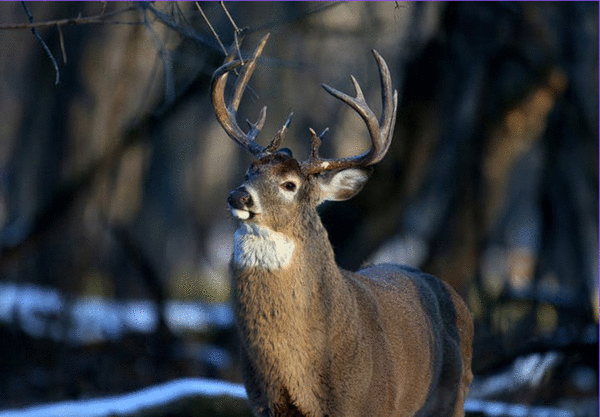
MINNEAPOLIS — Minnesota archery hunters are killing deer at nearly twice the pace of 2025, according to early harvest data, raising the prospect of another record-breaking year.
As of Monday, 7,948 deer had been killed since the archery season began Sept. 19. That’s 88% more than the 4,232 deer killed at this point in the 2025 season, and 41% ahead of the five-year average. Last year saw a record 30,000 deer felled either by arrows from bows or bolts from crossbows, which have been allowed by all archery season hunters since 2023.
The crossbow-to-vertical bow ratio appears on a similar track to last year, when the two weapons were about evenly split, said Paul Burr, deer coordinator for the Department of Natural Resources.
Burr suspects the fast harvest rate this year is the result of the weather, which has likely had more of an effect on deer hunters than deer. Temps have generally been running above average but modestly so, and opening weekend was pleasant for fully-outfitted hunters for the first time in years.
“It hasn’t been as hot as previous years,” Burr said Monday. “Hunters won’t sit in the woods for too long if it’s 80 degrees, but we didn’t have much of that this season — except for this weekend.”
Heat keeps pheasant hunters at bay
The 80- and 90-degree temperatures of the past weekend were too hot for many pheasant hunters, who likely heeded warnings about their dogs’ health in such swelter and ended their hunts early or stayed home altogether.
Despite the prospect of high pheasant numbers, hunter activity was far below what would be expected Saturday and Sunday, according to dispatches from conservation officers. Pheasant shooting hours start at 9 a.m., and the sun was already baking the open grasslands across the pheasant range by then.
I felt it firsthand Saturday morning in Northfield, where I attended the Governor’s Pheasant Opener, which is part political theater and part celebration of pheasant hunting and conservation.
Pheasant numbers around Rice County are far from the highest densities in the state, but the landscape of rolling prairies amid hardwood groves offers a pastoral appeal, even amid a sweaty walk.
I hunted with Jason Wood, an engineer from Northfield, and his 11-year-old lab Tucker, who paced himself well for the warmth but soon became ... tuckered.
In a field edge where young trees encroached, Tucker put up a pair of woodcocks, one of which I missed in a snap shot but Wood patiently swung on and downed. The diminutive bird ensured our bag stayed light — but it wasn’t empty.
In his eighth and final such event, Gov. Tim Walz hunted private land and, like many attendees, saw no roosters before heading in for an early lunch.
Walz told me he’s cherished the official events, but that he was looking forward to experiencing next year’s pheasant opener as a citizen. “It’ll be for me,” he said.
Redwood Falls will host next year’s event, which both candidates, U.S. Sen Amy Klobuchar and state House Speaker Lisa Demuth, have promised to continue.
Outbreak prompts refunds in S.D.
The warm September has also contributed to an expansion of epizootic hemorrhagic disease (EHD) in South Dakota’s whitetail deer population.
The outbreak has gotten bad enough — from 196 known dead deer to 407 in the past month — that the state is trying to restrict hunting to protect the doe population, senior wildlife biologist Brian Buckley told the state’s Game, Fish and Parks Commission last week. The methods range from making all archery tags bucks-only, clawing back some tags for sale, and trying to buy back tags — a kind of voluntary refund — from hunters in 14 counties in the most affected areas.
To date, the outbreak numbers are comparable to the past two years, but Buckley said he worried that October could see more cases.
The outbreak broadly traces the Missouri River and is isolated from Minnesota, where the state has only tallied one EHD death this year, according to Patrick Hagen, statewide disease response coordinator for the Department of Natural Resources.
EHD is spread through midges that thrive in the late summer, but are killed off with the first frost.
“Hopefully, that’ll be later this week,” Hagen said.
©2026 The Minnesota Star Tribune. Visit startribune.com. Distributed by Tribune Content Agency, LLC





Comments