Omar Kelly: Can Dolphins have immediate turnaround like Sunday's two Super Bowl teams?
Published in Football


MIAMI — It only required two seasons of wandering through the wilderness, two years of being irrelevant while the franchises reset.
That’s the timeline it took for the New England Patriots and Seattle Seahawks to rebuild their franchises, which have coincidentally — or not — played in the 2001, 2003, 2004, 2005 (Seattle lost), 2007, 2011, 2014 (Seattle beat New England), 2015 (Patriots beat Seahawks), 2016, 2017, and 2018 Super Bowls, and now face one another in Super Bowl LX.
Both the Patriots and Seahawks got to the pinnacle of their sport, playing in Sunday’s night’s big game, after embarking on two separate two-year rebuilds.
Both had coaching changes. Seattle broke up with Pete Carroll after 14 seasons.
The Patriots had more than one head coach the past two years because they fired Jared Mayo after one season to bring Mike Vrabel back to the team he played for.
Each franchise made quarterback changes.
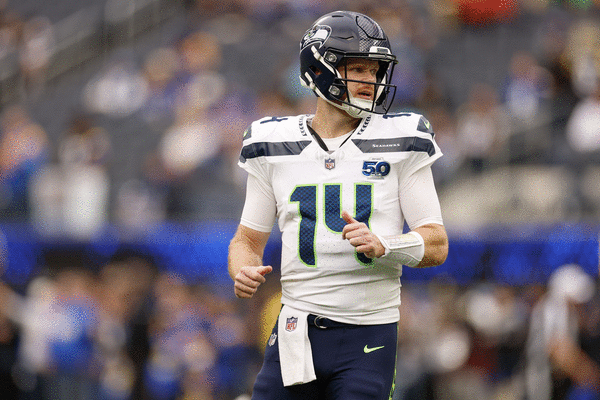
Seattle bid big to land Sam Darnold after his one dynamic season in Minnesota, and traded Geno Smith away to Las Vegas, where he paired up with Carroll for a season.
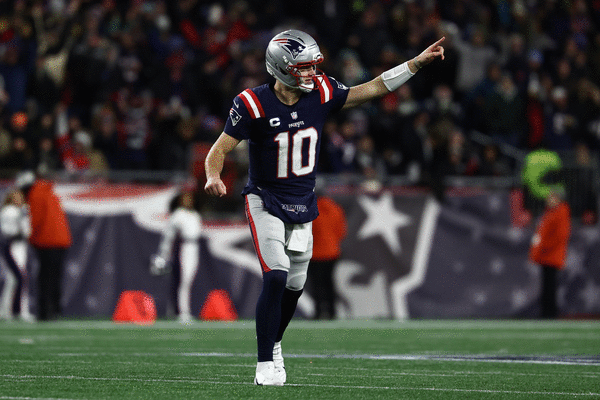
New England used a 2024 first-round pick to select former North Carolina standout Drake Maye, a quarterback that many evaluators liked in the draft process, but few loved.
Add in a culture shift and stir ... .and voila, Super Bowl.
That’s right, in two seasons the Patriots and Seahawks did what the Dolphins haven’t been able to do in two-plus decades.
How?
If we are to find one common thread, a theme that weaves its way into both franchises, it would be that they are each built off the Green Bay blueprint.
And coincidentally — or not — the Dolphins made a shift to that exact blueprint in 2026 when they hired Jon-Eric Sullivan as the team’s new general manager, and then added Jeff Hafley as the team’s new head coach.
Hafley and Sullivan became acquainted over the past two seasons while working together in Green Bay, so they know the Packers way.
One more than the other.
Sullivan spent the past 22 seasons working his way up the Packers’ front office, and actually worked under John Schneider, Seattle’s top football executive since 2010, during his first seven seasons in Green Bay.
And coincidentally, or not, Sullivan joined the Packers organization in the exact same year (2004) as Eliot Wolf, who happens to be New England’s top football executive after being handed the reins in 2024 after Bill Belichick, whom he worked for as a consultant and director of scouting since 2020, was removed.
Wolf happens to be the son of Ron Wolf, a long-time Packers executive, who is the architect behind Green Bay’s success, the creator of the Packers’ blueprint.
Having worked with both individuals, Sullivan should know exactly how to recreate what Schneider has built — teams carried by their rushing attack and forceful defense — and propped up in Seattle for 16 seasons.
He should also know how to execute the quick renovation that Eliot Wolf and Vrabel managed with Miami’s AFC East rival, which pushed out one of the NFL’s greatest coaches of all time, and then made it seems as if Belichick were holding the organization back because of how quickly New England became relevant.
These Patriots and Seahawks each have a tough, physical identity, and it’s been carved out by effective drafting, efficient and shrewd free agent and trade decisions.
Seattle encouraged quarterback competition instead of running from it, and eventually upgraded the position after three seasons with Smith as the team’s starter, despite the fact he had led the franchise to three straight winning seasons.
They weren’t afraid to make a bold move, signing Darnold to a three-year, $100 million deal despite having a player they were paying like a franchise quarterback on the roster.
They didn’t worry about hurting anyone’s feelings, or sending the wrong message.
They let it be known that championships are the expectations, and made moves designed to get them there. And here they are.
The same can be said about the Patriots, which spent big, but apparently wisely in free agency last offseason, finding talent that completed the roster they already had.
If Seattle and New England can transform their rosters, and shift their organization’s culture in two seasons, there is no excuse why the Dolphins have been unable to do it in two-plus decades.
It’s time to raise the bar and build South Florida a professional football team whose decisions, reputation and performance demands respect.
____
©2026 Miami Herald. Visit miamiherald.com. Distributed by Tribune Content Agency, LLC.






Comments