Rubio leaves door open to more military action in Venezuela
Published in Political News
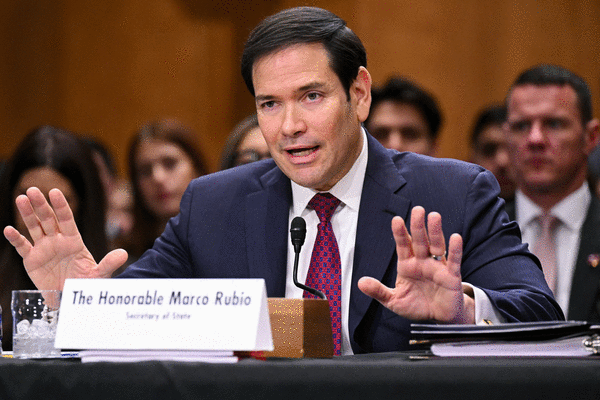
WASHINGTON — Secretary of State Marco Rubio would not commit Wednesday to seeking congressional authorization if the Trump administration takes further military action in Venezuela.
In his opening statement at a hearing before the Senate Foreign Relations Committee, Rubio left open the possibility that the administration could use military force if Venezuela’s interim president does not cooperate with the United States.
Pressed later by Sen. Christopher S. Murphy, D-Conn., if the administration would come to Congress before military action to compel cooperation from the Venezuelan government, Rubio did not directly answer, but said the 1973 War Powers Resolution applies to “sustained” military actions. He also suggested the administration would act unilaterally to address any “imminent” threats.
“I can tell you right now with full certainty, we are not postured to, nor do we intend or expect to have to take any military action in Venezuela at any time,” Rubio said. “On the other hand, if we tell them we don’t want to see drones from Iran, as an example, pointed at the United States or threatening our forces or our presence in the region or our allies’ presence in the region, the president does reserve the option in self-defense to eliminate that threat.”
Rubio also serves as the Trump administration’s acting national security adviser.
“I can tell you, military action is not good for recovery and transition. That’s not what we want to see. It’s certainly not our goal here,” he added. “A lot of that would depend on them. But I think it would require the emergence of an imminent threat of the kind that we do not anticipate at this point.”
Wednesday’s hearing provided senators with their first opportunity to publicly question an administration official on Venezuela policy since the U.S. military operation that captured President Nicolás Maduro at the beginning of the month and since the Venezuela-adjacent boat bombing campaign started in September. And while the hearing was called to discuss Venezuela, senators also used the opportunity to press Rubio on a number of other places the administration has threatened military action, particularly Greenland and Iran.
Rubio agreed to appear before the committee as the administration worked to stave off GOP defections on a vote on a war powers resolution that sought to constrain the administration’s ability to attack Venezuela again.
The pressure campaign against GOP senators worked, and two Republicans who had previously supported the resolution backed off their support, helping sink the resolution in a procedural vote earlier this month.
In addition to Rubio’s hearing appearance, the two Republicans who flipped — Sens. Todd Young of Indiana and Josh Hawley of Missouri — pointed to a written promise from Rubio to seek congressional approval before any “major” military operation in Venezuela.
Lack of consultation questioned
At Wednesday’s hearing, Rubio defended the administration’s decision not to brief Congress ahead of the Maduro operation, contending that the mission “was not even in the realm of possible until late in December when all our efforts to negotiate with Maduro had failed.”
But Democrats hammered Rubio for not publicly testifying sooner and for not notifying Congress ahead of the Maduro operation.
“It was rehearsed for months,” Sen. Chris Coons, D-Del., said of the Maduro operation. “If there was time to practice, there was time to consult.”
GOP Sen. Rand Paul of Kentucky, one of Congress’ most consistent antiwar voices, also fumed at the administration side-stepping lawmakers’ war authorities.
“If a foreign country bombed our air defense missiles, captured and removed our president, and blockaded our country, would that be considered an act of war?" Paul said.
Near-term vision
Rubio also filled in some detail on the administration’s plan for Venezuelan leadership and oil.
The Trump administration left in place Maduro’s vice president, Delcy Rodriguez, to serve as interim president.
Rubio acknowledged that Rodriguez — who allegedly ran the regime’s torture apparatus and has allegedly been involved in drug trafficking and other criminal activity similar to what Maduro is accused of — has been “involved things that would not be acceptable to us in the long term.” But he did not have a timeline for when the administration envisions democratic elections in Venezuela.
For now, Rubio said Rodriguez has been open to “cooperation, respect, dialogue,” dismissing her comments earlier this week that she has had “enough” of U.S. orders as playing to her domestic politics.
Meanwhile, the Qatar-based account that the administration set up to store revenue from Venezuelan oil sales will eventually be moved under the jurisdiction of the U.S. Treasury, Rubio said. In order to access the funding, Venezuela will be required to submit budget requests to the United States and commit to conducting audits to ensure the money is being used as intended, he added. That arrangement has been agreed to in writing, Rubio said, promising to deliver it to Congress after senators said they have not had access to it.
Democrats were skeptical of the plans.
“The scope of the project that you are undertaking in Venezuela is without precedent,” Murphy said. “I think a lot of us believe that that is destined for failure. I know you’re telling us today just to be patient, but a month later we have no information for a timetable on a democratic transition. Maduro’s people are still in charge. Most of the political prisoners are in jail, and by the way, those that have been let out have a gag order on them from the government. The opposition leader is still in exile. This looks already like it is a failure.”
Other areas of concern
Hours before the hearing started, President Donald Trump renewed his threats to attack Iran, posting on social media that a “massive armada” was on its way to the region and comparing the situation to Venezuela.
Asked about Iran at the hearing, Rubio acknowledged that it is “far more complex” than Venezuela and that “no one knows” who would take over if Iran’s supreme leader is toppled.
Rubio also defended the administration’s approach to Greenland, which Trump threatened to invade before backing down last week. Technical-level talks on the future of Greenland have started, Rubio said, adding that “we’re in a good place right now.”
_____
©2026 CQ-Roll Call, Inc., All Rights Reserved. Visit cqrollcall.com. Distributed by Tribune Content Agency, LLC.









































Comments