Lisa Jarvis: The problem with that 'Great Healthcare Plan'
Published in Op Eds
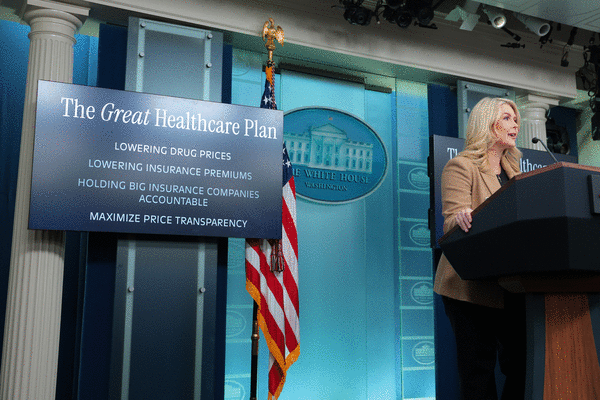
This month, as Americans who rely on Affordable Care Act plans opened their first bills of 2026 and experienced sticker shock, President Donald Trump began pitching them on an alternative: his “Great Healthcare Plan,” which would shift government support away from subsidizing insurance coverage toward putting money directly into accounts that consumers can use to pay for care.
The details, of course, are scant. But the concept of shifting government funds away from an approach that encourages comprehensive coverage to one that might leave many Americans behind is troubling.
Trump has long criticized the Biden administration-era subsidies that allowed millions of Americans to purchase better coverage at more affordable prices, arguing that they lined the insurers’ pockets while consumers’ costs rose. Although lawmakers are still exploring potential solutions to extend the subsidies, the president has threatened to veto any deal that materializes.
“I want to end this flagrant scam and put extra money straight into the health care savings accounts — in your name, and you go out and buy your own health care. And you’ll make a great deal, you’ll get better health care for less money,” he said in a video message this month.
So far, his plan to replace subsidies with Health Savings Accounts (HSAs) — tax-sheltered funds that can be invested and rolled over each year — amounts to little more than a list of bullet points. Among the unknowns are how much money people would receive each year, who would qualify for the help, and whether it would involve changes that expand the utility of HSAs, including whether they could be used to pay for care that falls outside of ACA guidelines (such as plans that can deny coverage based on preexisting conditions or fail to cover certain essential health care benefits).
That last part is important because, despite Trump’s claim that Americans will be able to “go out and buy your own health care,” current rules tightly restrict who is eligible for an HSA and how the money can be spent.
Currently, only people with a high-deductible health insurance plan can put money into an HSA, and the funds can only be used to pay for services, not premiums. That means the only ACA customers who could benefit from the government’s HSA contribution would be those enrolled in the lowest-tier (bronze) plans, which feature low monthly premiums but high deductibles. This year, people with a bronze plan will need to pay an average of $7,476 before their insurance starts covering care, according to KFF.
Diverting the money from subsidies to an HSA “is a reasonable approach for 80% of the population, and a terrible approach for 20% of the population,” says Gerard Anderson, a professor of health policy at Johns Hopkins University's Bloomberg School of Public Health. Most of us don’t end up in the hospital or needing an expensive drug each year, meaning a savings account would likely cover our health care bills.
But that smaller group — the people who get in a car crash or are diagnosed with cancer — could be much worse off, Anderson says. And the problem is nobody has a crystal ball to predict who will wind up facing enormous health care costs.
Others agree with Anderson’s assessment. In a survey of health policy experts published last month in Health Affairs, 70% of respondents said that a plan that diverted the value of the subsidies into an HSA “would measurably worsen the affordability of health care for Marketplace enrollees.” Just 10% of those surveyed believed a shift to HSAs would improve affordability.
The rest of us could be worse off, too. Someone who is underinsured or uninsured still gets emergency care, but the cost is ultimately borne by insured people. Hospitals and providers eventually pass some of those costs on to private insurers through higher prices.
Health policy experts also point to more fundamental questions: who, in the end, benefits most from HSAs? Among health care consumers, the vast majority of people with HSAs get them through their employer, and typically are wealthier, White or Asian, and in very good health, according to a recent analysis by the Government Accountability Office.
Meanwhile, the tax benefits of an HSA have primarily accrued to higher-income Americans, who can afford to put more money into them, not to lower-income people who have historically relied on subsidies to afford care and who might now be forced into this type of plan.
In other words, people with the most disposable income are by far the most likely to put enough money into an HSA to ensure that a health catastrophe doesn’t also lead to a financial one.
And some consumers might miss the fine print associated with their HSA. “The way HSAs are being marketed and discussed, it sounds a lot like free money to people — it’s not,” says Nicole Rapfogel, a policy analyst at the Center for Budget and Policy Priorities. A 2024 report from the Consumer Financial Protection Bureau found that many funds offered such low interest rates that the monthly fees exceeded the gains.
It’s true that the scenario would change if Trump’s plan involved overhauling the way HSA funds can be used, allowing Americans to use the payout to buy health insurance. Yet too many people might still gravitate toward cheaper, riskier plans—and that could end badly for everyone.
_____
This column reflects the personal views of the author and does not necessarily reflect the opinion of the editorial board or Bloomberg LP and its owners.
Lisa Jarvis is a Bloomberg Opinion columnist covering biotech, health care and the pharmaceutical industry. Previously, she was executive editor of Chemical & Engineering News.
_____
©2026 Bloomberg L.P. Visit bloomberg.com/opinion. Distributed by Tribune Content Agency, LLC.










































Comments