Juan Pablo Spinetto: How to navigate Venezuela's murky moral waters
Published in Op Eds
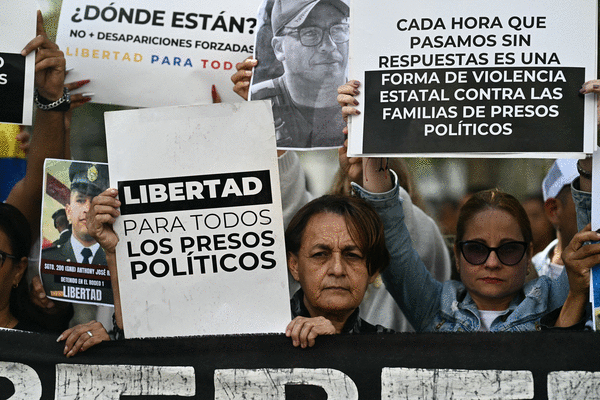
For those who think about politics in terms of ideology and rigid categories, the extraordinary events in Venezuela pose an uncomfortable question: what is the morally correct position to take in a drama this complex?
Some celebrate Nicolás Maduro’s removal simply because he was a brutal dictator. They’re largely indifferent to the violation of international law that the U.S. committed to seize him (this is the majority view among Venezuelans).
Others, mostly focused on U.S. politics, couldn’t care less about Maduro but recoil at President Donald Trump’s deployment of military forces in South America on dubious grounds, without congressional approval and with the familiar whiff of yet another nation-building experiment. Radical leftists oppose the intervention on principle and, not coincidentally, mourn the disappearance of Maduro’s absurd socialist proclamations (these die-hard anti-imperialists seem to have multiplied in the Trump era).
Finally, a more cynical camp marvels at the stark U.S. display of power while feeling no obligation to clean up the mess Venezuela has become.
The hardest position to defend belongs to those who feel genuine gratitude that Maduro is finally facing consequences but also recognize that the U.S. cannot simply roam the globe abducting leaders the White House dislikes. In today’s polarized climate, holding both seemingly contradictory thoughts at once can feel agonizing. I’ve already had more than a few arguments with friends about this and they rarely end well. If you’ve followed the flood of commentary on Venezuela in recent weeks, you’ve likely encountered compelling, rational arguments justifying both sides — just not at the same time.
But fear not. With a bit of perspective, this position is not only defensible; it is coherent.
It is entirely possible to support what the U.S. did in Maduro’s specific case while remaining deeply skeptical of similar interventions elsewhere and fully aware of Washington’s self-interest. And it is perfectly consistent to support the cause of a free and democratic Venezuela led by the U.S. without tying it to whatever one happens to think about Trump and his predatory foreign policy.
Some historical recap is necessary to explain this.
Venezuela isn’t just another troubled country; it is a tragedy on a scale Latin America hasn’t seen in generations. Not long ago one of the region’s richest nations, it was hollowed out by the Chavista socialist project. The economy collapsed, with GDP shrinking by nearly 80% since 2012, while its once-almighty oil industry fell apart. Such outcomes are typically associated with wars. An estimated eight million Venezuelans fled the country. Thousands were jailed as an increasingly authoritarian government crushed dissent.
To buy political cover, Maduro granted privileged access to foreign powers, from Cuba to Iran, and cultivated ties with terrorist organizations such as Hezbollah, further destabilizing the region. Russia even built an ammunition plant in Venezuela to produce cartridges for Kalashnikov rifles. Chavistas were not particularly concerned about sovereignty back then.
Over the years, there were multiple attempts to correct course: mass protests that were brutally repressed, government-opposition dialogues, international mediation led by independent actors such as Norway and Qatar, economic and political sanctions and the ill-fated experiment of a parallel government under Juan Guaidó.
The last real chance for a peaceful transfer of power came with the 2024 election, which the opposition won convincingly, only for Maduro to brazenly steal it and proclaim victory without presenting any evidence. What followed was predictable: renewed repression, enabled by the complicity of allies and neighbors who never managed to unite around a viable solution. Still, Maduro was reportedly given many opportunities to negotiate a golden exile. He refused them all.
From that perspective, Trump’s extraction of the Venezuelan leader can be understood as a positive and even inevitable circuit breaker: an extraordinary act that disrupted the decaying status quo protecting the regime, forcing the country onto a different trajectory. When I visited Caracas in 2021, during a brief period of apparent entente between the regime and Washington, Chavismo seemed likely to cling to power for decades. That assessment no longer holds. This new experiment, with interim president Delcy Rodríguez taking orders from Washington, the CIA included, may still fail spectacularly. But it has opened a new era. And with political skill and strategic patience, Venezuela may finally move toward the democratic transition it has long been denied.
The path I imagine hinges on Chavismo confronting its own fundamental contradiction: claiming to be anti-imperialist while acting as a U.S. government lapdog. Over time, internal cracks will likely widen, particularly within the military, the impenetrable force that has underpinned the regime and blocked the opposition. The political opening forced by Washington, combined with a degree of economic recovery, could realign incentives toward a new general election under the supervision of the U.S. and international organizations. In such a scenario, Chavismo would retain political representation, facing a reinvigorated opposition. If that happens, the forced removal of Maduro would not only be vindicated; it would have proved to be a progressive force for Venezuela and the region.
Before you press “send” on your hate mail, I am fully aware that much can go wrong, starting with a Trump administration that does not seem to have the discipline, or perhaps even the interest, to see this outcome through. Warnings on the risks of abandoning democratic efforts need to be heard; sooner rather than later, Venezuela will have to produce a framework for political transition, not least because constitutionally Rodríguez has only 180 days as interim president.
The scorecard to watch in the coming months is the continued release of political prisoners, the return of opposition figures, the reconstitution of the National Electoral Council to include respected representatives and the establishment of a credible electoral roll. On the oil front, companies should be granted equal rights to invest, rather than privileging business figures linked to the regime, as recent hydrocarbon law changes appear to do.
Will all this happen? Time will tell, but everyone genuinely interested in a free Venezuela should press for it. True, the U.S. seizure of Maduro violated international law, but you can’t unring that bell. And there is no moral contradiction between welcoming Maduro’s capture and acknowledging its contravention of international rules.
Polls suggest that this is precisely how most Latin Americans see the situation, sharply at odds with perceptions in the U.S. For all the brainy academic debate and political calculations, a simple but powerful vox pop quote in a New York Times story summarizes the appropriate position on the event: “I am happy because I saw the fall of a dictator, and I am happy because my Venezuelan friends are happy.”
I am sure that no decent Venezuelan wanted to reach this point. I wish this conflict could have been resolved using one of the many Latin American institutional tools designed for such crises. That didn’t happen, not least because of the cynical fecklessness of regional powers. If the path to normalization requires temporary compromises like tolerating Rodríguez as interim president or María Corina Machado having to swallow her pride, so be it. Perfect options for Venezuela disappeared a long time ago.
_____
This column reflects the personal views of the author and does not necessarily reflect the opinion of the editorial board or Bloomberg LP and its owners.
JP Spinetto is a Bloomberg Opinion columnist covering Latin American business, economic affairs and politics. He was previously Bloomberg News’ managing editor for economics and government in the region.
_____
©2026 Bloomberg L.P. Visit bloomberg.com/opinion. Distributed by Tribune Content Agency, LLC.


























Comments