NASA finds source of Artemis II problem that forced rollback from the launch pad
Published in Science & Technology News
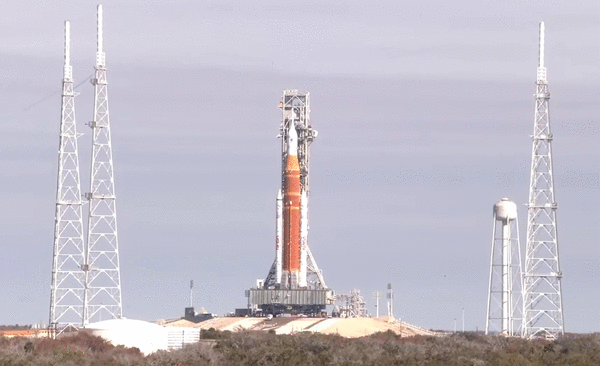
NASA announced it had found the source of a helium flow blockage that forced it to roll the Artemis II rocket back from the launch pad at Kennedy Space Center and delay its lunar fly-by mission until at least April.
In an update to its website Tuesday, NASA stated that technicians had gained access to the launch vehicle stage adapter next to the upper stage of the rocket that could only be accessible from the Vehicle Assembly Building at KSC.
Despite running through a successful redo of a wet dress rehearsal on Feb. 21 that had NASA eyeing a launch in early March, transitional work to get the rocket ready for launch at KSC’s Launch Complex 39-B ran into the gas flow issue soon after.
The upper stage, known as the interim cryogenic propulsion stage, and its single RL-10 engine wasn’t able to get the helium gas, used to purge the stage of cryogenic fuel and maintain proper pressure, to flow into it.
“It was disappointing, but that’s where we were, and the response of our team was exactly what we should be doing,” said Lori Glaze, NASA’s acting associate administrator for its Exploration Systems Development Mission Directorate, during a press conference last Friday. “The data were pretty clear that we were ‘no go.’ We were in a no-go situation without the ability to flow the helium to the RL-10 engine of the upper stage.”
That made the decision to roll back to the VAB necessary, she said.
“We allowed the data to talk to us and tell us what we needed to do, and allowed those findings, operational findings, to guide us in what decisions that we needed to make,” she said.
The culprit for the reduced flow of helium was a seal in what is called the quick disconnect, which is designed to break away from the rocket as it launches. Just why the seal was knocked out of place has yet to be determined, but engineers are looking to find out so it won’t happen again.
“The team removed the quick disconnect, reassembled the system, and began validating the repairs to the upper stage by running a reduced flow rate of helium through the mechanism to ensure the issue was resolved,” the NASA update stated.
The roll back to the launch pad won’t happen right away, though, with other work being done while the rocket is in NASA’s garage.
That includes getting new batteries active on the rocket’s flight termination system, which will need end-to-end retesting afterward to satisfy the Space Force’s Eastern Range safety requirements.
Teams are also replacing batteries on the upper stage, core stage and solid rocket boosters as well as charging batteries on the Orion spacecraft’s launch abort system.
Another major replacement job began on Monday with teams replacing a seal on the core stage liquid oxygen line feed system. This is on the same main line where work had already been done to fix an issue on the liquid hydrogen supply line. Since that was at the base of the rocket, that initial work was done at the pad.
“Once complete, teams will reassemble the oxygen tail service mast umbilical plate and perform various integrity tests to ensure the seal interface is tight,” NASA’s update read.
Glaze said that once the rocket is back at the pad, teams will still need about a week and a half before any launch attempt.
The earliest Artemis II could fly would be April 1 with backup dates through April 6. If NASA can’t hit those targets, the next opportunities begin on April 30.
The mission will mark the first time humans will venture beyond low-Earth orbit in more than half a century.
NASA astronauts Reid Wiseman, Victor Glover and Christina Koch, as well as Canadian Space Agency astronaut Jeremy Hansen, will be the first to fly on the Orion spacecraft, aiming for a 10-day mission that will fly by the moon.
The test mission’s goal is to prove Orion can transport humans safely and set up future moon missions.
NASA Administrator Jared Isaacman, though, last week announced the follow-on mission to Artemis II won’t be a lunar landing as originally planned. Instead, Artemis III will be a crewed mission close to Earth flying in mid-2027 that will have Orion dock with one or both of the human landing system spacecraft being developed by SpaceX and Blue Origin.
That would then set up two potential moon landing missions in 2028.
“We want to accelerate manufacturing, pull in the hardware, and increase launch rate, which obviously has a direct safety consideration to it,” he said. “You get into a good rhythm, launching with great frequency. You get that muscle memory.”
His plan would decrease the time between launches, which at this point saw the uncrewed Artemis I launch in late 2022 and Artemis II more than three years later. The old plan for Artemis III would have been hard-pressed to launch before the end of 2028.
“The ability to turn around our launch pads and launch with frequency greater than every three years is imperative,” he said.
_____
©2026 Orlando Sentinel. Visit orlandosentinel.com. Distributed by Tribune Content Agency, LLC.






Comments