Pennsylvania man finds sleep apnea relief via implantable tech
Published in Health & Fitness
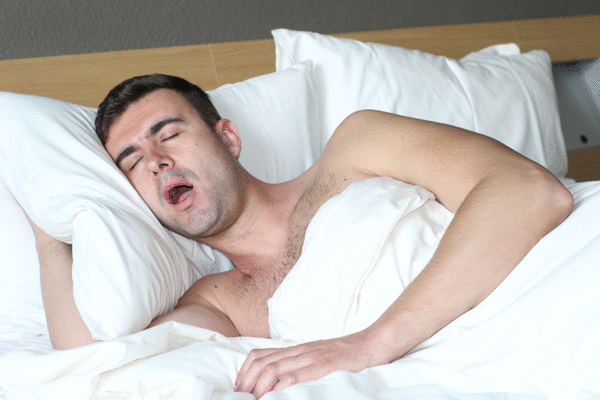
For years, Nino Orsini Jr. thought his restless nights were normal.
“I would go to bed at a decent hour. I would log six to eight hours of sleep where I was unconscious, but I wasn't getting what is ‘actual’ sleep,” said Orsini, 48, of Seven Fields, Pennsylvania.
Like an estimated 30 million Americans, Orsini was living with obstructive sleep apnea — a condition in which the airway collapses during sleep, interrupting breathing and reducing oxygen levels.
Left untreated, it can increase the risk of serious health problems, including heart disease, stroke and chronic fatigue, per the American Medical Association.
For years, the standard treatment was a CPAP machine, using a stream of air to keep airways open during sleep. But in recent years newer, implantable alternatives have emerged for patients who can’t tolerate CPAP.
The Inspire device, approved by the U.S. Food and Drug Administration in 2014 and available in Pittsburgh, stimulates the hypoglossal nerve in order to keep the airway physically open, rather than forcing air through.
Orsini’s symptoms were hard to ignore — especially for his wife, Michaelle Callihan, a nurse practitioner.
At night, Callihan would often hear her husband stop breathing, then suddenly take a very deep breath. Sometimes she’d hear a bubbling noise.
“I didn't know that I was not getting good sleep,” Orsini said. “I thought this was just the way people slept.”
After a sleep study confirmed a sleep apnea diagnosis, Orsini was prescribed a CPAP (continuous positive airway pressure) machine — the standard treatment, which uses pressurized air to keep the airway open. While effective for many, it wasn’t a good fit for him.
“I sleep on my stomach. That's one of the only ways I can sleep,” he said. “So having a mask on my face makes it very, very difficult to fall asleep and stay asleep.”
Additionally, Orsini describes himself as “a very aggressive sleeper. I move around a lot, so I tend to knock the CPAP off my face.”
Callihan said the couple often awoke entangled in the CPAP hose: “It would wrap around my head, around his head, around my feet.”
But Orsini said he still vividly recalls the first night he managed to keep the CPAP on all night. “(It) did exactly what it was supposed to do, and I got some of the best sleep I ever had in my life.”
Despite more failures than successful sleeps, he stuck with it on and off for years.
“I would get a couple of nights where it would stay on and it would work,” and then weeks would pass where he just couldn’t get through a night with it staying in place.
Thinking back to that first blissful night of rest when the device worked, Orsini said he grew frustrated, knowing what he was missing.
A different approach
Eventually, Orsini learned about Inspire, an implanted device that works differently from CPAP.
Unlike CPAP, which uses air pressure to hold the airway open, the Inspire stimulates the nerve controlling the tongue, preventing it from collapsing backward during sleep.
Basically, the “hypoglossal nerve stimulator,” said AHN sleep specialist Chris Pham, “zaps the nerve in your tongue, so (it) spasms your tongue forward,” creating an open airway.
The system includes a stimulation lead with a cuff that wraps around a branch of the hypoglossal nerve beneath the tongue. When activated, it sends a signal that moves the tongue and surrounding airway muscles forward, helping keep the airway open for normal breathing.
A second component, the sensing lead, is a thin wire placed near the ribs that detects each breath. That signal is relayed to a small pulse generator — similar to a pacemaker — implanted just under the skin below the collarbone. In response, the generator delivers a timed signal back to the nerve, prompting the airway to open with each breath.
The device is implanted during a 2- to 3-hour outpatient procedure and is controlled with a remote.
Patients turn it on before bed, and it can be programmed to activate after they fall asleep.
For Orsini, the results were immediate. Following the first night of use, “I had one of the best nights of sleep I've ever had.”
He said he’s gotten so used to the tongue sensations when the device is in use that he has to consciously think about whether it’s on or off before taking a sip of water if he wakes during the night.
Not for everyone
The device isn’t a first-line treatment. Patients must meet strict criteria.
First, a patient’s apnea index score has to be greater than 15 events an hour: in other words, someone with moderate to severe obstructive sleep apnea whose breathing stops or becomes very shallow, on average, more than 15 times for at least 10 seconds every hour of sleep, often resulting in oxygen drops and poor sleep quality, Pham said.
Additionally, prospective Inspire patients must have a body mass index, or BMI, below 32 to 35, and they must have already tried CPAP therapy but been unable to tolerate it.
Common reasons that CPAP fails as a treatment include anxiety, difficulty falling asleep while wearing the mask or sleep habits that make consistent use impractical. For some — like Orsini — being a stomach sleeper or moving frequently during the night can cause the device to become dislodged, limiting its effectiveness.
Even then, additional testing is required to determine whether a patient’s airway anatomy makes them a good candidate. And success is not guaranteed.
“The success rate is somewhere between 60-70%,” said Pham, though outcomes within AHN network have improved to about 80% in recent years. He said 271 AHN patients have received an Inspire device over the past five or so years that the hospital network has offered the option.
“This is still a last-case resort,” he said.
Orsini turned out to be an ideal candidate for the device, because of his struggles with the CPAP, preference for stomach sleeping, the severity of his sleep apnea and a history of serious health risks that may be exacerbated by the condition, including a heart attack nearly a decade ago.
Currently, of the handful of FDA-approved implantable sleep apnea devices on the market, Inspire and Remede, a phrenic (diaphragm) nerve stimulator, are offered at AHN, a spokesperson said. Both are also available at WVU Medicine, and Inspire is an available treatment at UPMC and St. Clair Health.
Adjusting to the device
After implantation, patients must wait several weeks before activating the device.
“They want to make sure that all the scar tissue heals over,” said Orsini, adding that he waited more than a month before trying it the first time.
And once activated, the sensation takes some getting used to: “You feel a slight vibration in your tongue that pushes it forward and down,” he said.
“So it was described to me that, ‘I just don't have control of my tongue.’ You can sound like Daffy Duck when it’s turned on,” Pham said.
Still, Orsini said he found the Inspire device far less disruptive than CPAP.
“It’s nothing that, on its own, would make you choke,” he said.
A life-changing difference
For Orsini and his wife, the improvement has been dramatic. Not only his mood, Callihan said, but “his overall health is better.”
Generally, Orsini said, his blood pressure has improved, and both he and Callihan are sleeping better.
“I can sleep. I'm not cranky. Nobody wants to shoot me at work,” she said, laughing.
In the past, despite starting work later, Callihan often had to wake up early to get her husband out of bed. After restless nights, he would sleep through alarms, forcing her to turn on the lights and repeatedly nudge him awake. Now, she said, “he actually can get out of bed now by himself with the alarm, which then I get a half hour or 45 minutes of extra sleep.”
Orsini now wakes up more rested — something he didn’t realize he had been missing.
“You don't understand what good sleep and good rest feels like,” he said. “And the first time you get it, it is amazing.”
Pham emphasized that many people with sleep apnea go undiagnosed, especially if they dismiss snoring as harmless.
The American Medical Association (AMA) estimates that roughly 80% of the 30 million Americans living with sleep apnea haven’t been diagnosed. Experts expect the total number to climb to 77 million U.S. adults by 2050.
The condition is more common in men — 38% of ages 30 to 70 have sleep apnea — versus 23% of the same age group for women, per the AMA.
While snoring is often associated with sleep apnea, “snoring itself is not the true symptom of sleep apnea, but the pauses between the snoring is,” Pham explained. Other signs include waking with headaches, brain fog or a racing heart.
Diagnosis requires a sleep study, and treatment is critical — particularly for those with underlying conditions.
The worse a patient’s sleep apnea, the greater risk they face for stroke, heart failure and heart attack, Pham said.
If left untreated, sleep apnea can increase the risk of heart disease, high blood pressure and type 2 diabetes, per the AMA.
For patients struggling with CPAP, Orsini encourages persistence — and exploration of alternatives.
He calls Inspire “a revolutionary advancement.”
“It is the greatest solution to this problem,” he said. “It has made a massive difference in my life.”
_____
© 2026 the Pittsburgh Post-Gazette. Visit www.post-gazette.com. Distributed by Tribune Content Agency, LLC.





Comments