Athenaeum Jazz at Scripps Research concert series flying high after 30 years
Published in Entertainment News
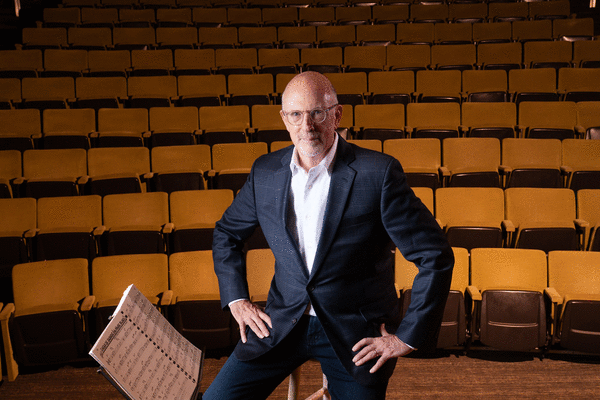
SAN DIEGO — The enormous Persian carpet that has been on the stage for numerous Athenaeum Jazz at The Scripps Research Auditorium concerts since 2013 doesn’t fly, at least not in any conventional sense.
Neither did its two finely woven predecessors that were used in previous decades at the acclaimed concert series, which will kick off its 30th anniversary season Nov. 3 with a rare area performance by saxophone dynamo Joshua Redman and his quartet.
But all three carpets have been front and center for elevated performances by a dizzying array of jazz giants. The list includes Chick Corea, Charlie Haden, McCoy Tyner, Dee Dee Bridgewater, Ray Brown, Pat Martino, Carla Bley, Gary Burton, Charles Lloyd, Regina Carter, John Scofield, Hank Jones and such past and present San Diego-based luminaries as James Moody, Holly Hofmann, Mike Wofford, Charles McPherson, Gilbert Castellanos and Mark Dresser.
“The carpet actually was donated by my wife, Jennifer, and her sister, Kristin Ewald, and had been in their grandparents’ house,” said concert series’ mastermind, producer and curator Daniel Atkinson. “We need to dampen the stage, especially for drums, so having this enormous living room-sized Persian rug is a godsend.”
Atkinson, who is also the founder of the San Diego Tijuana International Jazz Festival, chuckled when asked about the specific dimensions and weight of the carpet.
“It’s so heavy that it lives backstage!” he said. “It takes a major effort by several people just to move it from backstage to onstage and back again.”
The outsized carpet has not gone unnoticed by artists who have performed as part of the Athenaeum Jazz at Scripps Research concert series, including former Weather Report/Stan Kenton drummer Peter Erskine. A two-time Grammy Award-winner, he has recorded two albums with his chamber-jazz trio in the Scripps Research Auditorium. One of them, “Standards,” was nominated for a Grammy in 2009.
“It’s not a drum carpet,” the Los Angeles-based Erskine said. “I’m usually given something that is 5 by 5 feet. In the old days on wooden stages, we’d wantonly hammer a couple of nails into the stage to keep the drums from moving.”
But even the most valuable and intricately designed concert-hall stage carpets, no matter how formidable their size, are only as good as the artists who perform on them. And that is where Atkinson, who has curated and produced the La Jolla Athenaeum Music & Arts Library’s jazz series since its inception in 1989 — seven years before the Scripps series debuted — has scored consistently well.
“What Dan does is world-class,” said Erskine, whose many credits include collaborations with Joni Mitchell, Stan Kenton, Kate Bush, Arturo Sandoval, Diana Krall and Barbra Streisand. “Dan has excellent taste and just enough pride that he wants the concert series to be the very best — and he makes it work.
“It’s not so easy to lure so many musicians to play in San Diego. And yet, everyone I know who has played there for Dan always looks forward to it. The La Jolla audiences are some of the best we have played for. And it’s certainly easier to cite concert halls in Europe, especially Italy, that have the same quality as The Scripps Research Auditorium.”
‘Great, great, great!’
Those sentiments are shared by piano star Brad Mehldau and preeminent San Diego flutist Holly Hofmann, both of whom have performed sold-out shows multiple times in the venue.
“This is a great place to play and a great series of concerts — don’t change a thing!” Mehldau wrote in the Athenaeum’s autograph book after his 2000 TSR performance. “Great audience, great room, great piano!”
Hofmann, who has also presented notable jazz concert series here since the 1990s, agrees.
“The TSR Auditorium has been one of the major venues that has helped us keep jazz being played at the highest level,” she said. “Dan’s series there has been extremely successful, primarily because of the great musicians, the acoustics, the size and intimacy of the hall, the attentive audiences, the ease of parking and all the things people really value when they go to hear top jazz artists perform.”
“We don’t always get to play our music in special venues that provide the pristine acoustics we need, the high-quality piano and sound engineer we need,” she continued. “It’s easy to see why all the big-name artists who have played at TSR want to come back. It’s always a joy to have the sound on the stage be what you want to hear and it really helps you to put your best foot forward. Playing in a hall like that makes a big difference.”
Hofmann’s late husband, the sublime pianist Mike Wofford, always drew a full house to his concerts at the venue, some of which also featured her on flute. He recorded a live album there with his group, New York Trio, in 2003, even though the recording was not made with a live album in mind.
“Our record label at the time, Capri, put up two small microphones in front of Mike and his trio, which featured Peter Washington on bass and Victor Lewis on drums,” Hofmann recalled. “Capri was not planning on making a live album, just on documenting that concert for the three musicians.”
Wofford, who died last year at the age of 87, was perhaps best known for having been the pianist and music director for Ella Fitzgerald and Sarah Vaughan. His many other credits include playing with Dizzy Gillespie, Joe Pass and Charlie Haden, John Lennon, James Brown and Joan Baez. Atkinson and Hofmann are now planning a Dec. 30 Athenaeum jazz series concert celebration in Wofford’s honor.
Of all the many recordings Wofford made over his prodigious career, he singled out his 2003 “Live at Athenaeum Jazz” for its stellar audio quality.
“The sound on this SACD (Superior Audio CD) recording is the best I’ve ever captured on a live album,” he enthused in a 2016 San Diego Union-Tribune interview.
In another U-T interview five years later, Wofford said: “That hall is a performer’s dream. It’s just big enough to accommodate a reasonable amount of people, but it’s also intimate enough that it feels very personal. Plus, it’s a very user-friendly hall for both musicians and listeners. Holly and I have marveled at the acoustics. I love being there.”
Those exemplary acoustics are a main drawing point for many musicians who have performed at the TSR venue, which until 2012 was known as the Neurosciences Institute Auditorium. It is part of a three-building complex that opened in 1996 after the Neurosciences Institute relocated from New York to La Jolla.
Its design and striking aesthetics earned a 1997 Honor Awards from the American Institute of Architects for Tod Williams Billie Tsien and Associates and their associate architect, Joseph Wong Design Associates in San Diego.
‘Incredibly silent’
The concert hall’s exceptional sonic quality can be credited to the now-deceased acoustician Cyril M. Harris. His other credits include the Conrad Prebys Concert Hall at UC San Diego, the Metropolitan Opera and Avery Fisher Hall in New York, and the currently shuttered Kennedy Center in Washington, D.C.
“One of the things that make the TSR venue remarkable is how incredibly silent it is,” concert series honcho Atkinson said.
“I’ve had this experience many times when musicians walk in and they take notice that the room is very, very quiet. One of the reasons is that there is a gap of 6 feet between the ceiling and the roof, and there’s a lot of sound insulation in there. So, when a fighter jet from Marine Corps Air Station Miramar roars over the concert hall — which is quite close to the flight path — you can’t hear it at all inside the venue.”
Intriguingly, the Neurosciences Institute’s two leaders — Director/Founder Gerald M. Edelman and Research Director Einar Gall — were fans of classical music, not jazz, when Atkinson and now-retired Athenaeum Executive Director Erika Torri approached them about launching the Athenaeum jazz series at the Neurosciences Institute before the building has even opened in 1995. Moreover, Gall and Edelman had a different focus in mind at the time.
“The auditorium was built as a scientific lecture hall,” said Gall, who is now on the Athenaeum board.
“But it was hardly a secret that it was also to be a chamber music venue, which is why we engaged Cyril M. Harris, the acoustician, along with the architects. The institute’s official opening was in the fall of 1995 and there was a chamber music concert involved. After that, the institute offered the use of the hall to dozens of nonprofit performing arts groups in San Diego, including Mainly Mozart.”
Did Gall, the immediate past president of the La Jolla Symphony and Chorus, become a jazz fan as a result of attending the Athenaeum concerts at the institute?
“I have gone to many of the concerts and enjoyed them,” he replied. “Clearly, Dan has done an outstanding job of programing the jazz series for a long time and it engenders admiration.
“One of the most important two-hour periods I remember in my life was sitting with the great James Moody in between his soundcheck and his concert in the auditorium, in 1996, during the inaugural jazz series. He was such a wonderful and charismatic person, and I learned not just about Moody but about jazz speaking with him. It was a very memorable moment and so was his concert.”
Neurosciences Institute founder Edelman died in 2014, two years after the now-defunct institute relocated to a downtown La Jolla location. In 2012 the auditorium and the Neurosciences Institute’s other two buildings became part of The Scripps Research Institute, which initially discontinued performing arts programs at the venue but changed course after being lobbied by various arts groups, including the Athenaeum.
Where the Neurosciences Institute did not charge arts groups to use its auditorium, Scripps initiated a paid rental policy that has continued. The organization, which shortened its name from Scripps Research Institute to Scripps Research in 2018, values its role as a venue for cultural organizations in the region.
“Scripps Research is proud of its longstanding tradition of supporting San Diego’s vibrant arts and music community,” said Chris Emery, Scripps Research’s Vice President of Marketing and Communications.
“Over the years, the Scripps Research Auditorium has welcomed extraordinary talent and served as an important gathering place for both the arts and sciences. As we celebrate 30 years of the Athenaeum Jazz Series at Scripps Research, we’re reminded that jazz and science share a spirit of curiosity, creativity and a willingness to explore the unexpected.”
Mid-concert medical diagnosis
The unexpected was a key element at the first Athenaeum Jazz at Neurosciences Institute concert in 1996 by Hammond B-3 jazz organ pioneer Jimmy Smith.
As I noted in my review of that concert, the painfully over-amplified volume of Smith’s organ during the first half of the performance was disturbing. So were his “condescending comments about his listeners, band members and even his wife.”
Happily, the second half of the concert was much better and Smith earned a rousing ovation at the conclusion of his show, which Atkinson later described as a “baptism of fire” for the series.
“I learned very swiftly that the Hammond B-3 organ has a volume control right on top of keyboard,” he said. “So, regardless of what your soundman thinks the keyboard should sound like, the keyboardist will do whatever they please. And Jimmy, who was an all-time great, definitely decided to rock the place with the volume he wanted. That was a good lesson right out of the gate!”
Perhaps even more memorable — albeit for a very different reason — was the 1998 duo concert at the same venue by pianist Kenny Barron and bassist Charlie Haden.
During two consecutive songs, a concertgoer seated near the stage on the far right of the auditorium fell into a deep sleep. His snoring could be heard throughout the auditorium. Haden, who grew increasingly annoyed, glared repeatedly in the man’s direction.
Prominent La Jolla gastroenterologist Dr. Donald Wolochow was also at the concert, seated midway back in the center. He subsequently wrote a letter — which was published a week later in the Union-Tribune — offering what he described as a medical “diagnoses at a distance” of the snoozing man’s condition. The diagnoses was based purely on the very audible sound of the snoring man (whom Wolochow could not see from his vantage point) as heard from across the auditorium.
“The loud snoring,” Dr. Wolochow wrote at the time, “indicates upper airway obstruction found in people with the sleep disorder known as Obstructive Sleep Apnea. These folks literally stop breathing at intervals during nighttime sleep, and have poor-quality sleep as a result. Thus they have daytime (and concert-time) sleepiness, fall asleep at the wheel, etc.”
The day after the letter was published, the slumbering man in question contacted Wolochow to profusely thank him. After reading the letter, the man had gone to a sleep specialist who tested him and confirmed Wolochow’s diagnosis.
No subsequent concerts have been disrupted by snoring in the TSR jazz series, where attentive listening, hearty cheers and standing ovations are regular occurrences.
“Dan Atkinson has been a treasure for our community and he knows how deeply grateful we are,” said La Jolla psychologist Carol Randolph. As Athenaeum Friends of Jazz members, she and her husband, attorney Robert Caplan, have helped to provide underwriting for the Athenaeum jazz series at TSR since its inception 30 years ago.
“Dan has featured celebrated jazz artists and rising young stars alike in the series,” Randolph continued. “And he’s brought them from across the country, Europe and Latin America. Very often we’ve attended some of his concerts not knowing much about the artists and have been thrilled by the experience.
“He has brought great musicians here before the rest of the world has caught on. The Conrad Prebys Performing Arts Center in La Jolla is now presenting a handful of some of he same great jazz artists — years later in some cases — but Dan did it first and he’s done it more broadly.”
Retired Qualcomm Executive Vice President and General Counsel Lou Lupin is also a longtime supporter of the Athenaeum and its jazz programming.
“The series at TSR has been fabulous and I was very sad when the venue was closed for two or more years because of the pandemic,” said Lupin, who is on the Athenaeum’s board.
“I’ve seen so many incredible artists there over the years. I cannot lavish enough praise on the remarkable job Dan has done. He has made my life as a jazz listener infinitely richer.”
Although she is something a jazz neophyte, Christie Mitchell — who became the Athenaeum’s executive director four years ago — is also quick to sing Atkinson’s praises.
“I am constantly honored and impressed to be working with Dan and the great musicians he bring here,” said Mitchell, a San Diego native.
“As someone relatively new to the series, I see what a special relationship he has with these incredible artists who come back over and over again — not just because of the auditorium, but because of the connection he has with them and the audiences. That speaks volumes to me and the Athenaeum is super grateful to work with Dan, who has such a dedication to jazz as an art form.
“The TSR auditorium is such an incredible venue for us and allows us to present bigger-drawing artists than we can in our jazz series at the Athenaeum itself. So, we’re definitely going to continue to be presenting concerts at the auditorium, hopefully for another 30 years.”
The Joshua Redman Quartet
When: 7:30 p.m., Tuesday, Nov. 3
Where: Scripps Research Auditorium, 10620 John Jay Hopkins Drive, La Jolla
Tickets: $65-$70
Phone: 858-454-5872
Online: ljathenaeum.org/jazz
©2026 The San Diego Union-Tribune. Visit sandiegouniontribune.com. Distributed by Tribune Content Agency, LLC.







Comments