Commentary: The new 'Sense and Sensibility' channels our money anxiety
Published in Entertainment News
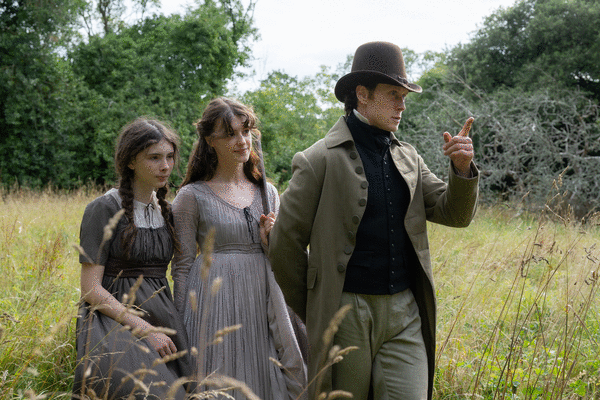
“What have wealth or grandeur to do with happiness?” teenaged Marianne Dashwood rhetorically asks in Jane Austen’s 1811 novel, "Sense and Sensibility." Her prudent sister Elinor replies: “Grandeur has but little, but wealth has much to do with it.”
Elinor’s wise answer seems to have served as the north star for a new film adaptation, directed by Georgia Oakley and written by Diana Reid. Austen is regular source material for filmmakers, but the most resonant retellings of her work tend to reflect their era. This latest one, released in U.S. theaters recently, does more to highlight the Dashwood sisters’ financial precarity — a smart creative choice that shows an understanding of what moviegoing audiences are especially attuned to now.
It’s clear from the get-go that the girls are extremely short of funds following the death of their father. There are bills they can’t pay. They’ve been all but evicted from their stately home by its new owners: their half-brother and his odious wife. Elinor writes letter after letter to try and find an affordable cottage. When she finally does secure one, it’s dim and cramped — a familiar fate for many a modern renter.
To underline their fall from the 1% to the 99%, we subsequently see the Dashwoods growing their own crops, cooking their own food, doing their own laundry and even — unless my eyes deceived me — chopping their own wood. (Perhaps it should be mandatory viewing for the tradwife-curious.)
It’s a harder fate than Austen herself devised for her heroines. But dialing up the Dashwoods’ money troubles resonates at a time when many moviegoers are feeling the pinch of higher prices for essentials.
Women, always the primary audience for Austen films, feel this acutely. A recent Pew poll finds American women are 11 points less likely than men to say they can pay all of their bills; a different survey shows women 13 points more pessimistic about the labor market. Experts suggest women are overrepresented in jobs that could be automated by AI.
So the central problem of so many of Austen’s novels — what does a woman have to do to get a little financial security around here? — hits close to home.
The prosperous 1990s were a different story. The successful Austen adaptations of that era tended to be marketed as Regency rom-coms. Some even gave rise to other rom-coms: 1995’s "Pride and Prejudice," which famously shows Colin Firth as Mr. Darcy in a wet shirt, inspired the screwball "Bridget Jones’ Diary" books and films (which, of course, featured Firth again).
For the most part, these adaptations were also explicitly escapist, greeted by critics as nostalgic comfort-viewing for audiences nervously awaiting the turn of the millennium. Adaptations that reached for more gravitas or grappled explicitly with difficult topics — like 1999’s "Mansfield Park," which explicitly included the slave trade as a major theme — struggled to reach audiences of that era.
But times change, and so do viewer expectations. By the 2005 adaptation of "Pride and Prejudice," starring Keira Knightley, viewers were getting a different type of heroine — rather shouty and slightly tomboyish. This was the era of so-called girlboss feminism, when women were encouraged to overcome the odds through pluck, grit and power poses.
That version came out post-dot-com bust but pre-Great Recession. It was a time when filmmakers were starting to have Austen’s women be more explicit about their financial fears. “I’m 27 years old,” says Charlotte Lucas in that adaptation, justifying her decision to marry the odious — but financially stable — Mr. Collins. “I’ve no money and no prospects. I’m already a burden to my parents, and I’m frightened.”
Those lines were improvised by British film icon Emma Thompson, who consulted on that script — and who won an Oscar for her screenplay for the 1995 version of "Sense and Sensibility," in which she also co-starred. That adaptation, directed by Ang Lee, does show the girls’ change in status, but as a much gentler comedown. Their sun-filled cottage is filled with art and knickknacks. They must economize on beef (relatable), but they still have live-in servants (not).
One scene that would have injected a frisson of real danger was eliminated before production began. Thompson had wanted to emphasize the Dashwoods’ vulnerability by showing a fox hunt — with a desperate vixen searching for an escape — but the idea was scrapped.
The 2026 version, by contrast, is crammed with such metaphors. A caged canary rides with the Dashwoods to their dank little cottage; we also get several close-ups of dead birds shot for dinner. Whether it’s a grouse or a spouse, everyone is on the hunt for something.
Yet as dire as the Dashwoods’ straits are, it’s clear that the answer is not to marry for money. The story is filled with cautionary characters who dug for gold and lived to regret it. (Perhaps the film should also be mandatory viewing for TikTok girlies looking to become stay-at-home girlfriends.)
Spoiler alert: In the end, Elinor gets her man. However, as punishment for choosing the penniless Elinor, his wealthy mother cuts him out of his inheritance. Grandeur he will not have. But he does find a stable job. In 2026, that’s swoon-worthy.
____
This column reflects the personal views of the author and does not necessarily reflect the opinion of the editorial board or Bloomberg LP and its owners.
Sarah Green Carmichael is a Bloomberg Opinion columnist and editor. Previously, she was an executive editor at Harvard Business Review.
©2026 Bloomberg L.P. Visit bloomberg.com/opinion. Distributed by Tribune Content Agency, LLC.











Comments