How NB Mager found her 'anxiety-to-creativity pipeline' to make the provocative 'Run Amok'
Published in Entertainment News
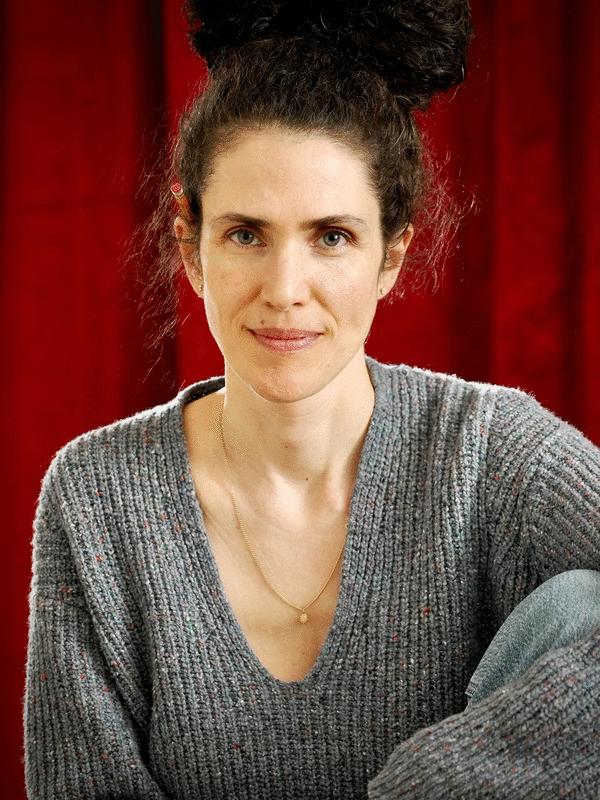
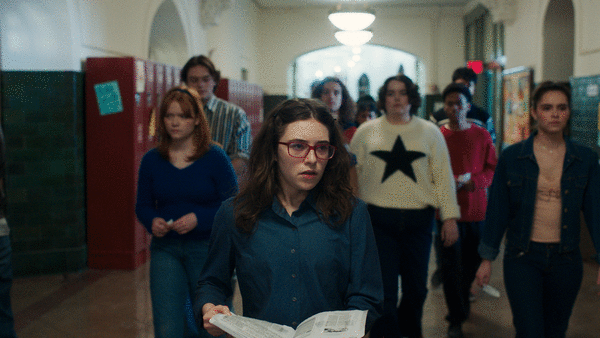


LOS ANGELES — Premiering today in Sundance‘s U.S. Dramatic Competition is “Run Amuk,” the feature debut from writer-director NB Mager. The film is an expansion of her 2023 short of the same name.
It’s a little tricky to talk about the movie without giving too much away. Let’s just say it’s likely to be a conversation-starter. A small community is still reeling from an act of gun violence years earlier. A teenager named Meg (Alyssa Marvin, who also appeared in the original short) is living with her aunt and uncle. Her closest friend is her slightly older cousin, Penny (Sophia Torres), a talented singer. When Meg decides to write a musical depicting the traumatic events, she sets off a chain reaction that impacts many people in town.
The expanded cast of the feature includes Patrick Wilson, Molly Ringwald, Margaret Cho, Elizabeth Marvel and Bill Camp.
Before the start of the festival, Mager, 40, got on a video call from her basement in Brooklyn to talk about the origins of the story, the casting and the picking of the songs for the musical numbers. (Mild spoilers ahead.)
The tone of “Run Amok” is tricky and unusual, at once lighthearted and serious. How would you describe it?
NB Mager: I actually started writing it as kind of a thriller-horror film. And Meg, instead of putting together a musical, she was an investigative journalist for her high school newspaper. And it was quite dark all the way through. And at some point I realized that it felt a little bit like putting a hat on a hat with the subject matter, so I changed it to her putting together this musical. And I think what ended up happening is that this darker foundation remained as this unifying thread, because it deals with really challenging subject matter, but then it’s laid with this comedy and this big hilarious adventure.
There’s something about laughter that’s just naturally disarming and puts us at ease. I think comedy is incredibly honest and it permits you to say things and to ask questions that just otherwise are not socially acceptable. And that’s what I wanted to be able to do. So I think it’s weaving the tension of this challenging subject matter and this very kind of dark undercurrent with the comedy that births this particular tone.
The program note s from the festival avoid phrases like school shooting or gun violence. How do you like to talk about what the movie’s about?
Mager: I think for me, this story is so much bigger than that. And I think that if I was going to tell a coming-of-age story that takes place in high school in our country, it felt honest and real to weave in the fact that this is something that happens here. But I wanted to be able to come into it with a sense of curiosity and compassion and to really center a coming-of-age story. This is a subject matter that unfortunately can be very divisive.
It’s about them. It’s about kids rejecting the status quo that’s been fed to them by the adult world around them. And I think that comes up in a lot of ways, like how do we deal with grief? How do we talk about the things that challenge us? How do we talk about violence? How do we talk about all the things that are part of coming into the adult world.
And that to me is what the movie is ultimately about. It’s about kids having this rude awakening. The adults aren’t going to give them the answers and they have to figure it out for themselves. And when the adults do give them the answers, they’re just not satisfying. They come with this veneer of society’s expectations and all of these things. And these kids, they just want something that’s more raw and honest and uninhibited than what the adults can give them. And so they kind of go for it.
What was it like for you expanding the cast from the short to the feature? These are some terrific actors.
Mager: Yes. Well, Patrick [Wilson] was the first. His role is the biggest adult role in the story. And so he was the first person that I approached and that came on board. And I write really nice letters — offer letters to my actors. So for Patrick I wrote a letter in the form of a three-act play, just honoring his background in the theater. And I think that brought him to the table. Literally. We met for lunch at a table. And then in that conversation I mentioned I come from this acting background, theater background, and I think that with Patrick and Elizabeth [Marvel] and Bill [Camp] and Molly [Ringwald] and all of these wonderful actors, we had this language in common of theater and being trained as actors.
And then with the cast of the young kids who put together the musical, we all came together in the auditorium where we filmed and we were just all together on stage and created this whole improv, this hour-long improv of having them relate to each other without the script and have like a day in the life of high school together. And then from there we were able to springboard into the text of the scenes, but we’d already created this foundation of their lives together and their relationships. So I love working with actors is the bottom line.
I don’t want to spoil the songs, but knowing that this was meant to be a student-created musical of somewhat questionable taste, what was it like to create that show?
Mager: I think the idea kind of dovetails in with the theme of the movie, which is these kids are looking for answers. They themselves are so curious, and what they are given has to be repurposed, you know, for their own needs. So it’s like they’re taking these songs, which aren’t the answer. They don’t answer the questions they have about the story that they’re trying to make, but they repurpose them in kind of an — I don’t know if I want to say inappropriate, but in an unexpected way. It’s like whatever they have, they have to make do with and they have to use the materials that are around them to try to figure this out on their own.
Was it tricky for you, especially in the writing, not to have it feel like a message movie?
Mager: I think that I don’t have a message. That can sometimes be a trap in making art — this feeling of: You need to give the audience the answer. You need to tell them what they need to think or what they need to do. And for me personally, I feel like my responsibility is not to give the audience the answer, but to give them the questions, because that’s what I’m grappling with and I want to do it together with you.
This film that I made and the films that I want to make, they definitely stem from my own anxiety about something. It’s like I have an anxiety about a certain issue and then it gets bigger and bigger until I have to write something about it so that I can figure out how to grapple with it. So that’s my anxiety-to-creativity pipeline. And my way to deal with it is to really allow myself to be in this place of curiosity. That’s the beautiful thing that art can really unlock is curiosity and empathy. It’s not my job to tell people what to think or to give them answers when I honestly can’t provide them.
---------
©2026 Los Angeles Times. Visit at latimes.com. Distributed by Tribune Content Agency, LLC.









Comments