Zelenskyy risks split with Trump as Kyiv resists US pressure
Published in News & Features
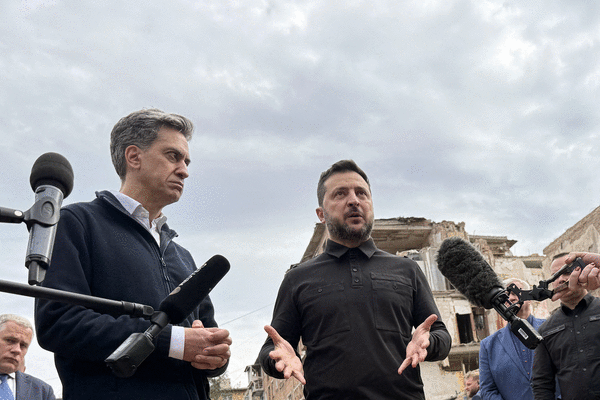
Ukrainian President Volodymyr Zelenskyy is on a collision course with President Donald Trump, who is increasingly looking at Kyiv’s battle against Russia primarily through the lens of energy prices ahead of U.S. midterm elections.
Trump sprung an announcement of an “energy ceasefire” between Russia and Ukraine on Zelenskyy, as the U.S. leader pushes for him to stop bombing Russian oil refineries and defends a controversial deal with Vladimir Putin on diesel exports.
After Trump posted on social media about the ceasefire, Zelenskyy said he is willing to accept it, but only if Russia does too — his long-standing position — making clear his significant doubts about that prospect.
“It was clear that Putin does not read Truth Social,” Zelenskyy told Warsaw Security Forum via a video link on Monday, referring to Trump’s social media platform. “If Russia doesn’t agree to energy ceasefire — we will respond.”
Ukraine’s state-run energy company Naftogaz said Monday that Russia attacked gas production facilities, damaging critical equipment in the eastern Kharkiv region.
The Kremlin has nothing to say yet on an “energy truce,” though contacts are continuing, spokesman Dmitry Peskov said, according to Tass.
But as Ukraine continues to respond to Russia’s invasion with its own attacks on refineries, Zelenskyy increasingly risks running afoul of Trump. That poses a hazard for Kyiv as it still relies on U.S. weapon purchases that are financed by other NATO allies and on intelligence-sharing from Washington. Ukraine is also strapped for cash ahead of the fifth winter of the war.
A day before his ceasefire announcement — the second in as many months — Trump lashed out at Zelenskyy, suggesting he should consider stepping aside as Ukraine’s president. On Friday, after Trump reached the diesel export deal with Putin, Ukrainian negotiators cut short their talks in Miami with U.S. envoys, according to people familiar with the matter, who spoke on condition of anonymity because they were not authorized to speak publicly.
In the meeting, U.S. negotiators, led by Trump’s son-in-law Jared Kushner and special envoy Steve Witkoff, told Ukrainian officials that the U.S. was a strong partner, providing munitions and intelligence, and so Ukraine shouldn’t take actions that hurt American consumers like striking refineries, according to one of the people. That was perceived as an implied threat from the U.S. to cut off intelligence to Kyiv, several of the people said. The Financial Times was first to report about the intelligence cutoff remark at the Miami meeting.
European officials present at the meeting received no prior notification from the U.S. on the imminent diesel deal with Moscow, one person said.
Ahead of U.S. midterms in November, the Trump administration is scrambling to bring down soaring fuel prices, which have raised costs for farmers and truckers. But the deal with Russia, which would release Russian diesel to global markets, risks sparking geopolitical backlash without boosting supply enough to materially lower prices.
It’s also triggered significant bipartisan pushback in the U.S. Seven U.S. senators — four Republicans and three Democrats — released a statement pointing out that Congress had banned imports of Russian energy since 2022, and that the deal was illegal.
After years of devastating Russian aerial barrages, Ukraine has developed an increasingly effective strategy of hitting sensitive parts of the Kremlin’s economy with long-range drones in an effort to undermine Putin’s ability to finance the war.
The attacks forced the Kremlin to pay oil companies steep subsidies to supply road fuels to the domestic market and ban diesel exports, which now also raises questions about Moscow’s ability to fulfill its deal with Trump. On Saturday, Russia partially lifted its ban on diesel exports, allowing 500,000 metric tons of fuel to reach international markets.
Tensions between the U.S. president and Zelenskyy have come and gone since Trump returned to the White House with a pledge to quickly end the war in Ukraine. Last year, the two leaders argued face to face in the Oval Office during an extraordinary public blowup over their clashing perspectives on the war, leading Washington to temporarily suspend military aid and intelligence sharing in the aftermath. The rupture proved short-lived and the U.S. cooperation resumed.
This time, Trump’s verbal attacks may make the situation more dangerous to Kyiv politically, according to Fiona Hill, who served as the top Russia adviser on the U.S. National Security Council during Trump’s first term and is now a senior fellow at the Brookings Institution.
“If he starts to actively play a role in Ukrainian politics,” she said, “and in this way essentially engaging in political subversion, he can do a lot more damage.”
While the Ukrainian leader has previously shown he could push back against Trump and withstand the immediate fallout, another confrontation could prove more dangerous now as his nation heads into winter.
Ukraine is chronically short of U.S.-made interceptors for Patriot air defense systems, its only effective way to down ballistic missiles. The country’s military remains dependent on other American weapons and intelligence even as European allies shoulder much of the cost of military assistance.
It’s possible that the U.S. may stop sharing some of the real-time intelligence Ukraine relies on for the oil refinery strikes, said Jennifer Kavanaugh, a senior fellow and director of military analysis at Defense Priorities think tank in Washington.
The chances that the U.S. cuts Starlink satellite internet access for Ukraine, its key source of military communication, is quite small, she said. However, if the U.S. stopped selling weapons through NATO’s Prioritised Ukraine Requirements List program, the implications could be more significant since Europe can’t backfill these supplies.
Russia, meanwhile, has shown no sign of easing its attacks on Ukraine.
In the past week alone, Moscow has carried out more than 200 strikes on Ukrainian electricity generation and transmission facilities, and another 17 attacks targeted gas and oil facilities, Zelenskyy said Sunday in a daily address to the nation. More than 150 people were killed and more than 700 wounded, he said.
Ukraine is in talks with European partners for additional air-defense systems and munitions for combat aircraft to counter faster jet-powered drones, according to Zelenskyy.
The military pressure comes alongside looming financial challenges. Russian attacks have disrupted Black Sea exports, threatening an important source of revenue, while the International Monetary Fund estimates Ukraine faces a funding gap of more than $30 billion in 2027.
Ukraine’s parliament is due to consider a broad package of legislation this week that Kyiv urgently needs to pass to secure further financing from the European Union and the IMF. The measures include closing tax loopholes and boosting scrutiny over politically exposed persons, proposals unpopular with both the general population and elites.
Meanwhile, Russian officials still have little hope that Trump can deliver a deal to end the war on terms favorable to Putin any time soon, people close to the Kremlin said. Moscow was also taken aback by the force of the U.S. president’s criticism of Zelenskyy, other people close to the Kremlin said.
Trump’s rudeness towards Zelenskyy won’t help unless the U.S. cuts intelligence sharing and arms sales to Ukraine, according to one of them.
“Trump? He never changes his position, as we know all too well,” Dmitry Medvedev, Russia’s ex-president and the deputy head of the country’s Security Council said on his account on the state-backed Max social network. “Only our guys, ballistic missiles and Geran drones are bringing victory closer.”
____
—With assistance from Alex Wickham and Tony Halpin.
©2026 Bloomberg L.P. Visit bloomberg.com. Distributed by Tribune Content Agency, LLC.






Comments