Ron Schutz tries to keep Trump at arm's length in Minnesota attorney general's race
Published in News & Features
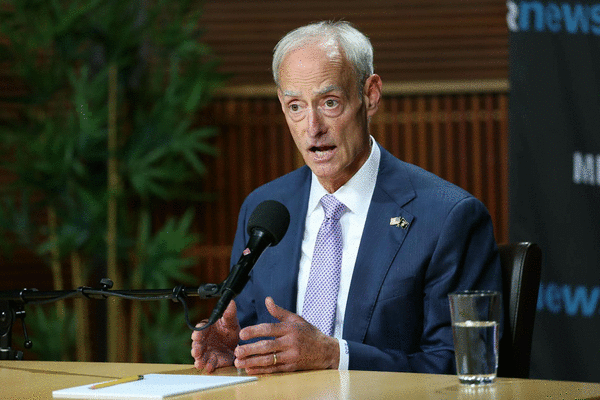
MINNEAPOLIS — Ron Schutz was a young lawyer when he took a case to trial on behalf of the inventor of the MRI, claiming General Electric had infringed on his client’s patent.
His opposing counsel urged him to settle: “You’re never going to win this case,” Schutz recalled. His team forged ahead anyway — and won more than $100 million for the inventor, reported at the time as the largest patent infringement verdict upheld on appeal.
That case launched Schutz’s career. It also exemplifies the hard-charging nature that has made him a well-know patent attorney and spurred him to jump into the attorney general race against two-term DFL incumbent Keith Ellison.
Over his 40-plus year career, Schutz has won trial verdicts against Apple and and Sony over patent infringements while working at a top-tier Minneapolis law firm, experience he says will make him an “aggressive advocate” for Minnesota and one who will “depoliticize” the office.
“I don’t like what’s happening. I don’t like the direction the state is going in general and where the current attorney general has taken a stand,” he said.
Republicans are hoping Schutz can break Democrats’ 55-year hold over the Minnesota Attorney General’s Office. Ellison is seeking a third term at a time when the GOP hopes voter outrage over fraud in the state’s social services programs gives them a chance to boot DFLers from office.
But Schutz faces a political climate that, at least nationally, has become increasingly favorable to Democrats. President Donald Trump is historically unpopular, and Ellison has positioned himself as someone defending Minnesota from the White House.
Ellison said Schutz would “enthusiastically drive the Trump program.”
While it’s Schutz’s first run for public office, it’s not his first foray into politics. A fixture of Minnesota’s conservative circles, he advised former Gov. Tim Pawlenty on judicial nominations and chaired his presidential campaign committee. He’s been a prolific fundraiser for and donor to Republican candidates and sits on the board of the Center for the American Experiment, a conservative think tank.
Before launching his campaign for attorney general, Schutz weighed a run for governor and was a finalist to be Trump’s pick for U.S. Attorney for the District of Minnesota.
Early in the race, he said he expected to approach the White House for support, but he said this month that he’s not seeking Trump’s endorsement at a time when the president’s unpopularity threatens Republicans candidates.
“I have not asked for one, have no intention of doing it,” Schutz said, “and I’ve tried to make it as clear as a bell every time I get asked that I don’t take orders from Trump.”
‘In the arena’
Schutz grew up on a southwest Minnesota dairy farm in Adrian before attending Marquette University on an ROTC scholarship. He attended the University of Minnesota School of Law before being commissioned as an officer in the U.S. Army.
A member of the Judge Advocate General’s Corps, he worked as both a defense attorney and prosecutor on felony cases involving service members.
That’s where he honed his trial style.
As he built his legal career, he started getting involved in Minnesota Republican politics. He worked on state Sen. Warren Limmer’s first state House campaign in the late 1990s before being appointed by Pawlenty to the Commission on Judicial Selection, which recommends candidates to serve as judges. Pawlenty said in an email that he first met Schutz and his wife, Janet Schutz, when he was in the Minnesota House because of a shared interest in school reform.
He said Schutz is a “fantastic lawyer” who “also understands the everyday challenges people face and the importance of serving and helping them.”
Schutz has given hundreds of thousands of dollars over the years to congressional Republicans, Pawlenty and conservative PACs. He was a regular donor to Republicans in the Minnesota Legislature.
Mitch Pearlstein, founder emeritus of the Center for the American Experiment, said Schutz saved the organization from financial ruin as board chair.
Schutz said he’s been asked and considered runs for office before, and he went unchallenged in the GOP primary this year, he believes, because other Republicans agreed he was the most qualified.
“I’ve always been someone who believes that the place to be in life is not on the edge of the arena, but in the arena,” Schutz said, “and right now, someone needs to be in the arena here.”
Fraud and Trump
With Democrat Amy Klobuchar favored to win the governor’s race, the attorney general’s office may be Republicans’ best shot at winning a statewide seat. Ellison narrowly won reelection four years ago and has faced attacks from Republican groups who accuse him of not doing enough to root out fraud in state government.
The Republican Attorneys General Association considers Ellison “the most vulnerable attorney general in the country” and has pledged to spend $1.1 million on broadcast ads.
Outside spending has poured into the race for both candidates.
While the attorney general has a wide range of responsibilities like consumer protection and representing state agencies, the bulk of the political advertising has come down to two major themes: fraud and Trump.
Ellison has highlighted his own efforts to stand up to the Trump administration and cast Schutz as someone who would serve as an ally for the president.
In a campaign ad launched this month, Ellison highlighted Schutz’s comments doubting Trump would take any “blatantly illegal” action and saying Schutz will “never stand up to Trump.”
“Mr. Schutz wouldn’t stand up to Donald Trump,” Ellison said at a recent news conference. “He’d be Trump’s ally.”
Schutz has said he would dedicate more resources to prosecuting fraud, including by using artificial intelligence research tools to free up attorneys and reallocate positions.
He asked legislators not to pass a bipartisan bill to fund additional fraud prosecutors in Ellison’s office, saying the office didn’t need more money to do the job Ellison “failed” to do. During a recent debate, Schutz said Ellison’s office has plenty of resources to combat fraud but his “priorities are wrong.”
The bill passed at Ellison’s urging, and also increased penalties for fraud. Ellison said Schutz isn’t against fraud, but simply against him.
Schutz has also criticized Ellison’s litigation against the Trump administration as “political theater,” arguing Ellison simply jumps on board with other Democratic attorneys general and should file and try cases in federal court in Minnesota.
Schutz said he hadn’t evaluated the merits of the dozens of cases Ellison has brought, but said if the federal government does something that hurts Minnesotans he’d “certainly” challenge it in court. Ellison has accused him of dodging the question and claimed he would drop all of the challenges.
“My guess is, if I were to look at all those cases, there would probably be some in there that should have been brought,” Schutz said, because they challenge a Trump policy that harms Minnesotans. “As I sit here, I can’t tell you which one in particular.”
Schutz issued a press release during Operation Metro Surge calling for a joint investigation into the killing of Alex Pretti in south Minneapolis by immigration agents. He said he would likely sue, as Ellison did, to get access to evidence in the case, which the federal government withheld for months.
“I don’t want federal government agents coming into the state, shooting at citizens without there being an investigation,” he said.
To win in left-leaning Minnesota, Schutz will need to persuade independents, and perhaps even some DFL voters, to back him. Klobuchar’s presence at the top of the ticket and an unpopular federal administration help Democrats’ chances as they grapple with voters’ frustration over fraud in state government.
Asked about his message to those voters, Schutz again asserts his independence, something that was on display in a debate performance where he agreed with Ellison on several topics.
“I’m not taking orders from Trump, not taking orders from anybody in D.C.,” Schutz said. “I didn’t get to this stage of my legal career ... by being anything other than somebody who is driven by doing the right thing.”
©2026 The Minnesota Star Tribune. Visit startribune.com. Distributed by Tribune Content Agency, LLC




Comments