Trump demands reopening of Hormuz ahead of US-Iran peace talks
Published in News & Features
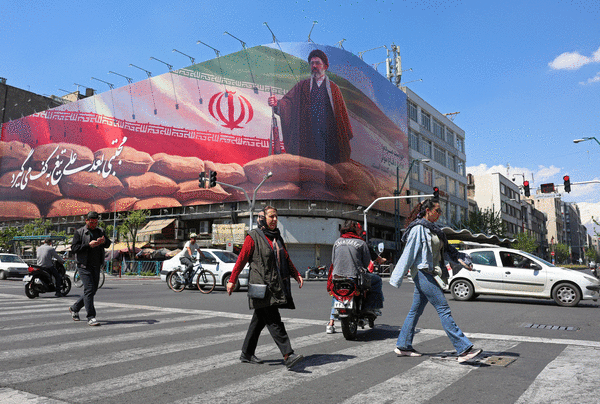
U.S. President Donald Trump demanded Iran reopen the Strait of Hormuz while Israel and Hezbollah exchanged fire, complicating upcoming talks aimed at turning a fragile ceasefire into lasting peace.
The truce announced on Tuesday remains shaky, with Kuwait reporting large-scale drone attacks on “vital” facilities overnight and accusing Iran and its proxy groups of violating the terms of the agreement. There were no further reports of strikes on Friday.
Israel continued to target towns in south Lebanon, where its parallel campaign against Tehran-backed Hezbollah threatens to undermine negotiations. Hezbollah said it launched drones and rocket salvos toward Israel, while Israeli medics reported treating several people injured while rushing to shelters in central and southern Israel.
U.S. and Iranian delegations are set to meet in Pakistan on Saturday, with shipping through Hormuz — which handled about a fifth of the world’s oil and liquefied natural gas before the war — a central sticking point. U.S. Vice President JD Vance is expected to lead the U.S. delegation in discussions scheduled for Islamabad, Pakistan’s capital.
The broader Middle East war has killed thousands of people and damaged energy infrastructure across the oil-rich Persian Gulf in the past six weeks, while Iran’s ongoing shuttering of Hormuz has choked global fuel supplies.
“Iran is doing a very poor job, dishonorable some would say, of allowing Oil to go through the Strait of Hormuz. That is not the agreement we have!” Trump said in a Truth Social post on Thursday. “You’ll see Oil start flowing, with or without the help of Iran and, to me, it makes no difference, either way.”
The U.S. president also warned Iran against charging fees on tankers going through Hormuz.
Traffic through the strategic waterway has shown little sign of a meaningful pickup since the truce began, as shipowners await clarification of its status.
The ongoing blockage has maintained pressure on oil prices, which traded about 1.9% higher at almost $98 a barrel in London on Friday. Asian stocks rose, extending their first weekly gain since the conflict began, with investors cautiously hopeful before the weekend negotiations.
Despite the challenges, Trump said he was “optimistic” about a deal with Iran.
The U.S. president described Iran’s leaders as “much more reasonable” than their public comments would suggest in a phone interview with NBC News.
Iran’s new supreme leader, Mojtaba Khamenei, whose father was killed on the first day of the war, said in a statement on Telegram that Iran “will definitely bring the management of the Strait of Hormuz to a new stage,” though it was unclear whether he was referring to previous Iranian demands to retain control of the waterway that the U.S. has rejected.
Khamenei reiterated that Iran wants war reparations — a likely nonstarter for U.S. negotiators.
Trump told NBC that Israeli Prime Minister Benjamin Netanyahu was “going to low-key it” with airstrikes on Lebanon, after the two leaders spoke by phone on Wednesday.
Even so, Lebanon remains a major flashpoint. Iran has said the U.S. bears responsibility for halting fighting in the country, which has killed more than 1,700 people, while American officials insist the country wasn’t part of the ceasefire accord.
Iranian President Masoud Pezeshkian has said the Israeli strikes in Lebanon are a “clear violation” of the ceasefire and will render the planned peace talks “meaningless.”
Netanyahu said he would open direct talks with Lebanon to discuss disarming Hezbollah and ending the conflict, and the U.S. agreed to host a meeting next week, according to a State Department official.
But the Israeli leader also reiterated his position that the ongoing attacks in Lebanon aren’t part of the U.S.-Iran ceasefire deal.
The Israel Defense Forces “is in a state of war; we are not in a ceasefire on the northern front,” the IDF’s chief of the general staff, Eyal Zamir, said on Thursday. “We continue to operate here on this front. This is our primary operational focus.”
Hezbollah has not officially commented on the direct talks, though is unlikely to be willing to cooperate. The Lebanese government pledged to disarm the militant group after a 2024 ceasefire, but hasn’t succeeded — with the powerful militia refusing.
The Lebanese group — founded in 1982 as a reaction to Israel’s occupation of the country’s south — was inspired by a revolution in Shiite-majority Iran three years earlier. It evolved into Iran’s most powerful proxy, helping it deter enemies and expand its influence across the Middle East.
It’s Iran’s most important ally in a network of affiliated groups that includes Yemen’s Houthi rebels and Hamas in Gaza.
The U.S. and Iran appeared to pause most strikes after fighting continued in the region on Wednesday.
After the Kuwaiti Foreign Ministry said fresh strikes were carried out by Iran and its proxies, Tehran’s Islamic Revolutionary Guard Corps said the country’s armed forces haven’t launched drones or missiles at any country since the ceasefire began, according to Press TV.
Saudi Arabia, where a key oil pipeline was attacked a day earlier, has lost more than half-a-million barrels a day of oil output capacity because of Iranian strikes, according to the state-run Saudi Press Agency.
Strikes on a pumping station serving the vital East-West Pipeline this week crimped daily throughput by 700,000 barrels, the agency said.
The war in the Middle East has claimed more than 5,500 lives, according to governments and non-governmental agencies. More than 3,600 people have been killed in Iran, the U.S.-based Human Rights Activists News Agency estimates, while more than 1,700 people have died in Lebanon, the government says.
Israel said it’s killed more than 1,400 Hezbollah militants, including 200 on Wednesday.
Israel has reported about three dozen deaths, and a similar number have been killed across Gulf Arab nations, government reports show. There’ve also been several dozen casualties in Iraq. Thirteen American troops have been killed, according to U.S. Central Command.
----------
—With assistance from Eltaf Najafizada.
©2026 Bloomberg L.P. Visit bloomberg.com. Distributed by Tribune Content Agency, LLC.




Comments