Artemis II astronauts set to splash down on Earth tonight
Published in News & Features
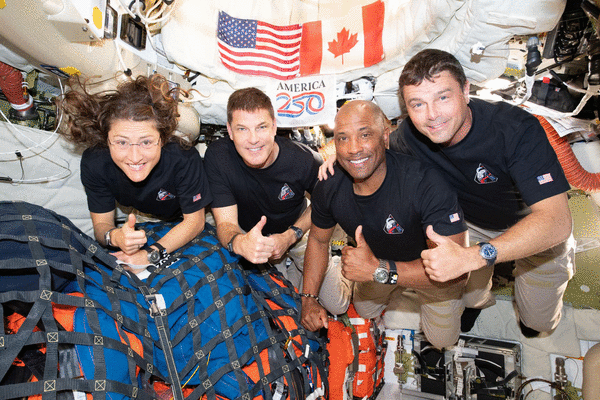


Records were set. History was made. Now all that’s left is to get the four Artemis II astronauts home safe.
NASA’s Reid Wiseman, Victor Glover and Christina Koch along with Canadian Space Agency astronaut Jeremy Hansen are in the final run of a 600,000-mile trip that began on April 1 when they launched from Kennedy Space Center on the first crewed mission of the Artemis program.
Their return is slated for 8:07 p.m. EDT with their spacecraft Orion set to splash down in the Pacific Ocean off the coast of San Diego.
Their descent will take about 13 minutes once they reenter the atmosphere coming in at nearly 24,000 mph enduring temperatures close to 5,000 degrees Fahrenheit.
“It’s 13 minutes of things that have to go right,” said Artemis II lead flight director Jeff Radigan on Thursday afternoon. “I have a whole checklist in my head that we’re going through of all the things that have to happen.”
That includes the successful deployment of a pair of drogue parachutes that slow it about 200 mph before the final three main parachutes slow it to about 20 mph before hitting the water’s surface.
“You’re really coming straight down and come in and hit the atmosphere a whole lot faster, but that means you go through it a whole lot faster too,” Radigan said. “I’d say it parallels Apollo much more than it does some of our low-Earth-orbit returns and and that’s really what we’re looking forward to. They’re coming home pretty fast.”
Once in the water, recovery teams will rendezvous with the capsule. The crew will be extracted within two hours and flown to the USS John P. Murtha by helicopters where they will undergo post‑mission medical evaluations. Then they’ll be flown to shore, and board an aircraft flying to Johnson Space Center in Houston.
“We’re not done on this mission. We’ve got another day and a half, and you know that’s when we can start celebrating, is when we have a crew safely in the med bay of the ship,” Radigan said. “That’s really when we can allow the emotions to take over and, start talking about success. We need to have the crew home before we do that.”
Earlier this week, the quartet surpassed the record for the Apollo 13 mission in 1970 for farthest distance from Earth ever flown by humans. Glover became the first Black man, Koch the first woman and Hansen the first non-American to ever fly near the moon.
They have now grown the number of humans ever to venture into deep space to 28, and the first since the final flight of the Apollo program in 1972.
Along the way they flew around the far side of the moon, taking in sights never seen before by human eyes, and witnessed a solar eclipse with the moon blocking out the sun from a new perspective.
The return will conclude the 10-day mission that had a primary goal of proving Orion could support humans for NASA’s future lunar plans future. It sets up an Artemis III mission that could fly as soon as mid-2027, although that flight will stay close to Earth with a task of testing out Orion’s ability to dock with one or both of two lunar landers being developed.
It won’t be until the Artemis IV mission, targeted for early 2028, that humans would return to the lunar surface for the first time since Apollo 17 more than half a century ago.
In the meantime, the Artemis II astronauts have a lot to talk about.
During a call with press late Wednesday, the quartet weighed in on the highs and lows of the journey so far.
Among the most poignant moments was the call back to Houston after the quartet had broken Apollo 13’s distance record. Hansen announced the crew wanted to name a pair of craters on the moon, one for the ship, named Integrity, and another for Wiseman’s late wife Carroll.
Wiseman, even though he knew about the idea which was conceived beforehand by his three crewmates, could not help but wipe away tears as Hansen spoke.
“That was an emotional moment for me. And I just thought that was just a total treasure that they had thought through this, and they had offered this. And I said, ‘Absolutely, I would love that.’,” he said, noting he knew he would not have been able to give the speech. “And Jeremy, the kind of guy he is, he said he would do it and and it was getting emotional there. And I think when Jeremy spelled Carroll’s name, ‘C-A- R-R-O-L-L,’ I think for me, that’s when I was overwhelmed with emotion.”
He said he saw Koch crying and he put his hand on Hansen as he was still talking, as he could tell his Canadian crewmate was trembling.
“We all pretty much broke down right there,” Wiseman said. “And just for me personally, that was, that was kind of the pinnacle moment of the mission for me. That was, I think, where the four of us were the most forged, the most bonded, and we came out of that really focused on that day ahead.”
Glover was particularly moved by the eclipse, which in the end made up for the fact that because they had launched on April 1 instead of a launch window, some of the observable far side of the moon would be shrouded in lunar night. And while they had been prepared by the science team, the moment hit hard.
“When that actually happened, it just blew us all away,” he said, and while the eclipse “seemed to be a consolation, and it was one of the greatest gifts of that part of the mission.”
Hansen said he had seen extraordinary things, some that he expected, but others he could not have imagined.
“But I have to say, it hasn’t changed my perspective, or the perspective that I launched with,” he said. “That we live on a fragile planet in the vacuum, in the void of space. We know this from science. We’re very fortunate to live on planet Earth.”
Hansen added that another perspective hammered home from space is one he’s learned from others through life.
“Our purpose on the planet as humans is to find joy and (lift) each other up by creating solutions together, instead of destroying,” he said. “And when you see it from out here, it doesn’t change it. It just absolutely reaffirms that. It’s almost like seeing living proof of it.”
Koch talked about the path they’ve paved for future Artemis crews.
“Part of our ethos as a crew and our values from the very beginning were that this is a relay race,” she said. “In fact, we have batons that we bought to symbolize physically that we plan to hand them to the next crew, and every single thing that we do is with them in mind.”
She did weigh in on the difficulties of the mission, such as the toilet not working 100% of the time.
“It’s actually easier in human spaceflight, especially on a first mission, to accept some of the things that aren’t working quite right, or the operational work arounds,” she said. “And we have actually been diligent to try to fix everything. And we’re always thinking from the perspective, what is the next crew going to think about this? How will this help them to succeed?”
Koch said the premium on personal space on board a spacecraft no bigger than a camper van was laughable at times.
“We have loved living in Orion, and in fact, we’ve all said that sometimes you can forget where you really are, because we’re in this small space that just gives us everything we need,” she said. “It is bigger in microgravity, and yes, we are bumping into each other 100% of the time.”
She said a common phrase you might here in the cabin is, “Don’t move your foot. I’m just going to reach for something right under it” and that “Everything we do in here is a four-person activity, but it’s also really fun.”
She’s embraced it, and will miss it when they’re done, she said.
“I will miss this camaraderie. I will miss being this close with this many people and having a common purpose, a common mission, getting to work on it hard and hard every day, across hundreds of thousands of miles with a team on the ground,” she said. “This sense of teamwork is something that you don’t usually get as an adult. I mean, we are close, like brothers and sisters, and that is a privilege we will never have again.”
In the end, there’s nothing about the mission she could have done without.
“This whole thing is a package. We can’t explore deeper unless we are doing a few things that are inconvenient, unless we’re making a few sacrifices, unless we’re taking a few risks, and those things are all worth it,” she said.
Wiseman noted that the camaraderie among the four spilled out into calls they all had with their families back on Earth.
“One of the neatest things being a crewmate on this spacecraft has been, not being in the family conference, but hearing your crewmates giggling and crying and just gasping and listening and loving their families from afar,” he said. “Family is so important to all four of us, and that has been amazing. And when I got to talk to my daughters, Ellie, Katie, for the first time, like I just couldn’t even speak, I was just so overjoyed. I was crying. I mean, it’s just, it is an amazing experience.”
Wiseman also weighed in on the moment Orion dipped behind the moon and the Earth disappeared from view.
“When we watched that, Earth eclipse behind the moon, well, I’m actually getting chills right now. Just think about — my palms are sweating — but it is amazing to watch your home planet disappear behind the moon,” he said. “You could see the atmosphere. You could actually see the terrain in the moon projected across the Earth as the Earth was eclipsing behind the moon. It was just an unbelievable sight. And then it was gone. It was out of sight.”
He said the quartet took a moment, even shared some maple cookies brought by Hansen, but after a few minutes, the crew got back to work as they had a lot of scientific work to do.
The gravity of the mission he expects will hit even harder when they’re back on Earth and have time to reflect.
“There’s a lot that our brains have to process. Human minds should not go through what these just went through,” he said. “It is a true gift. And we have a lot that we just need to think about and journal and write, and then we’ll get the full feeling of what we just went through.”
---------
©2026 Orlando Sentinel. Visit at orlandosentinel.com. Distributed by Tribune Content Agency, LLC.






Comments