Calif. Gov. Gavin Newsom blasts Trump's climate retreat while defending his own green agenda
Published in News & Features
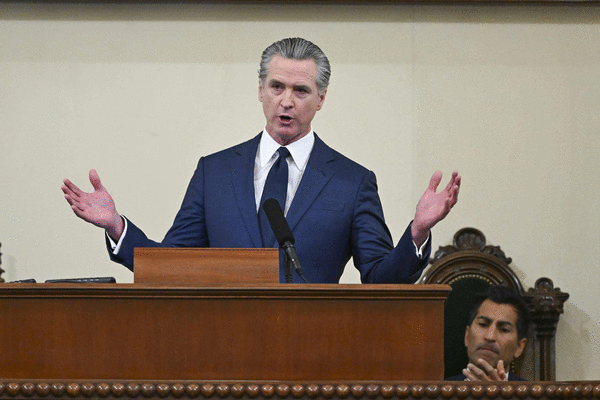
California Gov. Gavin Newsom’s State of the State address came a day after President Donald Trump announced the U.S. withdrawal from dozens of international and United Nations organizations, including the U.N. Framework Convention on Climate Change — the foundational U.N. agreement that has guided international cooperation to combat the climate crisis.
In his address Thursday, Newsom continued to position California as resisting Trump administration climate rollbacks, warning of China’s advancement in the clean energy sector while the U.S. lags behind.
“I want to remind everyone China today manufactures 70% of the world’s electric vehicles. They’re flooding the global market with increasingly high-quality and inexpensive cars … this is not about green power. This is about economic power. They are dominating this space,” Newsom said.
“They’re locking in markets, they’re locking in supply chains, they’re locking in their influence all across the globe. They’re cleaning our clock. But in California, we are not bystanders. We have already seen seven times more clean energy jobs than fossil fuel jobs in the state of California.”
Newsom, along with other California delegates, attended the COP30 U.N. climate summit in November, while the Trump administration chose not to send an official delegation to the talks.
Trump has favored and advanced the administration’s “drill, baby, drill” mantra and withdrawn the U.S. from international cooperation, with climate efforts among the most heavily impacted since his first term.
By signing the executive order “Putting America First in International Environmental Agreements” on his first day in office, Trump initiated the United States’ withdrawal from the Paris Agreement for a second time. The administration’s blocking of climate-related funding extended beyond domestic science programs, also halting support for low-income countries working to expand renewable energy and prepare for natural disasters.
The stark contrast in their climate policy positions has put Newsom in the spotlight, a role he has not shied away from embracing.
California filed at least 50 lawsuits against the Trump administration since the president took office last year, among them the state’s efforts to restore its own clean‑air standards for cars and trucks, opposing removal of federal support for clean energy programs, and blocking oil and gas developments being fast-tracked without full environmental review.
“By withdrawing from the United Nations climate framework and 65 other international organizations, our brainless president is surrendering America’s leadership on the world stage and weakening our ability to compete in the economy of the future — creating a leadership vacuum that China is already exploiting,” Newsom said on Wednesday following the White House’s announcement.
California’s climate fight at home
During Thursday’s address, the Democratic governor touted the state’s green goals and economic growth, saying that the Golden State is in the “‘how’ business” when it comes to staying competitive in green investment.
Newsom celebrated California’s coal-fired power exit and an extension of the cap-and-trade program last year, which secured $1 billion annually through 2045 for the project, the progress the state has made with Sites Reservoir, as well as the Darden Clean Energy Project, the world’s largest solar and battery storage project, located in western Fresno County.
“The number one driver … of your increased energy bills over the last decade has been the cost of hardening our infrastructure and other wildfire-related costs … driven by climate change,” Newsom said,
“That’s why I was proud … to extend our nation-leading cap-and-invest program for another two decades. But when we did this, we were mindful of this crisis as it relates to utility bills, and we provided in that extension close to $60 billion in rebates for your monthly energy bills.”
In 2025, climate change’s impacts were felt throughout the state, from devastating wildfires to a thinning snowpack and declining kelp forests.
To mitigate the damages, California entered the new year with pivotal environmental policies, including SB 1053, which bans all checkout plastic bags at grocery, convenience, and liquor stores, retail stores with pharmacies and food marts, and SB 253, which requires large companies in the state to measure and publicly report their greenhouse gas emissions.
But Newsom has faced criticism from those who saw that his climate policies lagged behind the pace and scale of the crisis, especially when it came to his handling of looming AI dominance globally.
In his speech, the governor described artificial intelligence as a “tech genie,” framing the technology as the future of our economy.
“Last year, we worked together on landmark legislation to create the nation’s first rules for responsible, ethical, and safe use of AI, regulations that provide guardrails that balance risk and opportunity,” the governor said, referring to Senate Bill 53, which requires big AI developers to come up with and follow internal safety plans that spell out how they will detect, manage and reduce catastrophic risks from their systems, while also providing strong protections for whistleblowers.
“That’s California leadership. We’re leading the way in this space. It’s how we’re shaping the future. It’s a unique combination … of conscience and capital, entrepreneurial and innovative spirit that encourages risk-taking but discourages recklessness.”
However, that landmark SB 53 was quickly followed by Newsom’s veto of another transparency bill that would have added a layer of protection for California’s water.
In October, Newsom vetoed AB 93, a transparency measure that would have required California’s rapidly expanding AI data centers to disclose their water use, as he was “reluctant to impose rigid reporting requirements about operational details on this sector without understanding the full impact on businesses and the consumers of their technology”
Sean Bothwell, executive director of California Coastkeeper Alliance, who worked closely with Assemblymember Diane Papan, D–San Mateo, on drafting AB 93, said he was “incredibly surprised” by the veto, and described the governor’s decision as a missed opportunity to protect water in light of growing water demand by AI data centers.
“That bill was really a transparency bill. There weren’t a lot of onerous requirements, and it was really just to lay the foundation so we knew the water demand that AI centers were using,” Bothwell said in November.
“It just confirmed my concerns throughout his governorship — that the image of being pro-tech is more important than preserving our water supply.”
_____
©2026 The Sacramento Bee. Visit sacbee.com. Distributed by Tribune Content Agency, LLC.



Comments