New US dietary guidelines are heavy on meat and carbon emissions
Published in News & Features
At the top of the new U.S. food pyramid are a bright red steak and a packet of ground beef. That reflects the new U.S. dietary guidelines’ emphasis on animal proteins. Plant-based sources of protein like almonds and peanuts are tucked farther down, and whole grains appear at the bottom.
The new recommendations, released Wednesday by the U.S. Department of Health and Human Services and the U.S. Department of Agriculture, are focused on health, but they also have implications for the climate. Beef is responsible for 20 times more greenhouse gas emissions per gram of protein than beans, peas and lentils.
“If someone did care about environment or climate change, one would have a hard time signing onto these new dietary guidelines,” said Walter Willett, professor of nutrition and epidemiology at Harvard T.H. Chan School of Public Health. “This goes way beyond what’s environmentally sustainable, essentially because of the massive emphasis on meat and dairy production.”
The changes reflect the weight that HHS Secretary Robert F. Kennedy Jr. and the “Make America Healthy Again” movement have put on eating protein and avoiding added sugars and processed foods, and line up with the Trump administration’s broader position on climate change.
“The Trump administration will no longer weaponize federal food policy to destroy the livelihoods of hard-working American ranchers and protein producers under the radical dogma of the Green New Scam,” a USDA spokesperson said in a statement.
Inverted pyramid
Previous dietary recommendations from the US government — which began releasing them in 1977 — also told Americans to eat protein, but the latest guidelines appear to as much as double the suggested amount relative to those in place from 2020 to 2025. They also say to “prioritize protein foods at every meal.”
Americans are now being urged to eat as much as 1.6 grams of protein a day for each kilo they weigh. That roughly translates to between 84 grams and 112 grams per 2,000 calories, according to an analysis of the new guidelines by Marion Nestle, a New York University nutrition scientist. Earlier recommendations suggested adults eat between 46 and 56 grams of protein.
The new guidelines also drop previous advice to focus on lean meats and cutting red and processed meats, and describe beef tallow as one of the cooking oils that should be prioritized. “This is about getting people back into eating meat and dairy products,” said Nestle, calling it a major win for those industries.
While protein can come from plants, Americans typically get theirs from animal sources. The new guidelines mention non-meat options like beans, nuts, seeds and soy, but position them as secondary to animal products, listing them second in explanations of where Americans might find protein and featuring them less prominently in the food pyramid graphic, experts noted.
“You had to look hard and almost knowingly to find any hint of plant protein source in that graphic,” Willett said. The EAT-Lancet Commission, which Willett co-chairs, put out a planetary health diet late last year to curb emissions; it suggests eating a total of two servings of animal sources of protein per day.
At that level, “we could just sort of barely squeak by with keeping within sustainable amounts of greenhouse gas emissions,” he said.
An outsize footprint
Livestock contribute around 12% of all human-related greenhouse gas emissions, and some 40% of agriculture’s total emissions, according to a 2023 report by the Food and Agriculture Organization of the United Nations. Cattle used in meat and milk production contribute to more than half of that footprint.
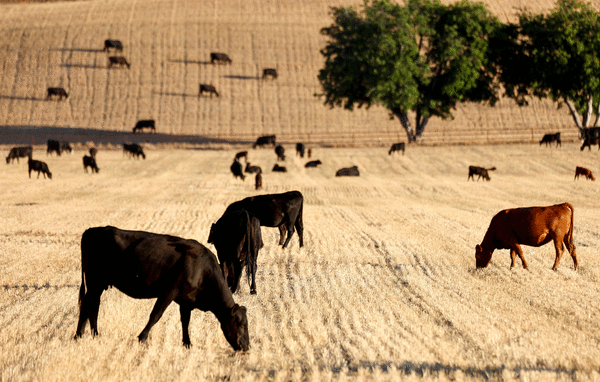
Cows are outsize emitters because an enormous amount of land is used to raise them, making beef a less efficient source of calories than other foods, and because their burps release the potent greenhouse gas methane into the atmosphere.
Climate change is not an issue that previous iterations of the dietary guidelines have tackled, and the new version doesn’t mention it either. As part of the multiyear process of coming up with the latest recommendations, which will be in place from 2025 to 2030, HHS and the USDA told an advisory committee not to take climate change into account. The committee nevertheless did emphasize plant-based protein sources in its recommendations, but that advice was not incorporated into the resulting guidelines.
Four of the nine outside nutrition experts involved in reviewing scientific evidence for the new guidelines disclosed financial ties to the dairy, beef or pork industries, according to a report that HHS and the USDA released alongside the new pyramid.
“This will definitely result in higher intakes of meat,” said Becky Ramsing, a registered dietician and public health expert at the Johns Hopkins Center for a Livable Future. Because government guidelines shape what foods are served in locations such as schools and prisons, “the long-term consequences could be large.”
_____
©2026 Bloomberg L.P. Visit bloomberg.com. Distributed by Tribune Content Agency, LLC.






Comments