San Diego attracts $62B in foreign investment, but that trails its peer cities
Published in Business News
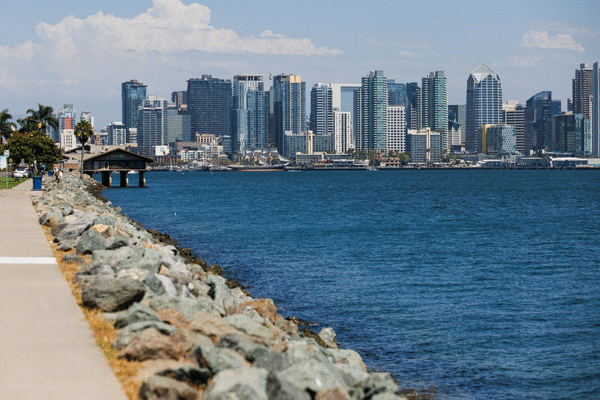
Foreign investment in San Diego reached $62 billion over the last decade, and local leaders recently launched an effort to increase it.
World Trade Center San Diego released its Go Global 2030 report this week, which praises the benefits of the region for investors while laying out a roadmap for increased trade and investment.
Ideas in the report include attracting Pacific Rim investors from nations like South Korea and Taiwan through better port connections and nonstop flights; deepen connections with Baja California with increased co-production of goods and partnering with universities on both sides; and, in general, make San Diego an easier place to do business.
The report, completed with research from Boston Consulting Group, detailed foreign direct investment over the years, which occurs when a company, foreign government or individual makes a long-term commitment to a local business.
In the past decade, the most foreign investment came from companies in Switzerland, Japan, France, Germany and Israel. The majority of investment involved a company from a foreign nation buying a San Diego business, which was often in the biotech industry.
Mayor Todd Gloria has been promoting the report on social media and on local radio programs. On Tuesday on KOGO Radio, he said San Diego is competing with cities worldwide for foreign investment, and it takes a coordinated effort to be successful.
He recalled a 2022 visit with trade officials to ASML, the semiconductor manufacturer based in the Netherlands. He said he made the case for expansion at its local operation, which is in unincorporated county land near Rancho Bernardo. It has increased from around 1,600 workers in 2022 to more than 2,000 today, show recent estimates from the San Diego Regional Economic Development Corp.
“We want to see more of that,” he told the radio program. “We want to make sure we are laser-focused on how we can invite more foreign investment into our city. That’s the money that creates those jobs and, in turn, creates revenue that (the city) can use to repair roads, house more homeless people and keep San Diegans safe.”
The Go Global report also lists other examples over the past decade:
—Israeli company Teva Pharmaceuticals purchased San Diego’s Auspex Pharmaceuticals for $3.5 billion in 2015.
—French pharmaceutical giant Sanofi acquired local company Synthorx for $2.5 billion in late 2019.
—Switzerland tops investment in the region for major purchases in 2025 and 2026: Swiss drugmaker Novartis acquired San Diego’s Regulus Therapeutics for $1.7 billion and Swiss pharma company Roche acquired Poseida Therapeutics for $1.5 billion, both in 2025. Novartis completed another purchase in early 2026 of San Diego’s Avidity Biosciences for $12 billion.
Despite billion-dollar investments, the report says San Diego is falling behind 12 peer cities of similar size. In the 10-year period, America’s Finest City was surpassed by Boston, with $235 billion in foreign investment; San Francisco, with $226 billion; San Jose with $143 billion; Anaheim, with $118 billion; and others. (Bigger metros with larger populations, like Chicago, New York and Los Angeles were not compared because they aren’t considered “peers”).
The report identifies South Korea and Taiwan as major investors across peer metros and worth pursuing. One major focus is getting direct flights to both nations, which are available in Los Angeles and San Francisco but not here.
Lucas Coleman, director of World Trade Center San Diego, said local officials can win nonstop flights through trade missions that show airlines — such as Korean Air — that the region can fill higher-cost business class seats.
Coleman said the organization had success in a trade mission last year to France where they made the case for a nonstop flight. Air France announced last month that it will start nonstop flights between Paris and San Diego starting next summer. The idea is that making connections between cities easier, instead of layovers in other metros, will encourage business in both directions.
Another case trade officials make is for greater use of the Port of San Diego, or at least making foreign companies aware it is an option. Coleman said the port cannot handle the massive cargo ships seen in the Ports of Los Angeles and Long Beach, but some companies may be unaware the Port of San Diego is an option for smaller cargo loads. That need could become more urgent as workers at the Los Angeles and Long Beach ports may go on strike as soon as Saturday, said The Wall Street Journal.
Going forward, trade officials want to diversify the type of foreign investment in San Diego. Mergers and acquisitions accounted for 74% of foreign investment in the past decade. While that is a positive for the region, Coleman said he’d like to see other categories increase. For instance, 16% of investment was in venture capital, where a foreign company invests in a business but doesn’t take it over. About 10% was in so-called greenfield investment, where a foreign company would build a new facility or infrastructure.
One challenge trade officials in San Diego must face is the difficulty of doing business here — and they have the data to back it up. Boston Consulting Group surveyed 34 international investors headquartered outside the U.S. who had decision-making authority or influence over U.S. investment location decisions. The investors ranked San Diego second to last in 13 peer metros, only ahead of Minneapolis
Their task is steep, as many foreign investors find California a difficult environment as opposed to any deficiencies in San Diego. San Francisco, San Jose and Anaheim all were near the bottom of the “ease of doing business” category in the report. Investors’ main gripes were restrictive environmental laws in California, a lack of state tax incentives, high cost of living, substantial labor costs and expensive real estate (primarily for biotech and industrial space locally).
The survey also pointed to missed opportunities: 56% of surveyed investors shortlisted San Diego — the highest share of any metro — before choosing elsewhere, largely due to real estate, utility, tax, incentive and labor costs
While San Diego got high marks for its talent base and other factors, it is still losing out to other metros that have a lot of the same high-cost issues. Investors said they often chose cities like Boston and San Jose because it already has a lot of the executive talent they need living there.
Coleman said the “2030” in the report title reflects a plan that looks at doable, short-term goals instead of a decades-long trade strategy.
“A lot can change in 10 years,” he said.
©2026 The San Diego Union-Tribune. Visit sandiegouniontribune.com. Distributed by Tribune Content Agency, LLC.






Comments