Gold surged to a record, then fell hard. What happened?
Published in Business News
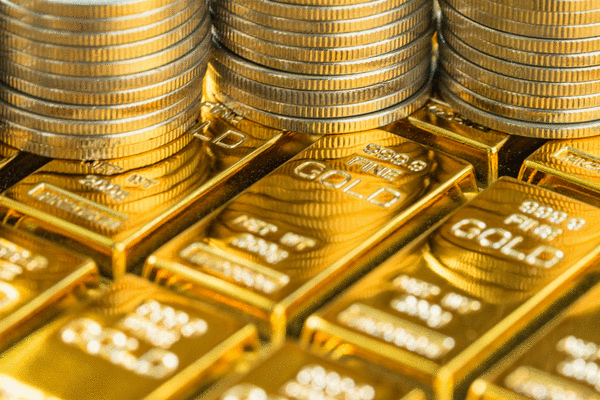
Gold has been on a wild ride this year.
The precious metal soared to a record of nearly $5,600 an ounce before tumbling to roughly $4,000. It has since clawed its way back to about $4,200, leaving investors wondering whether gold’s spectacular run has more room to go — or whether the metal’s best days are behind it.
Daniel Eye, senior portfolio manager at Focus Partners Wealth in Green Tree, Pennsylvania, said investors shouldn’t lose sight of one of the biggest forces moving gold — the Federal Reserve. Interest rates, inflation and the strength of the dollar have been central to gold’s story this year, and Fed policy is likely to remain the big swing factor.
When the Fed signals that it is finished raising rates — or begins cutting them — gold has historically benefited. But persistent inflation could force the Fed to keep rates higher for longer. Rising bond yields can make gold less appealing because, unlike bonds, gold pays no interest.
Still, Eye says the longer-term reasons investors have turned to gold haven’t disappeared. Governments continue to run large deficits and accumulate debt, while central banks around the world have been diversifying their reserves away from the U.S. dollar.
In the latest installment of the Post-Gazette’s “In Conversation With” Q&A series, Eye weighs in on where gold could go from here, what could be the next big move — and what investors should consider before chasing the precious metal after its record-breaking run.
Pittsburgh Post-Gazette: What’s behind gold’s volatility this year?
Daniel Eye: The story this year has been mostly about Fed policy, interest rates and the dollar.
Gold ran hard into January on speculation that the Fed would cut rates multiple times in 2026, and a weak dollar, strong buying by central banks, and plenty of geopolitical worry.
Then the script flipped. The spike in oil and commodity prices completely shifted expectations from the rate cuts to how many interest rate hikes would be needed to contain inflation. Gold pays no dividends, so it’s less attractive in an environment where bond yields and interest rates have spiked to 20-year highs.
PG: Is the drop from the peak to about $4,200 an ounce a normal correction, or a sign that enthusiasm got overheated?
Eye: Honestly, probably some of both. Gold nearly doubled from early 2024 to the January peak, and assets that move that far that fast usually give some back. A pullback of about 20% to 25% after a run like that isn’t unusual. A lot of momentum and speculation came in near the top, and some of that has been flushed out.
I’d treat it as a reset in expectations rather than a verdict on whether gold “works.” The longer-term reasons people own it — such as government debt, deficits and central banks wanting to diversify away from the dollar, haven’t gone away.
PG: What could get gold climbing again? And what could push it much lower?
Eye: The biggest swing factor is the Fed. If the Fed signals it’s done raising rates, or starts cutting because the economy slows, yields and the dollar would likely ease, and that has historically helped gold.
More worry about deficits, a pick up in central bank buying, or a new geopolitical shock could also help.
On the downside, if inflation stays sticky and the Fed keep raising rates, real yields keep rising and gold has a hard time competing with bonds.
PG: Since gold produces no income, how do you decide whether it’s worth owning for diversification?
Eye: This is where my bias comes through. I’d much rather own great businesses that grow their earnings, dividends and cash flow over time, because that’s what compounds wealth.
A bar of gold sitting in a vault doesn’t produce anything, so its return depends entirely on what someone else will pay for it later.
Where gold earns a place is as insurance. It doesn’t depend on any government or company paying you back, and it has tended to hold its value when people lose confidence in paper currencies or in how much governments are spending and printing.
So, the question isn’t “Will gold beat stocks?” Over long periods it usually hasn’t. The question is whether a small portion lowers overall risk in your portfolio in the scenarios you worry about most.
PG: For someone with a diversified retirement portfolio, what percentage of gold ownership is reasonable?
Eye: If someone wants exposure, I think a small slice — something in the 2% to 5% range is reasonable. That’s enough to matter as a hedge without giving up much of the long-term growth you get from owning businesses. I’d be cautious about going much higher, and I don’t think anyone needs gold to have a sound retirement plan. Zero is a perfectly reasonable answer too.
PG: Which do you prefer — physical gold or gold ETFs vs. gold mining stocks?
Eye: There’s a meaningful difference. I’d rather own the physical metal outright. The biggest advantage is that there’s no counterparty risk. You aren’t depending on a fund, a bank or a company to hold up their end. You simply own the gold.
The trade-offs are practical ones. You have to pay to store and insure it, and dealer markups cost you a bit when you buy and sell.
Gold ETFs are the most convenient way to track the price. They’re inexpensive, easy to trade, and don’t require storage. But you’re owning gold through financial structure rather than holding it yourself.
Mining stocks are a different animal. When you buy a miner, you take on the gold price plus a second layer of risk tied to the business itself — cost overruns, operating problems, management decisions and political risk where the mines are located.
Miners can do very well when gold rises, but they can also fall harder than gold, especially in a broad stock market selloff.
PG: For a 60-year-old person with little or no gold, would today’s lower price change your thinking about that person adding gold to their portfolio?
Eye: A lower price makes it a little more palatable, but I wouldn’t add gold just because it’s cheaper than it was in January.
For someone at or near retirement, the biggest questions are whether they need more income, how much risk they can tolerate, and what they’re actually trying to protect against.
Gold produces no income, which matters when you’re drawing on your portfolio to live. That’s especially true now. Bonds are paying the highest yield in more than two decades. So, a retiree can get paid a meaningful amount just to hold high-quality bonds, and that raises the cost of owning an asset that pays nothing.
If they’re worried about deficits, money printing or the dollar, a small 2% to 5% position phased in over time can make sense as insurance. But the core of a retirement portfolio should still be high-quality businesses that grow their dividends and cash flow, plus bonds that pay you to hold them.
Gold can complement that, not replace it.
©2026 PG Publishing Co. Visit at post-gazette.com. Distributed by Tribune Content Agency, LLC.







Comments