New NTSB report: Loss of some flight instruments preceded deadly Biffle NC plane crash
Published in Auto Racing
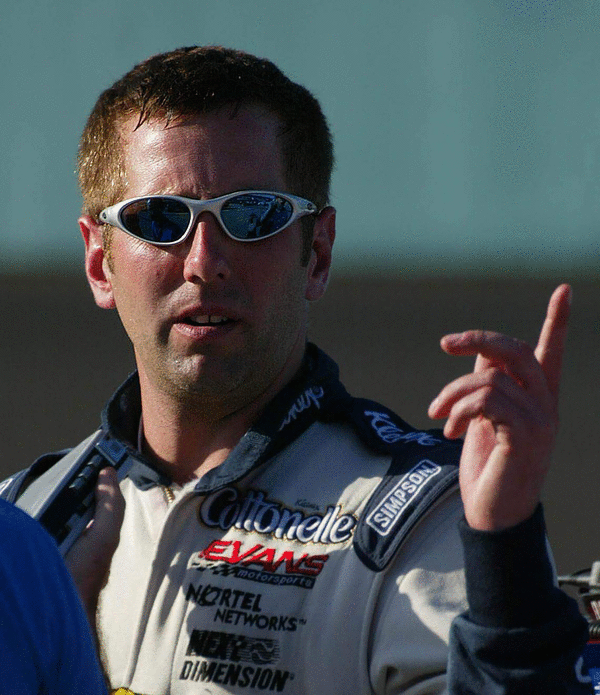
CHARLOTTE, N.C. — Multiple issues, including failure of some instruments and decreasing visibility conditions, occurred in the minutes leading up to the Statesville plane crash that killed seven people in December, including NASCAR star Greg Biffle and his family, a preliminary federal report released Friday said.
The National Transportation Safety Board’s preliminary investigation examined the Cessna Citation 550 crash on Dec. 18 at Statesville Regional Airport. It claimed the lives of Dennis and Jack Dutton, along with Craig Wadsworth, Biffle and Biffle’s family: his wife Cristina, son Ryder and daughter Emma.
The crash sent shockwaves through the tightknit NASCAR community. Biffle, who lived with his family on Lake Norman in Mooresville, won 19 races in the NASCAR Cup series over 16 years. Biffle also had been honored for his community contributions, including flying Hurricane Helene relief supplies to the Western North Carolina mountains.
The NTSB is still investigating the crash. Typically, those investigations take 12 to 18 months to complete. NTSB officials could not be reached Friday afternoon.
The preliminary NTSB report does not indicate the direct cause of the crash.
The report stated that an “airline transport rated pilot” was flying the plane and his “adult son” was co-piloting. Dennis Dutton was an “airline transport” pilot, according to the Federal Aviation Administration. And he was the only person on board with an adult son, Jack. The rear passenger also had a private pilot certificate.
‘... we’re having some issues here’
The aircraft departed for Sarasota, Fla., at approximately 10:06 a.m., the NTSB report stated.
The report mentions an engine gauge issue noticed before takeoff: “During takeoff roll, the rear passenger commented that the left engine was producing more power than the right and indicated there may have been a faulty gauge. The pilot continued the takeoff.”
About five minutes after the plane left the airport, the pilot noted that he was experiencing trouble with the flight instruments at takeoff, specifically the altitude indicator and some of the other left-side flight instruments.
Shortly after, the pilot began to return to the airport.
But on the return, visibility had decreased due to heavy drizzle, according to the NTSB report. Before the flight, visibility levels were at a 10, meaning 10 miles ahead of visibility. As the plane descended, sight decreased to a 5, or half the visibility from before takeoff.
The first identified point of impact was the easternmost light station of the runway approach light system, about 1,380 feet from the runway threshold, the report stated.
Right before the crash, discussions captured on the cockpit voice recorder indicated that the pilot wanted the landing gear to be launched. Communications-wise, it seems the gear was opened, but the gear indicator lights were not illuminated, the NTSB report stated.
About two minutes before the crash, the right-seat passenger transmitted on a common traffic advisory frequency: “we’re having some issues here,” the NTSB stated.
Less than a minute later, “the rear passenger made a query to the pilot regarding power to the ‘alternator,’ ” the report stated, followed soon after by the pilot referring to a ‘problem’ that was not specified. Investigators noted this type of plane, the CE-550, is not equipped with an alternator.
At about 10:15 a.m., the plane crashed before the runway entrance and caught fire.
That post-impact fire consumed a majority of the fuselage and heat damaged both wings and both engines, the NTSB stated. Investigators did not see any evidence of pre-impact separation of any airplane component or structure.
There was no evidence of uncontained engine failure with either engine, the report said.
More details on Biffle crash in NTSB report
The report also noted that the pilot was not flying with a proper co-pilot as required by his license. The person sitting in the co-pilot seat was not qualified to perform second-in-command duties, according to the NTSB report.
Dennis Dutton, who had over 30 years of flight experience, had limitations on his license that required him to have a second in command, according to the FAA.
Jack Dutton became certified to fly single-engine planes just three weeks before his death, according to a LinkedIn entry. It’s unclear whether he was qualified by the FAA to perform second-in-command duties.
The airplane was not equipped with a flight data recorder, nor was it required to be, the report stated.
©2026 The Charlotte Observer. Visit charlotteobserver.com. Distributed by Tribune Content Agency, LLC.





Comments