Trump banks on rallies to turn out MAGA faithful one more time
Published in Political News
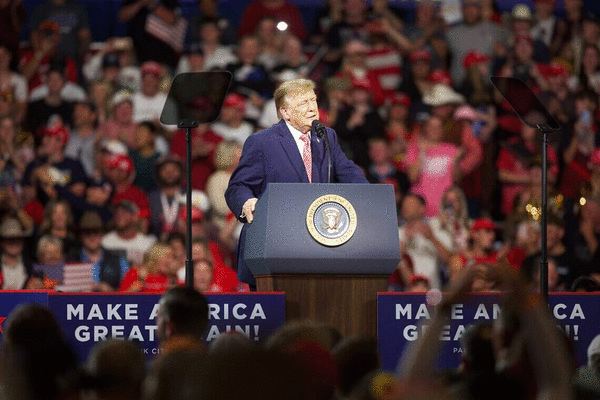
Donald Trump is capping his final electoral campaign the way he began over a decade ago: hoping a whirlwind sprint across the country will turn out his most fervent supporters and thwart Democratic designs to curtail his power in the sunset of his political career.
The 80-year-old president, weary from a nearly month-long blitz through ruby red states, initially called off campaign stops he had planned this weekend in Iowa and Kansas for telerallies instead, before changing his mind and deciding to go forward with them on Sunday.
Most surveys give rival Democrats strong odds of gaining three congressional seats needed to take control of the House, and Democrats are increasingly optimistic that they have multiple routes to the Senate, with seven seats closely locked in the polls.
But Republican insiders, based on private data, describe a Senate map — albeit one in which the GOP is unexpectedly on defense — that’s still largely in toss-up territory or within reach for a win. They envision a path to Senate control that involves holding seats in Maine and Midwestern states such as Iowa, Kansas and Nebraska.
For Republicans, though, it’s unclear whether the president’s rallies are a help or a distraction. The GOP is on its back foot, largely burdened by Trump’s low approval ratings, including broad disappointment over his failure to fulfill campaign pledges to lower the cost of living and to keep the U.S. out of foreign wars.
Moreover, the final leg of his campaign rallies — many at smaller venues than Trump has spoken at over the course of the past decade — have been marked by odd remarks, including musing about male candidates’ physiques, messaging that Democrats have pounced on to bolster their argument that he hasn’t paid adequate attention to the economy.
Republican Senator Jon Husted is in a closely contested race for reelection in Ohio, but much of the attention Trump has bestowed on him has been for his athleticism and figure — in particular his backside. During a rally in Michigan, another state with a razor-thin race, Trump, in an aside, commented on rapper Nicki Minaj’s posterior, saying it was “hard to miss” and “beautiful.”
Trump’s freewheeling style thrills his most loyal supporters, who have long seen it as a sign of political authenticity. But in a campaign in which voters say the economy and health care are extremely important issues, Trump’s off-message remarks risk undercutting his own party.
Trump in speeches does hit on the key points of his party’s economic message: touting tax relief on Social Security benefits and overtime pay, investment pledges to boost manufacturing and other economic goodies. But those are often overshadowed by the president’s attention on other matters.
In Husted’s state, Trump defended an ad from Republican gubernatorial candidate Vivek Ramaswamy that features the estranged mother of Democratic opponent Amy Acton calling her daughter a liar despite worries the backlash over the ad could drag down the rest of the GOP ticket.
Trump won Ohio in all three of his presidential runs, but a Marist Poll in October found only 43% approving of the job he’s doing and 55% disapproving.
A Republican official speaking on condition of anonymity acknowledged that the environment for Republicans is particularly tough due to Trump’s numbers being significantly underwater in many states. The official said that in the closing stretch of the race, Republicans needed to remind voters of what they stand for — policies such as lower taxes.
Even when Trump has sought to address the high costs that are his biggest political vulnerability, though, his messaging has been erratic. He bemoaned the affordability issue as a hoax before later claiming his administration had made progress and blaming his predecessor Joe Biden for high inflation.
Higher pump prices brought on by the Iran war have been a particularly resonant symbol of the economic pain U.S. households are facing. But while Trump has insisted those prices will fall immediately after the midterms, he’s also threatened new strikes on Iran that risk extending the conflict and further disrupting energy supplies.
Trump began holding his signature campaign rallies in 2015 as he waged what was then considered a long-shot presidential bid. The rallies — raucous, unbridled affairs with Trump abandoning then-politically correct rhetoric while courting disaffected blue-collar workers — helped steam him to the White House.
In 2024, he again leaned on rallies to deride Democrats and promise those blue-collar workers that he’d keep the U.S. out of foreign wars, lower gasoline prices and help salve COVID-19-induced inflation.
This year, the attention and headlines for Trump’s rollicking rally speeches, though, have often been centered on his more unusual asides.
Trump in recent days has reignited his feud with former President Barack Obama, who joked that Trump’s gold-gilded renovations of the White House looked like “Saddam Hussein opened a Cheesecake Factory.” And Trump has jabbed at his own supporters, joking that even if they received his promised $5,000 checks for keeping Congress Republican they would at best be able to spring for “a hamburger and maybe a small dessert” at his Mar-a-Lago resort in South Florida.
Democrats, meanwhile, have been trying to expand their targets and be more aggressive in GOP strongholds than in many cycles. Some operatives describe a perfect storm hitting Republicans based on economic pain that is easily traced to Trump policies.
Their House campaign arm made ad buys in the Kansas 2nd Congressional District, where Trump won easily in the past, and in the district represented by Representative Richard Hudson, the head of the GOP House campaign arm.
But even as Democrats are well positioned between the current climate and historical trends, a resounding victory on Tuesday isn’t guaranteed. During the 2022 midterm election, Republicans, who were then the opposition party when Biden was in the White House, underperformed polling and expectations.
Trump’s campaign blitz has taken him to traditional GOP strongholds in a bid to rally conservative supporters. That’s also been an indication of the danger an unpopular president poses to Republicans in swing districts.
Still, as Election Day nears, Republicans are optimistic that in historically conservative areas, voters will show up for the party, according to a longtime GOP strategist, who said Trump’s rallies would help make that happen.
In many ways, Trump is banking on his personal rapport with the MAGA faithful, who helped send him to the White House twice. He’s regularly touted himself as the one Republican who can get voters to the polls.
On Friday, explaining why he agreed to do back-to-back rallies in Iowa and Kansas on Sunday that had initially been scrapped, Trump said it was because they wanted him there.
“They asked me,” he said. “So I’m going to do two on Sunday.”
_____
©2026 Bloomberg L.P. Visit bloomberg.com. Distributed by Tribune Content Agency, LLC.
































Comments