How do the candidates for president of Chicago's school board plan to boost student achievement?
Published in Political News
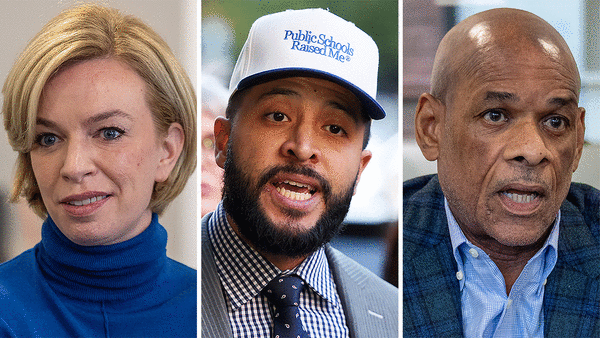
CHICAGO – As the Chicago school board elections creep closer and the city prepares to vote for its first fully-elected school board on Nov. 3, the candidates for president – Hilario Dominguez, Jessica Biggs and Victor Henderson – have been vocal about how best to improve Chicago Public Schools. One issue in particular is student success: for younger kids, it’s boosting math and reading proficiency; for older kids, it’s raising high school graduation rates. The candidates agree that improved academic outcomes should be among the district’s top priorities. However, their paths to achieve those goals diverge.
Henderson, a longtime white-collar civil litigation attorney, is looking outside the district to K-12 education and financial “experts” he proposes bringing in to offer solutions to CPS’s troubles, including its billions of dollars in debt.
For Biggs and Dominguez, however, the solution is to expand learning opportunities at district schools to reach younger students.
Chicago Teachers Union-backed Dominguez has proposed universal, free pre-K for Chicago children starting at age 3, with the district ideally partnering with home providers and daycares to deliver those services.
“I want everyone to be able to say that they went to a fully-funded, fully-resourced school,” Dominguez said earlier this month at an NAACP-hosted candidate forum. Universal pre-K, he said, not only drives up enrollment but also relieves parents of having to “choose between housing or childcare.”
Similarly, Biggs, a current board member and former CPS principal, has said the district needs to focus on supporting its youngest learners in kindergarten through second grade and track how students perform after leaving the district and high school. She also called for the district to invest in birth-to-pre-K programs and prioritize literacy and numeracy from kindergarten through second grade.
“The younger and younger we can go to really support families for stronger outcomes throughout is going to be really important in whatever plan we devise,” Biggs said in a meeting with the Tribune’s Editorial Board last month. “Additionally, I’m focusing on post-secondary success rather than graduation rates as a metric because I want to know what is happening to our 18-year-olds when they leave us? Are we sending kids to college that are not yet ready and prepared in a variety of ways? We need to understand that.”
CPS student outcomes show room for improvement
The district’s graduation rate has steadily ticked up over the past decade, but chronic absenteeism — the percentage of students who miss 10 days or more of school — remains stubbornly high at 40%. The year before the pandemic, that figure stood at 24%.
Academics also show a mixed picture, according to the most recent Illinois State Report Card.
On average, 42% of CPS students were proficient in English Language Arts, including reading comprehension and writing, compared with roughly 52% statewide. Roughly a quarter of CPS students are proficient in math, compared with 38% statewide.
More broadly, CPS fourth-grade reading and math scores have trended downward over the last decade, according to an analysis of the Nation’s Report Card, which measures what U.S. students know and can do in some academic subjects. While those results largely mirror national trends, districtwide averages mask major demographic gaps, with Black students consistently scoring about 17% lower than their peers in math and 19% lower in reading comprehension in 2024.
“It’s a mixed bag here. We talk about the strengths, in eighth-grade reading, we’re ahead of demographically-similar, large peer districts,” said Hal Woods, chief of policy at KidsFirst Chicago, which conducted the analysis. “But we also identified some of the equity challenges.”
Last year, the district launched its Black Student Success Plan, a blueprint to close historic achievement and opportunity gaps for Black students, but delays and a federal probe have slowed its rollout.
The plan emerged from years of stakeholder advocacy to combat disparities in educational outcomes for Black students, according to the CPS website.
Specifically, it looks to close academic gaps, double the number of Black male teachers, reduce out-of-school suspensions and expulsions for Black students, and boost culturally responsive curriculum, including lessons on Black history and culture.
Board members generally shouldn’t meddle with day-to-day school operations; instead, to boost student outcomes, they should pick a handful of goals for student success and use them to set broad district policy, according to Bridget Lee, executive director of the Academy of Local Leadership, a local education advocacy non-profit.
“We should not expect or want board members to go into classrooms and try to teach kids. But I think we can all agree that if the school system is doing its job well, all of our kids are learning, right?” Lee said. “So we can anchor it in a specific set of outcomes.”
For Henderson, that means ensuring all students, including Black students, have math and reading skills that meet not only the Black Student Success Plan benchmarks but also his overall district goals, he said at a recent NAACP forum.
“I would not rely solely on the expertise inside of CPS…because I don’t trust CPS because they haven’t been doing a good job,” Henderson said. “…There’s all this wealth of knowledge of people who are outside of the system who can help move us forward.”
Ensuring post-graduation opportunities for students is key to success for Biggs and Dominguez.
For Biggs, developing new targets to measure post-secondary achievement is crucial.
“We paid lots and lots of attention in Chicago to graduation rates, which is important. But what happens to our young people when they leave us at age 18?” Biggs said at the NAACP forum. “Are…we providing opportunities and pathways into the trades, into City Colleges, and are students persevering and being successful in those places? That’s something our district should be held accountable for.”
For Dominguez, post-graduation success starts with prioritizing improving neighborhood schools. The candidate has leaned into CPS’ existing Sustainable Community Schools model, which joins community organizations and nonprofit voices with school leadership, parents, educators and other community members. Together, they make shared decisions about each school’s curriculum, culture, programming and more. The district currently has 51 schools with the designation.
“If we want to talk about investing in pathways for jobs and in trade opportunities, then it has to start by investing in the schools in our neighborhoods on the south and west sides,” Dominguez said at the NAACP forum.
____
©2026 Chicago Tribune. Visit at chicagotribune.com. Distributed by Tribune Content Agency, LLC.























Comments