Supreme Court recusals in spotlight as Alito drops from oil case
Published in Political News
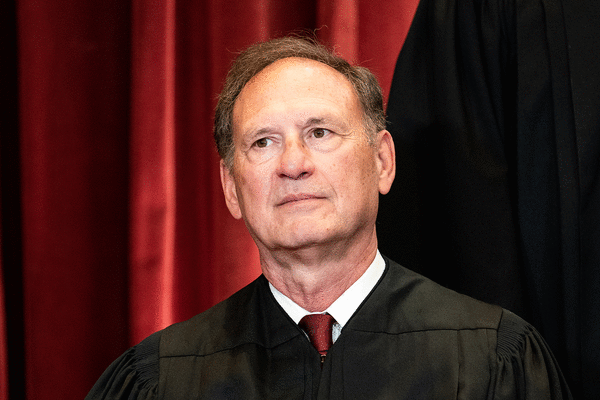
Justice Samuel Alito’s decision not to take part in a major climate change case because of his wife’s stock holdings is putting renewed focus on the U.S. Supreme Court’s recusal practices as it kicks off its new nine-month term.
The justice said in a Sept. 30 interview that Martha-Ann Alito didn’t want to sell the oil-company stocks that led him to step aside in a case testing whether cities and states can sue businesses to recoup costs tied to climate change. His absence from Monday’s argument means the court could divide 4-4, an outcome that would leave the case’s key issues unresolved.
The episode offers a window into the broad discretion the justices often have to decide whether to participate in a case and whether to explain their reasons when they don’t. Alito wasn’t required to step aside in the case, and his decision to discuss the move marked an unusual step at a court that isn’t always so transparent about recusals.
Alito’s disqualification stemmed from a portfolio of more than two dozen individual stocks listed in his most recent financial disclosure report, which covers the couple’s combined assets. Alito says his wife, who inherited at least some of the stocks, made the decision to keep those holdings rather than putting the money into a mutual fund, as other justices have done.
“It’s because that’s what my wife wants to do,” he said as part of a discussion in his chambers about his new book. “It’s a sound rule that the test for a recusal for a financial interest applies to all of the holdings of the justice and the justice’s spouse. But it is not the case today, and it should not be the case today, that a justice can compel the justice’s spouse to do whatever the justice wants. And that’s true of owning stock or anything else.”
Alito is the only current justice with a stake in more than two individual companies. His disclosure form lists more than two dozen stocks, including Boeing Co., Procter & Gamble Co. and DuPont de Nemours Inc. The holdings have caused him to disqualify himself from 153 cases since 2020, primarily when the court was considering whether to take up an appeal, according to data collected by Fix the Court, a group that presses for more Supreme Court transparency.
“It’s kind of ridiculous,” said Gabe Roth, the group’s executive director. “If you’re a justice, you should want to do the job and that should mean the entire job, which means trying to limit your potential exposure when it comes to conflicts.”
Chief Justice John Roberts, who owns Lam Research Corp. and Thermo Fisher Scientific Inc., is the only other sitting justice to own individual stocks. Retired Justice Stephen Breyer also holds stocks, as he did before he stepped down in 2022.
The latest recusal was notable because the Alitos don’t own stock in the two companies involved in the case, Exxon Mobil Corp. and Suncor Energy Inc. The ruling could affect similar lawsuits involving ConocoPhillips and Phillips 66, but only indirectly.
Federal law requires judges to recuse when they have a direct financial interest in a case, as when they own stock in one of the parties, but the rules are less clear-cut when the impact is more attenuated. The court’s 2023 code of conduct says justices should disqualify themselves if their impartiality “might reasonably be questioned.”
Alito said he decided after studying the briefs in the case that recusal was “the prudent step,” even though the court’s legal office had told him at an earlier stage he wasn’t required to step aside. He said the climate case was different from most corporate disputes because the oil companies and their supporters were contending that a loss could lead to devastation for the industry down the road.
“In most instances, a decision of this court, even a very important decision, has zero effect on the price of publicly traded companies,” Alito said. “But in light of arguments being made here, it was my judgment that I should recuse.”
Recusal can be a tricky issue at the Supreme Court. As noted in the code of conduct, a justice who steps aside can’t simply be replaced by another jurist, as can happen at lower courts. The absence of a justice can both create the prospect of a 4-4 divide and make it harder for a litigant to get the required four votes to consider a case in the first place.
“In short, much can be lost when even one justice does not participate in a particular case,” the high court said in the commentary attached to the code of conduct.
The climate change recusal was also unusual because Alito explained his decision in media interviews. Federal law doesn’t require justices to explain their recusal decisions, though in recent years Justices Elena Kagan and Ketanji Brown Jackson have a practice of indicating a reason at least in some cases.
“I wish he would explain every recusal, not just the one that happens to occur the day before his book comes out,” Roth said. “But I think he gets credit for explaining it, and I do think he gets credit for looking at this case and recusing.”
©2026 Bloomberg L.P. Visit bloomberg.com. Distributed by Tribune Content Agency, LLC.



































Comments