Valadao and Villegas clash in Central Valley debate over gas prices, war in Iran
Published in Political News
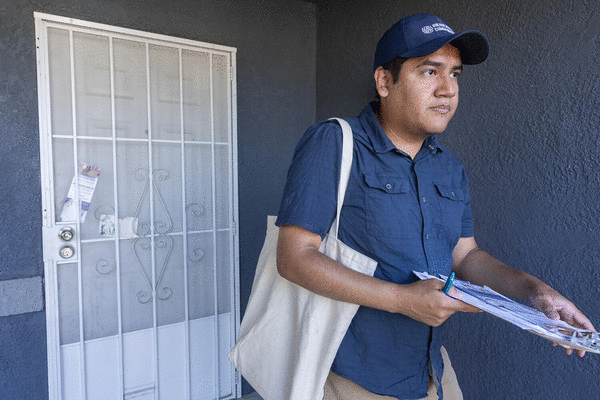
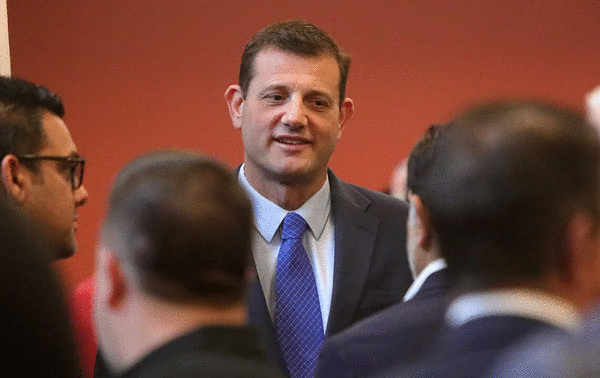


SACRAMENTO, Calif. — In their first and only debate of the campaign Tuesday night, Rep. David Valadao, R-Hanford, and progressive challenger Randy Villegas laid out sharply different strategies for winning over Central Valley voters.
Villegas repeatedly attacked Valadao’s record, calling it a failure for working families while pushing for a new leadership not beholden to corporations. Valadao, meanwhile, cast himself as an experienced policymaker who delivers for the region and dismissed the criticism as the political bickering voters are tired of.
“For far too long, the Central Valley has been left behind by politicians who care more about power than people and who are more interested in catering to corporations and than our communities,” Villegas, 31, said in his final remarks.
“You have someone on this side of the room that is actually trying to deliver for their constituents and not be the combative type of person that we hate to see in Washington,” Valadao, 49, said shortly after in his own closing statements. “We’ve got enough of that crap in Washington D.C.”
The two men made their cases during a candidate forum at the KGET-TV studios in Bakersfield. They are locked in a tight general election battle for California’s 22nd Congressional District, a Central Valley wing seat viewed as crucial to both parties’ efforts to control the House.
Valadao, a Republican from Hanford, has won the seat in six of the last seven elections despite the district’s slight Democratic tilt. Villegas, a populist, is hoping his message of progressive change and growing voter frustration will put an end to that streak.
Tuesday’s forum, moderated by Jim Scott with KGET TV and Nikki Laurenzo of Inside California Politics, was the only scheduled debate for the race and touched on a range of issues including the economy, healthcare, foreign wars and immigration enforcement.
Gas prices and war in Iran
The first questions centered on increased gas prices.
Both men blamed the surge on gas prices on the Iran war and cited support for suspending the federal gas tax. Villegas used the opportunity to note that Valadao had voted multiple times in support of continuing the conflict.
Valadao acknowledged that the “Iran situation” would likely drag past the election, though said it was necessary to prevent the country from having access to a nuclear weapon. He also noted that California’s fuel prices were the highest in the country, even before the conflict, and encouraged more oil production through refineries.
“We all agree this needs to end because no one likes this type of situation,” Valadao said. “But having the world’s largest, state sponsor of terrorism have access to a nuclear weapon is something we cannot allow to happen, and it does make the world safer by preventing it from happening.”
Valadao and Villegas later disagreed on what was needed for the war in Iran to end.
Valadao called for a negotiated settlement that detailed no access to a nuclear weapon and the opening of the Strait of Hormuz.
Villegas concurred on the necessity for “assurances,” but said “there is no evidence to support that Iran is any closer to a nuclear weapon than they previously were.”
“What there is evidence for is the fact that we have record-breaking prices for gasoline, for diesel, and that working families here in the Central Valley are struggling to get to work, to get to school, and to live their lives as a result of the reckless decisions made by my opponent in Congress,” Villegas said.
Immigration policy and increased enforcement
Neither candidate supported providing amnesty or immigration relief to people who had committed a violent crime. They instead called for individuals to be treated on a specific case by case basis.
But Villegas accused Valadao of misconstruing his approach on immigration, citing his House votes to increase federal immigration agencies’ budgets without reforms.
“We have a representative who’s not willing to actually stand up for our immigrant communities and for our farmworkers,” said Villegas, who is the son of Mexican immigrants. “I think it’s shameful. I think it’s disrespectful.”
Valadao called Villegas’ criticism dishonest and said he had reached out to many families across the district affected by immigration enforcement. He later admitted not being fully supportive of enforcement under President Donald Trump’s second term, though said many arrests involved people with criminal records.
More than two-thirds of people currently in immigration detention centers have not been convicted of a crime, according to multiple non-partisan organizations.
“The reality is there are a lot of these folks who are being targeted and picked up because they do have something in their background to justify those types of things. … But it is what it is,” said Valadao, who is the son of Portuguese immigrants. “And if my opponent makes the decision to support allowing criminals to be deported. He would be in support of pretty much every single case that I’ve run across.”
Healthcare and Medicare for all
Many of Villegas’ attacks revolved around Valadao’s deciding vote last year on H.R. 1, a sweeping federal policy bill passed in July 2025 that will cause millions of Americans to lose healthcare coverage.
“When push came to shove, he was the deciding vote on this big B.S. bill that is going to rip away healthcare from Valley families to go give $1.1 trillion in tax cuts to the wealthiest Americans in this country — to the people that are funding David Valadao’s campaign,” Villegas said.
Valadao defended the vote by framing the healthcare provisions in the bill as additional work eligibility requirements. He also pointed to a “$50 billion in rural healthcare transformation fund” in the legislation. It remains unclear how much of that money will be allocated to the district.
“We need people to actually put in and make a fair effort to try to cover their expenses and be a part of their community,” Valadao said. “This is not an unreasonable ask. … There’s a lot more to that bill than just that.”
The debate then shifted to Villegas’ support of Medicare for All, a progressive policy that would provide universal, comprehensive healthcare to all residents. The candidate forum moderators noted that such proposals have failed in Congress at least 15 times since 2003.
Villegas’ response mainly focused on America’s high cost of healthcare and politicians who are beholden to corporations benefiting from these prices.
“So, no answer on how to actually pay for it,” said Valadao, who is against such a proposal.
“We’re going to tax your donors,” Villegas fired back. “That’s how we’re going to do it.”
Marriage and movies
The debate ended on a lighter note with questions about their favorite movies and secrets to their marriage. Both candidates married their high school girlfriends.
Valadao went with the classic comedy Ferris Bueller’s Day Off, while Villegas chose a more modern, acclaimed film: Christopher Nolan’s Inception.
As for their marriages, both men offered similar answers.
“Knowing that you have a happy wife, you have a happy life,” Villegas said.
“Being as nice as I possibly can and giving in every time there’s a request because there’s really no other way,” Valadao said after.
____
©2026 The Sacramento Bee. Visit at sacbee.com. Distributed by Tribune Content Agency, LLC.









Comments