Appropriators seek ways to curb Trump's spending cancellations
Published in Political News
WASHINGTON — Senate appropriators began plotting ways to defend their power of the purse Monday after President Donald Trump announced plans to cancel $810 million in appropriated funding without the approval of Congress.
The so-called pocket rescission to claw back funding, announced Friday night, drew immediate condemnation from appropriators of both parties, who denounced the move as illegal. With the current fiscal year set to end Wednesday, Trump allowed virtually no time for Congress to vote on the rescissions request to block it.
But with no clear solution at hand, Senate GOP appropriators began reviewing their options as they returned to the Capitol Monday night for a few final days before the October recess.
Appropriations Chair Susan Collins, R-Maine, told reporters that lawmakers were “already looking at language” targeting pocket rescissions as part of a fiscal 2027 funding deal. The effort, if successful, would be a notable rebuke to a White House that has repeatedly attempted to find creative ways to exert greater control over spending decisions.
“We do not have a line-item veto available to the president, [and] this is almost the same thing,” said Sen. Mike Rounds, R-S.D., an appropriator. “So, for me, I think it’s wrong, and I think it makes it very difficult for Congress to do their job. … Now we’ll have to find a way to resolve the issues.”
Rounds said the legality of pocket rescissions is yet to be determined, but added he suspects “the courts will have to step in at some point.”
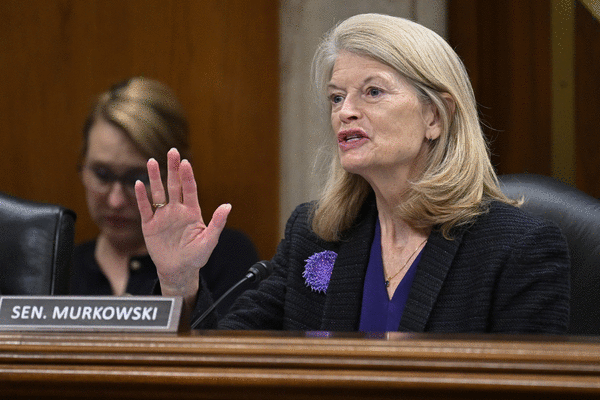
Sen. Lisa Murkowski, R-Alaska, a senior appropriator, said guardrails to rein in pocket rescissions could be explored in annual funding bills. But she added, “I think we need to look at this more broadly in terms of the contours of the Impoundment Act itself.”
The 1974 Impoundment Control Act was designed to set limits on the president’s power to rescind, or cancel, money appropriated by Congress.
Under the normal rescissions process, presidents can formally ask Congress to cancel federal funding, which kicks off a 45-day clock for lawmakers to act on the request. But if that clock runs out after the end of a fiscal year, the withheld funds can lapse without congressional authorization, resulting in a pocket rescission.
Budget experts differ on whether the law permits such rescissions within 45 days of the end of a fiscal year. Last year, the Supreme Court allowed Trump to cancel more than $4 billion in foreign aid through such a rescission, but the brief order did not address the underlying question of whether pocket rescissions are legal.
“Congress needs to save ourselves,” Murkowski said Monday. “I don’t think that our strategy should be just hoping for a good decision out of the court. I think we have a role here, and it’s up to us to exercise it.”
Doubts and dissent
But not all GOP appropriators shared that sentiment. Sen. John Kennedy, R-La., defended the pocket rescission Sunday as a legitimate presidential tool to cut wasteful spending.
“This stuff’s spending porn,” Kennedy said on CBS’s “Face the Nation” program, “Congress ought to get up off its ice-cold, lazy butt and cut it itself. But since we’re not, I’m glad that [White House budget director] Russ Vought’s doing it.”
And despite the new push by Collins for legislative restrictions, some Democrats expressed doubt that Republicans would adopt such measures given their track record.
“We tried to get [rescissions] language in past appropriations bills, and the Republicans blocked it,” said Sen. Patty Murray of Washington, the top Democrat on the Appropriations Committee.
Murray, in a statement soon after the rescissions were announced, called the move “theft from the American people, plain and simple.”
Last week’s request called for canceling about $810 million in funding for health, education and other programs. That includes about $567 million for the Department of Health and Human Service’s Office of Refugee Resettlement programs, along with other health and education initiatives the administration branded as “woke” or wasteful.
Senate Majority Leader John Thune, R-S.D., said he expects the rescission to face litigation, though he declined to say if he supports the administration’s move.
But appetite within the Senate GOP could be growing to rein in the White House as some lawmakers take issue with what they see as overreach.
“That job belongs to Congress, not the executive branch,” Sen. John Curtis, R-Utah, said when asked about the pocket rescission.
David Jordan contributed to this report.
©2026 CQ-Roll Call, Inc., All Rights Reserved. Visit cqrollcall.com. Distributed by Tribune Content Agency, LLC.













































Comments