Supreme Court halts Trump's proposed limits on mail ballots for this year's elections
Published in Political News
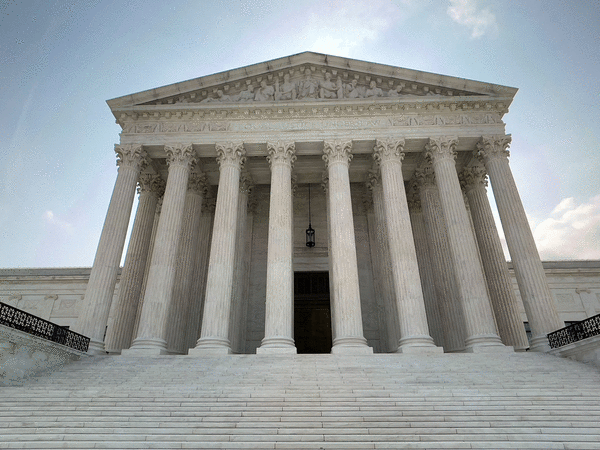
WASHINGTON — The Supreme Court has blocked President Donald Trump’s plan to restrict voting by mail, ruling it is too late to impose new postal service rules for the November election.
The justices on Monday turned down an emergency appeal from Trump’s lawyers, who argued the government needed a new and untested system of unique bar codes to track all the ballots of the tens of millions of people who vote by mail.
Instead, the justices left in place a judge’s order that prevents the U.S. Postal Service from enforcing the new rules for the midterm elections.
Concurring, Justice Brett M. Kavanaugh agreed it was too late to enforce the new rules for this election.
Justices Samuel A. Alito Jr. and Clarence Thomas dissented.
The decision in USPS vs. California is a victory for California Atty. Gen. Rob Bonta and the attorneys general for 22 other Democratic-led states who sued to block the new rules.
Last week, they warned there would be chaos and confusion if Trump’s rules were put in effect now.
Under the proposed rules, state and county election officials across the nation would be required to enroll each voter with a unique bar code and submit this data to a new online portal that, as of last week, was not yet functioning.
Without the individualized bar codes, states could not send ballots through the mail.
In California, that would mean election officials would have to enroll 23 million voters with new bar codes before state ballots could be mailed.
“Compliance with the USPS’ rule would be impossible ahead of the midterms, meaning that millions of voters would be unable to vote by mail and some would not be able to vote at all,” the state attorneys general told the court last week.
The impact would not be limited to Democratic-leaning states. Utah Lt. Gov. Deidre Henderson said it will be “an unmitigated disaster” if the new rules were put into effect now.
About 30% of the nation’s voters — and 80% of Californians — cast ballots by mail in the 2024 elections.
But Trump has maintained that voting by mail leads to cheating and fraud. Election experts say there is no evidence of widespread fraud, despite robust audits and other searches for it.
In March, he issued an executive order that called on the postal service to do more to “enhance election integrity.”
“Unique ballot envelope identifiers, such as bar codes, enable confirmation that only citizens receive and cast ballots,” he said.
State attorneys general argued that the Constitution entrusts states, not federal officials, to conduct elections. While Congress may impose new rules, it is not done to limit voting by mail or to empower the postal service to do so, they said.
Trump and his lawyers maintained the administration had a duty to combat fraud, including in elections.
Solicitor Gen. D. John Sauer described the new rules as “modest measures that will help prevent and restrain potential gross abuses of the mails to perpetrate a fraud on the Nation.”
But U.S. District Judge Indira Talwani, in Boston, ruled the postal service may not put its new regulations into effect for the Nov. 3 election.
The 1st Circuit Court affirmed her order and said administration lawyers “have not even seriously challenged the ... detailed findings about the chaos and widespread disenfranchisement that would occur between now and November 3 should the USPS rule take immediate effect.”
But the courts did not declare the new rules to be illegal or unconstitutional. That means the administration could try to impose new regulations for the 2028 elections.
_____
©2026 Los Angeles Times. Visit at latimes.com. Distributed by Tribune Content Agency, LLC.








































Comments