Trump's embrace of AI data centers adds to GOP's midterm peril
Published in Political News
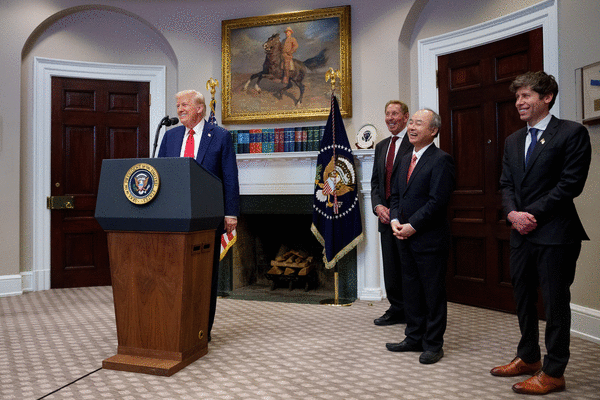
President Donald Trump’s fervent support for artificial intelligence data centers has put him at odds with voters who increasingly oppose them and comes despite direct warnings that his stance threatens to deepen Republicans’ peril in the November midterm elections.
Over the past few months, political strategists have warned administration officials they were in danger of losing the public opinion war over data centers, people familiar with the matter said. Recent polling has shown around seven in 10 Americans don’t want the facilities built near them, and Democratic candidates have sought to outflank their GOP opponents by tying rapid growth in AI infrastructure to voter concerns about the cost of living.
Trump has frequently boasted of American AI prowess and asserted that speedy development of the technology is essential to “beat China.” Yet administration officials were advised that the president needed to focus more on AI’s benefits, including for voters whose jobs might be at risk, said the people, who were granted anonymity to discuss private conversations.
Rather than adjusting his approach, Trump has doubled down, claiming on social media this week that the only reason communities would oppose data centers is if they want to be “backwards and poor” and calling on the public to “let data reign.” On Friday, the president amplified his argument, framing it as a choice for localities.
“If you want to pay lower taxes, if you want to create tremendous wealth, if you want your house to be more valuable and everything else, you’re going to want a data center,” Trump told reporters in the Oval Office. “If you want to go through poverty, crime and squalor, I would say don’t approve data centers.”
Commerce Secretary Howard Lutnick chalked up opposition to “propaganda by our adversaries” and said the benefits to communities are “obvious.” Trump’s former AI czar, David Sacks, asserted that “misinformation” was to blame for the backlash and said “no one is trying to force these data centers down anyone’s throats.”
The dynamic shows how AI’s biggest boosters, including Trump, are confronting an awkward bind: The technology they’ve championed as essential to U.S. economic growth depends on a massive buildout of data centers that has become deeply unpopular in cities and towns facing higher power bills, strained electric grids and hulking new infrastructure.
That’s left proponents with few easy options. Slowing development risks undercutting an industry they’ve cast as essential to the U.S.’s great power competition with China, but admonishing Americans to embrace data centers could deepen the backlash and turn the facilities into an even bigger political liability.
“It’s such a new issue that the politics of it are still developing,” said Republican strategist Alex Conant. “A lot of politicians reflect what their poll numbers tell them and clearly these AI companies can do a better job explaining the benefits of data centers.”
The data-center issue threatens to add to the headwinds Republican candidates are facing, including Trump’s low approval ratings and the fallout from the war in Iran.
In Ohio, Democrat Sherrod Brown has aired television ads blasting Republican Sen. Jon Husted as the “face of data centers” for his past support for tax breaks to build them. Husted and other GOP candidates have tried to thread the needle by supporting the AI buildout while backing requirements to ease its burden on communities in the form of power and water concessions.
Even in Texas, Republicans including Gov. Greg Abbott and Attorney General Ken Paxton have broken with Trump. Abbott imposed a temporary moratorium and Paxton, the party’s Senate nominee, proposed his own plan in recent weeks. The pivot led to charges of flip-flopping by Paxton’s well-funded Democratic opponent, James Talarico.
Mike Rogers, the GOP’s Senate candidate in Michigan, also recently called for a one-year moratorium on data centers in his state, after facing attacks from Democrat Abdul El-Sayed, who has called for new standards for them.
All three states, which Trump won in 2024, are rated as tossups by the Cook Political Report, and the outcomes could determine control of the upper chamber. If Democrats win a majority in Congress, it would stymie the president’s policy agenda and expose him and his administration to new investigations.
Polling indicates Democrats see the issue as a potent one. There has been a 12-point shift against data centers since February and March, with opposition crossing party lines, according to a new national poll from the Annenberg Public Policy Center.
So far this year, there were 15,000 broadcast airings amounting to $7.6 million in spending on ads about data centers, according to analytics firm AdImpact. Democrats made up 73% of estimated spending while Republicans were behind 26% of spending — with Brown as the top spender.
The counsel the White House received starting earlier this year was straightforward: The president won’t prevail by telling people they have to shoulder a data center burden to help the tech industry, according to the people.
Instead, the White House was told Trump should make clear how much the technology promises to make life better, from helping generate bespoke cancer treatments to curing genetic diseases and providing children personalized tutoring. On Friday, the president acknowledged some of the promise offered by artificial intelligence.
“This is a revolution, and and I’ve seen some results that are incredible medically,” he said. “We’re coming up with things medically that we wouldn’t have, maybe in 100 years.”
Trump’s support for unfettered AI development aligns with many Silicon Valley figures who are close to him and his administration. He signed an order last year to expedite permitting and provide financial support for AI infrastructure projects as well as allowing the use of federal land to build new data centers. The president has also convened industry leaders in the Oval Office to tout new data center investments.
The president believes that his administration should not do anything to slow the development of AI and understands that data centers underpin the U.S. economy and are crucial to winning the race against China, according to people familiar with the matter.
Yet some inside the White House have grasped the political risks of data center construction, according to the people. Several officials view data centers as a distinct issue and they’re paying close attention to how they have shaped congressional races, according to the people.
The White House understands that voters care more about whether a data center is erected in their backyard than the economic benefits and cybersecurity concerns surrounding the emerging technology’s rapid advances, one of the people said.
“With this backlash on data centers, I think that it is downstream of the fact that the United States doesn’t build enough power, or at least it didn’t until about 18 months ago. But obviously, that stuff takes a little while to come online,” Vice President JD Vance told reporters on Thursday. “It’s going to come online really fast under the president’s leadership.”
White House officials and the president’s allies contend he’s addressing local backlash by establishing his “Ratepayer Protection Pledge,” a nonbinding agreement with power utilities and data center developers to pay above and beyond normal rates to ensure that development costs are not passed on to households.
But the initiative is voluntary and doesn’t speak to the intense and negative emotions votes are feeling toward data centers, according to Republican pollster Brent Buchanan.
“The part that’s being missed by the White House is that they’re still seeing these arrangements as voluntary instead of strong-arming the data centers into paying the multiple types of costs for people around them,” Buchanan said.
Industry leaders have taken note. Build American AI, an industry-aligned group backed by top AI executives, launched a multimillion-dollar campaign to counter the mounting public pushback in states including Kansas, Ohio and Wisconsin, where data centers have loomed large in statewide elections.
OpenAI Chief Executive Officer Sam Altman on Thursday conceded that developers have failed at communicating the benefits of the new technology.
“The industry has done a terrible job of this on the whole,” he told Bloomberg Television.
———
(With assistance from Nancy Cook and Mia Kraus.)
©2026 Bloomberg L.P. Visit bloomberg.com. Distributed by Tribune Content Agency, LLC.
















































Comments