Online liability shield still a lightning rod after 30 years
Published in Political News
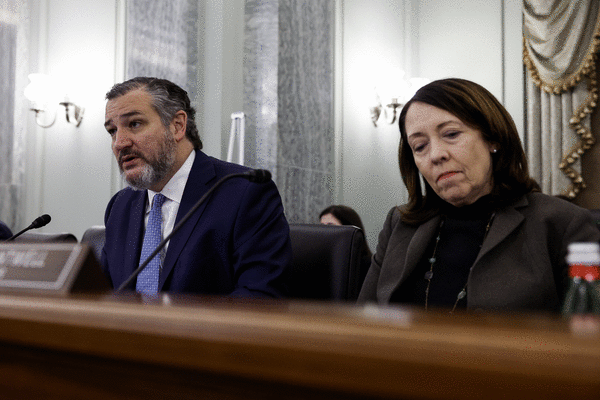
WASHINGTON — Senators on both sides of the aisle criticized liability protections for social media platforms at a Senate Commerce Committee hearing Wednesday, but largely stopped short of supporting a full repeal as sought by some lawmakers.
The hearing, billed as a review of Section 230 of a 1996 communications law 30 years after enactment, saw experts testify that while flawed, the liability shield has offered necessary protections for speech online.
Chair Ted Cruz, R-Texas, reiterated his opposition to repealing the protections, which shield online platforms from being considered the publisher of content posted to their sites, but left the door open to select changes.
“I’m concerned that a full repeal or sunset would lead platforms to engage in worse behavior, to engage in more censorship, to protect themselves from litigation,” Cruz said.
Section 230 also prevents platforms from being held liable for content moderation policies under which they remove obscene, violent, harassing or otherwise objectionable content.
Late last year, Sen. Lindsey Graham, R-S.C., introduced a bill with nine bipartisan co-sponsors that would sunset Section 230 after two years. That bill was referred to the Commerce Committee but has not received a markup.
Committee members Marsha Blackburn, R-Tenn., and Amy Klobuchar, D-Minn., are co-sponsors of Graham’s bill.
On Wednesday, Sen. Brian Schatz, D-Hawaii, called platforms’ treatment of Section 230 as sacrosanct “preposterous.”
“There’s this idea that Section 230 (was) somehow perfectly written 30 years ago, as if it is a constitutional provision, as if it is the only federal statute that must not be touched,” Schatz said.
Schatz urged the committee and Congress to respond to changing online circumstances.
“For so long, tech companies have used Section 230 as an excuse to avoid taking meaningful action to protect users, especially kids, from egregious harm – harassment and abuse, frauds and scams. It’s not that they don’t know it’s happening or even why it’s happening. It’s that to do something about it would be to hurt their bottom line. And so long as federal law provides a shield, why even bother?” Schatz said.
Debate over impacts
Nadine Farid Johnson, policy director for the Knight First Amendment Institute, testified against a repeal, which she said could make problems online worse. She urged stronger privacy protections instead.
“The better approach would be to pass structural regulation that would protect users’ privacy, allow them to engage the platforms on their own terms or leave them more easily, and make the platforms more transparent and accountable to the public,” Farid Johnson said, saying such protections could be made conditions for platforms to receive Section 230 protections.
In a statement released prior to the hearing, Amy Bos, vice president of government affairs for industry group NetChoice, called Section 230 a “critical legal firewall that prevents the weaponization of liability from crushing American innovation and silencing speech online.”
“By ensuring that companies are not held liable for the speech of their users, this foundational law provides the certainty necessary for businesses of all sizes to host diverse viewpoints without the constant threat of predatory litigation,” Bos said.
Government ‘jawboning’
Cruz and Sen. Eric Schmitt, R-Mo., cast Section 230 in the context of what they said was platforms’ censorship of conservative speech at the behest of the Biden administration.
Cruz encouraged support for bills he said would “actively support free speech online.”
Last June he introduced a bill that would require platforms to publicly disclose their acceptable use policies, notify users in writing in advance of suspending or terminating their account, and publish reports on enforcement of the platforms’ acceptable use policy.
He also reiterated his plan to introduce legislation to limit government “jawboning,” or indirect censorship of disfavored speech. He said the eventual bill would “stop government agencies from bullying platforms into silencing the American people.”
Schmitt introduced his own bill last year that would condition Section 230 protections on platforms not censoring political speech as a result of communications with the government.
Sen. Tammy Baldwin, D-Wis., drew a parallel between Republicans’ Biden-era jawboning concerns and Federal Communications Commission Chair Brendan Carr’s record of threatening television stations for their content.
“There’s examples we can draw upon from multiple administrations, including this one. President (Donald) Trump has attempted to rewrite history by forcing museums to remove content. Brendan Carr, the head of the FCC, has threatened broadcasters’ licenses, including very recently, who air unflattering news about this administration and this president,” Baldwin said.
Daphne Keller, director of platform regulation for Stanford Law School’s Program in Law, Science, and Technology, testified that jawboning is connected to monopoly control.
“All of this leads to unprecedented vulnerability of our speech and communication to this type of pressure because, as you pointed out, chairman… all of our speech is very dependent on these big private companies right now,” Keller said.
Section 230 and AI
The hearing also covered how Section 230 might apply in the age of artificial intelligence, including to AI-generated content posted on a platform and to chatbots.
Brad Carson, president of Americans for Responsible Innovation and a former Democratic House lawmaker, advocated for Congress to clarify that AI chatbots are not covered by Section 230’s protections. ARI is a nonprofit group focused on ensuring that technology, including AI, serves the public interest.
Carson said that the protections for social media platforms assume active users producing content and passive websites hosting the information.
“Generative AI systems do not fit that model. The user provides a prompt. The company designs the model, selects the training data, fine tunes the system and deploys it with parameters of its choosing. The resulting output is not third-party content. It is the product of the AI system,” Carson said.
Sen. Shelley Moore Capito, R-W.Va., expressed concern that potential changes to Section 230 or other laws governing the internet could quickly become obsolete.
“I think part of our problem is, if we legislate today in this area, we’re not going to pick up what I learned, day before yesterday, the new thing that’s coming, which is super intelligent AI that’s smarter than anybody in this room and all of us put together. And so we’re going to still have those gaps, I think, that are still going to be able to catch our young people and others into the entrapment to do damaging things to themselves,” Capito said.
Witnesses said that the risk of obsolescence is high, but that existing laws outside of Section 230 could allow for some protections, and that changes to increase transparency and protect researchers would help with governing AI as well as social media.
_____
©2026 CQ-Roll Call, Inc. Visit at rollcall.com. Distributed by Tribune Content Agency, LLC.



























Comments