Commentary: Trump's retirement proposal already failed -- under Obama
Published in Political News
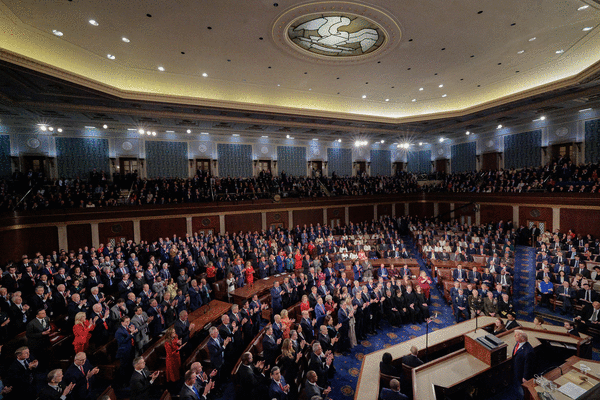
In his State of the Union address, the president announced a new type of government retirement account designed for Americans who don’t have access to one. Whether he can make good on this promise remains to be seen, given the likely need for legislative approval from a deeply divided Congress in an election year.
Donald Trump in 2026? Try Barack Obama in 2014.
Obama’s MyRA program (for My Retirement Account) launched in 2015 and was abruptly ended by the Trump administration in 2017. Political hypocrisy aside, there is a policy implication here: There is great potential for the federal government to help Americans struggling with financial insecurity, and the main obstacle is Congress.
Some history: The Revenue Act of 1978 opened the door for the 401(k). Employers can open a tax-preferred investment account for their employees, automate savings contributions from paychecks, and vet investment options. It’s very successful at building retirement savings. Yet nearly 50 years later, half of US workers do not have access to a retirement plan at work, according to the AARP, and 1 in 5 Americans over 50 have no retirement savings at all.
So it makes sense for the government to fill in the gap. It can create a similar retirement savings account with automatic contributions for workers who do not get one through their employer — taking what works in employer accounts and offering it to everyone.
Here’s where the trouble begins. What is it, exactly, that “works” with 401(k)s? A lot of people would say that it’s exposure to the stock market. Your portfolio doesn’t need to be risky or large, it just needs a long enough period to benefit from the market’s returns. Nor does the government need to create accounts, since any worker can open an IRA and set up an automatic contribution. It’s the people, not the government, who need to do something.
Implicit in this theory is that some people are just “bad at saving.” Maybe it’s not their fault, because they don’t have that much money to begin with, and maybe they need some kind of financial literacy education. But there’s no structural issue in the retirement savings system.
It’s a convenient conclusion, but it’s not quite correct. What “works” about 401(k)s is a more mundane feature: auto-enrollment.
The seminal economics research about employer-defined contribution accounts came to this conclusion in 2001. It found that a large corporation that switched from voluntary to automatic enrollment saw retirement plan participation jump from 37% to 86%. It attributed it to the trait that supersedes almost all others when it comes to savings — inertia. Other aspects, including employer-matching incentives, are a distant second to auto-enrollment.
This and similar research was formative in the design of the Pension Protection Act of 2006, which encouraged auto-enrollment and auto-escalation of contributions, and the Secure 2.0 Act of 2022, which required it (and which Trump’s proposal is based on).
Everyone should have an auto-enrolled, auto-escalating savings account. Around the time of the Pension Protection Act, the Brookings Institution and the Heritage Foundation came together to propose the automatic IRA. Retirement policy makes strange bedfellows. Obama’s 2014 push for the MyRA was similar to today’s Trump Savings Plan; both want to create a federal auto-IRA.
What went wrong with MyRA? Congress needed to approve auto enrollment, and it didn’t. The Treasury Department at the time was able to create MyRA accounts using an existing authority, and the Labor Department gave those accounts its blessing. They were set up as Roth IRAs, had a maximum balance of $15,000, and could only be held in Treasury bonds. The idea was that the accounts would help savers get accustomed to saving in a risk-free investment, and then the accounts would move to a private bank.
Republican Senate Finance Committee members questioned whether the government had the authority to set up MyRA accounts. Treasury spent $70 million to set them up and projected $10 million in annual costs. At the end of its first year, there were $34 million in MyRA assets. That was deemed not worth the costs, and the 30,000 newly open accounts were closed in 2017, to the dismay of advocates who pointed out the foolishness of ending a long-term savings program with less than two years of data on its use.
It stings, too, knowing MyRA would have 10 years of data now. Such is the drama and frustration of flawed policy. The MyRA was ended for political reasons but was nevertheless unsuccessful for the same reason so-called Trump Savings Plans will be: The problem of insufficient retirement savings cannot be solved with accounts that have voluntary enrollment.
The federal government can go through the same song and dance, spending taxpayer money to set up accounts that will create the savings infrastructure that auto-enrollment will need when it comes. And without congressional approval, it will be vulnerable to the same vindictive politics that squashes whatever contributions the other party made at the first chance it gets.
In the meantime, Americans will remain deeply unequal in their paths to retirement. Workers deserve better, especially with a proven solution at hand.
____
This column reflects the personal views of the author and does not necessarily reflect the opinion of the editorial board or Bloomberg LP and its owners.
Kathryn Anne Edwards is a labor economist, independent policy consultant and co-host of the Optimist Economy podcast.
©2026 Bloomberg L.P. Visit bloomberg.com/opinion. Distributed by Tribune Content Agency, LLC.















































Comments