Coast Guard budget boost hangs in limbo amid DHS debate
Published in Political News
WASHINGTON — A proposed 5% raise in Coast Guard discretionary funding in fiscal 2026 hangs in the balance amid a congressional fight over funding for the Department of Homeland Security.
Last week, the House passed the six fiscal 2026 spending bills that cover most federal spending but have yet to become law. These include the Defense and DHS money measures. The House combined the six bills into a single $1.33 trillion package.
Yet Senate Democrats appear united in their opposition to clearing the bills in one piece for the president’s signature with the DHS funds included. Some Republicans may join Democrats in resisting new DHS spending for now. That is because the Jan. 24 killing of Alex Pretti in Minneapolis has hardened many senators’ determination to hold out for policy and funding changes in the DHS bill.
The funding fight may last beyond the Jan. 30 expiration of the current continuing resolution, which is keeping major portions of the federal government operating. If the Jan. 30 deadline passes without a new funding bill for DHS, a CR of as yet undetermined length for that department may be the most the Trump administration can hope for in the near term.
A shutdown remains a possibility for DHS as well as other departments and agencies with spending bills before the Senate this week.
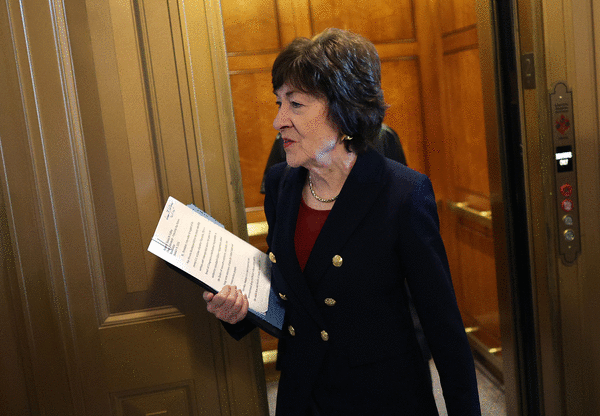
Maine Republican Sen. Susan Collins, who chairs the Appropriations Committee, noted on the Senate floor Monday that 80% of the DHS funding bill is for “non-immigration and non-border security” functions.
“Looming is a government shutdown — another harmful, unnecessary disastrous government shutdown — if we do not complete our work,” Collins said.
Stepped-up operations
A CR would fund most programs at the fiscal 2025 level unless specified otherwise in law. Flat funding would appear to prevent the Coast Guard from advancing on a number of priorities.
The Coast Guard is flush with cash because of the $25 billion it got in last year’s budget reconciliation law. But the additional $12.7 billion in discretionary funds in the Coast Guard’s portion of the fiscal 2026 DHS spending bill is still significant for a military and law enforcement service that is increasingly busy supporting a growing number of missions near U.S. shores, from counter-narcotics operations to maritime interdiction.
The $12.7 billion in proposed fiscal 2026 discretionary Coast Guard appropriations would pay for new cutter and icebreaker ships, plus new helicopters and drones, not to mention higher spending on day-to-day missions.
The Coast Guard has been active in recent weeks in pursuing and seizing control of tanker ships suspected of violating sanctions against transporting oil from Venezuela. In at least one instance, Coast Guard and Navy personnel dropped onto a merchant ship from helicopters.
What’s more, with each of the U.S. military’s lethal strikes on suspected drug-running boats, the Coast Guard deploys search and rescue units to look for survivors of the attacks. At least 36 strikes have been conducted since early September, killing an estimated 125 people whom the Trump administration has dubbed “narco-terrorists.”
The latest strike came on Jan. 23 in the Eastern Pacific Ocean, when the U.S. military blew up a boat carrying three people. One person in the targeted vessel survived, and the Coast Guard was dispatched to find the survivor, according to the U.S. Southern Command.
The fiscal 2026 DHS spending measure would also include $116 million to pay for “increased operations” in the Indo-Pacific region.
©2026 CQ-Roll Call, Inc., All Rights Reserved. Visit cqrollcall.com. Distributed by Tribune Content Agency, LLC.





















































Comments