Trump voter data push prompts privacy concerns
Published in Political News
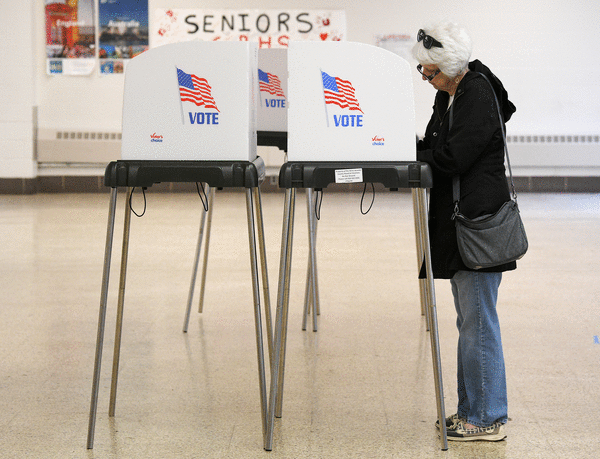
WASHINGTON — The Trump administration has spent months on a campaign to collect nonpublic voter data from nearly every state, facing pushback from states and concerns from privacy advocates.
President Donald Trump and Justice Department officials have cast the effort as a push to clamp down on alleged voting fraud, amid a broader Trump administration effort to collect data about Americans.
Justice Department officials contend that the requests to states, and the lawsuits the government has filed against those who haven’t turned over the voter information, are needed to keep American elections secure.
“Clean voter rolls protect American citizens from voting fraud and abuse, and restore their confidence that their states’ elections are conducted properly, with integrity, and in compliance with the law,” Harmeet Dhillon, the head of the DOJ Civil Rights Division, said when announcing several lawsuits against states.
Frank Torres, a civil rights and technology fellow at the Leadership Conference on Civil and Human Rights, said that “people are alarmed and more ought to be alarmed by this” effort, saying the Justice Department is compiling a “de facto national citizenship database.”
Torres said he and others are concerned that the Trump administration will use the data to attempt to feed into a system like SAVE, administered by the Department of Homeland Security to try to find noncitizens or otherwise ineligible registered voters.
“If anything, we should be making moves to expand to make sure every eligible voter should vote,” Torres said. “The real impetus for this is the opposite, to try and kick people off of the voter rolls, which is the speculation for one of the reasons for this.”
The Justice Department voter records effort started in the summer, when the department sent letters to at least 40 states demanding records about state election administration, including unredacted copies of voter registration records. The letters said they were needed to make sure states complied with the National Voter Registration Act, which requires states to perform voter registration list maintenance.
At least one state has publicly complied with the requests. At a news conference in September, Indiana Secretary of State Diego Morales said the state had complied with the DOJ data request, citing an alleged noncitizen on the state voter rolls.
“We have recently responded by sending all the information they have requested, complying with federal oversight,” Morales told reporters.
Some Democrat-led states publicly refused the request or provided information that the DOJ found insufficient. Rhode Island, for instance, offered a free copy of a voter roll file it normally provides to the public for a $25 fee.
The Justice Department first filed suit against six states in September, including California, Michigan, Minnesota, New York, New Hampshire and Pennsylvania.
The Justice Department added more states in December. The first wave of lawsuits targeted Delaware, Maryland, New Mexico, Rhode Island, Vermont and Washington. A second wave targeted Colorado, Hawaii, Massachusetts and Nevada, all for refusing to provide voter data to the DOJ. And a third wave of lawsuits targeted the District of Columbia, Georgia, Illinois and Wisconsin.
The lawsuits, which were largely similar, alleged that states had refused a legal request under the Civil Rights Act requiring that state officials make records available for “inspection, reproduction, and copying,” to comply with the National Voter Registration Act and Help America Vote Act.
In the Delaware complaint, the DOJ alleged that state officials provided some information but didn’t provide a state voter registration list, which would include private information like driver’s license numbers and a partial Social Security number.
In its effort to dismiss the case, California argued that the Justice Department overstepped by asking for nonpublic information that is protected by both federal and state privacy laws. The state accused the DOJ of engaging in a “fishing expedition” to see whether the state had kept perfectly accurate voting records.
“At bottom, DOJ sued California because it wants the state’s entire unredacted voter registration list in electronic form, using the NVRA as a fig leaf,” the motion to dismiss stated.
The state also raised a free-speech issue, arguing that federal law doesn’t allow the government to collect information on political affiliations like voter registrations.
“No statute authorizes DOJ to maintain Americans’ full, unredacted voter registration records,” the state wrote.
The state argued its motion to dismiss in court in December, the first major legal test for the nationwide DOJ effort.
Several civil rights groups have also sought to intervene in the lawsuits, including in Rhode Island, where the state ACLU and Common Cause stepped in alongside the state government to fight efforts to hand over the state voter data.
Privacy and use concerns
Matt Germer, policy director for governance at the R Street Institute, said the dispute is “really a question of data privacy and federalism” rather than voter registration.
“This isn’t about whether we should maintain accurate voter rolls in this country. We should,” Germer said. “Instead, it is really the question of who has access to this data and whether the U.S. DOJ can compel states to share it.”
Torres and Germer both said that if the DOJ is successful in its effort it would create a high-value target for both criminal hackers and foreign governments.
“If there were to be a breach or misuse, that is a lot of incredibly valuable information and information voters would think is protected,” Germer said.
Torres also pointed out that the data may not be accurate enough to use for flagging ineligible voters. Names, birth dates and other information could be misspelled, duplicated or near-matches. Torres said something as simple as not updating the Social Security Administration on a new address could be enough to flag a false positive in the SAVE system.
“In that case, you could be denied your right to vote. You might have to jump through a lot of hoops to vote,” Torres said.
Germer said the partisan slant of the lawsuits — all the states sued are led by Democrats, except for New Hampshire and Georgia — “starts to feel like little more than a partisan exercise” and “the real merits of the case will be buried in sort of discussions about partisanship.”
Germer pointed out that in the past there were bipartisan efforts to have states work on voter registration maintenance together. Several states founded a voluntary program to help states compare voter data in the 2010s, known as the Electronic Registration Information Center, before several conservative states withdrew amid concerns about partisanship starting in 2022.
Rather than pursue litigation, Germer pointed out that the Trump administration could seek to have Congress update national voter registration laws.
©2026 CQ-Roll Call, Inc., All Rights Reserved. Visit cqrollcall.com. Distributed by Tribune Content Agency, LLC.

















































Comments