NASA reinvests, taps commander for Boeing Starliner's return to crewed flight
Published in Science & Technology News
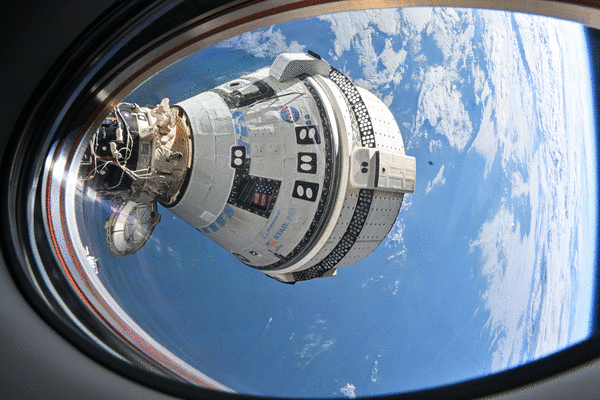
With SpaceX signaling it wants to sunset its crew Dragon spacecraft flights, NASA has reinvested its efforts to bring the beleaguered Boeing Starliner back in line with the agency’s needs to ferry astronauts to the International Space Station.
“Given our extensive history with Starliner and the taxpayer investment already made, we believe it represents the fastest path to preserving reliable crewed access to low-Earth orbit,” NASA Administrator Jared Isaacman announced Monday at a press conference from Kennedy Space Center.
That includes news that Starliner-1, an uncrewed mission to the station, is still on track to fly as early as December, and that Starliner-2 would be the first operational crew flight commanded by NASA astronaut Woody Hoburg.
Hoburg, a member of the 2017 class of astronauts, flew to space once before as part of the Crew-6 mission to the station in 2023.
His flight, though, won’t come until 2028, as issues seen during Starliner’s previous missions have a longer path to fixing before NASA is comfortable flying humans on it again.
SpaceX and Boeing were both awarded commercial crew contracts in 2014, with Boeing getting the larger commitment of $4.2 billion since it was considered the more reliable legacy provider. Each company was to fly both uncrewed and crewed test flights to the space station before beginning regular operational crew flights. The original contracts called for six operational missions each.
But while Elon Musk’s Crew Dragon took the lead returning human spaceflight to Florida in 2020, Boeing’s efforts with Starliner’s kept hitting hurdles that culminated in the maligned Crew Flight Test (CFT) in 2024.
That flight saw helium leaks and thruster issues flying NASA astronauts Butch Wilmore and Suni Williams to the space station. Those issues led to NASA later classifying the mission with its most severe designation, a Type A mishap, calling it “nearly catastrophic.”
The incident led the agency to decide to keep the two astronauts safe on the station and fly Starliner home without crew. The duo ended up flying home on a SpaceX Crew Dragon nearly 10 months after they arrived, as opposed to the original plan of staying on board for as little as eight days.
“We have taken responsibility for NASA’s contributions to the program’s challenges, including our handling of the post-mishap investigative process,” Isaacman said. “At NASA, we took ownership of the matter and delivered extreme transparency and corrective actions, as outlined in the (Program Investigation Team) PIT report, and Boeing responded as we would have expected from a longstanding agency partner.”
NASA stated it’s investing an additional $359 million to deal with corrective issues since the Crew Flight Test as well as assisting in certifying United Launch Alliance’s Vulcan rocket to be able to fly Starliner. There is only a limited number of Atlas V rockets left, on which Starliner currently get its rides to space.
Boeing’s potential contract, which earlier this year had been dialed back from the original six missions to only three contracted crewed flights, now has been given the possibility of flying a fourth and fifth rotational crew flight again before the end of the space station’s operational lifespan some time after 2030.
Meanwhile, SpaceX recently was awarded three more missions to fly up through Crew-17, meaning at least five more launches of Dragon are in store.
Crew-13 is up next, targeting liftoff from Cape Canaveral Space Force Station’s Space Launch Complex 40 as early as Thursday morning.
For Boeing, some of the fixes are in place, but others are still in the works.
“The teams have made substantial progress in that regard. Corrective actions have been assigned across the PIT recommendations, with the work divided between what is required for an uncrewed Starliner-1 mission and what must be completed before it carries our astronauts once again on Starliner-2,” Isaacman said.
From Hoburg’s perspective, he said the moves made by both NASA and Boeing have reinstalled faith in the spacecraft, which has some benefits compared to SpaceX’s Dragon.
“There’s a lot that’s right with this vehicle. I’ve flown a lot of types of aircraft, and let me tell you, Starliner is a pilot’s spacecraft,” he said. “Starliner gives the crew real capabilities to respond to off-nominal events.”
During Wilmore and Williams’ CFT flight, they took manual control, for instance, as thrusters were failing, and thus avoided catastrophe.
He’s looking forward to seeing how the fixes already in place perform on Starliner-1.
“Starliner-1 is going to be a key step forward in that development effort to get back to crewed flight,” Hoburg said. “Flight is, of course, the ultimate validation test.”
That includes validating the new seals to avoid hydrogen leaks and looking at how some thermal remediation efforts work to deal with the thruster failures. It will also adjust how the thrusters fire in an effort to have them not overheat.
“We will see anomalies. Every single human spaceflight mission, and even cargo mission, experiences anomalies. What I’m looking for is flattening in the learning curve, hopefully moving from major anomalies to more minor ones. And I’m expecting that every flight in space will make us better, and Starliner-1 will be no exception,” he said.
_____
©2026 Orlando Sentinel. Visit at orlandosentinel.com. Distributed by Tribune Content Agency, LLC.






Comments