'No-brainer': St. Cloud, Florida's new drone program joins nationwide trend as city, population grows
Published in Science & Technology News
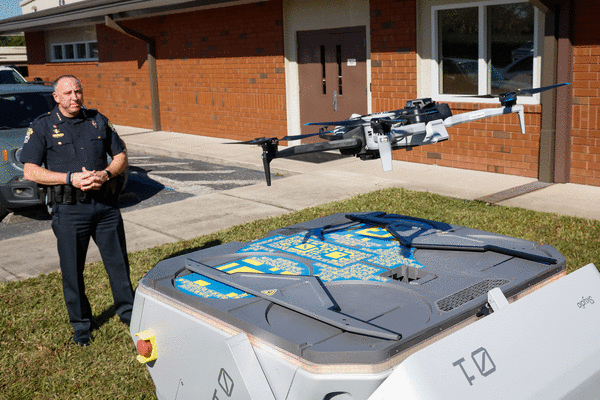
ORLANDO, Fla. — When a mental health call came in to St. Cloud police last fall of a man digging into the street with a fixed-blade knife, officers weren’t the only ones to respond.
A drone, deployed and piloted from the real-time intelligence center inside police headquarters, beat the units to the scene and watched as the man put the knife in his pocket, information immediately relayed to the officers as they pulled up.
The man was ordered to remove the knife and drop it on the grass — and he complied. Often during calls like these, little is known about what officers can expect once they show up, forcing split-second decisions fraught with risk. But the drone clarified the threat of a lethal weapon, which police Chief Douglas Goerke said might have saved that man’s life.
“I don’t want to hurt anybody in the field, but I certainly want to go home to my family,” Goerke said. “That’s the goal of this, to really get ahead of what’s happening and remove as many surprises as possible.”
The drone, part of St. Cloud’s “drone-as-first-responder” initiative, or DFR, is the first of its kind for Central Florida, allowing for quick, remotely-accessed deployment serving as eyes in the sky. The department began testing the new technology in September, focusing on training and piloting the program before it was officially launched in November.
With its plethora of possible uses from emergency reconnaissance to searching for people reported missing, the technology is seen as a promising part of the future of public safety in the region.
“The DFR program is a no-brainer for me,” Goerke said. “It’s not cheap technology, but if we can save one life, I think that’s well worth it. If we can use that to locate somebody, it pays for the system all day long.”
How it works
Earlier this month, reporters were invited to observe a demonstration of how DFR functions and the ways it can be used in tandem with traditional emergency responses. Drones are not new to police work, but they have more typically been used to assist officers’ response, not independently or in advance. Even then, they often required a two-person team to pilot them, one with hands on the controls and another with eyes on the drone’s movements.
These drones, situated in strategic areas of the city and controlled using a couple monitors and an Xbox controller, can travel two miles on a single charge, fly 35 to 40 mph and use artificial intelligence to get to their destination while avoiding obstructions in their flight paths.
During a recent demonstration, pilot Marcus Dodd monitored the drone’s flight path on his screens, toggling the camera from telephoto to thermal imaging while keeping an eye on its speed, its altitude and wind gusts — all without a second pair of eyes. Its video feeds can also be streamed to responding officers’ cellphones and in-car monitors as they head to a scene.
A second drone, located on the City Hall rooftop nearly three miles away, can also be activated, covering areas the aircraft at police headquarters can’t reach.
Putting the DFR program in place carried an $890,000 price tag spread over five years, with two more drones are yet to be deployed. The program, already with nearly 200 drone deployments since its launch, is expected to further expand as the city booms in size and population.
“St. Cloud is going to continue to grow, and as we grow into these neighborhoods, that will clearly be part of our annexation strategy,” Goerke said.
From California to Florida
Although drones have been used by public safety agencies for more than a decade, DFR akin to St. Cloud’s program is a relatively recent phenomenon.
Pioneered by the Chula Vista Police Department in southern California, it’s a way to help agencies spread their reach and their dollars further at a time they struggle to recruit and retain officers.
It also promises to reduce emergency response times, since the drones can more directly travel to scenes while officers navigate the streets. Every year since 2019, the first full year of of CVPD’s DFR program, drones shaved between 36% and 44% off average response times to “priority 1” calls compared to officers traveling to the same incident, according to the agency’s publicly available dashboard, updated daily.
Disturbances, “person down” calls and domestic violence reports make up more than half of Chula Vista’s DFR deployments since its inception, with nearly one in five of them not requiring a patrol unit to follow up, according to CVPD’s online dashboard. But it does not explain why the calls were abandoned once drones have been dispatched.
Unanswered questions
Putting DFR in place, like any new policing methods, is not without concerns. That includes how the drones are used, civil rights questions, and discussions about the proper guardrails to prevent abuse and stay secure from cyberthreats.
St. Cloud’s policy restricts drone use to gathering evidence in specific circumstances, including reasonable suspicion of imminent danger, to prevent a suspect’s escape, to capture the destruction of evidence and to assist in other missions like traffic accidents or missing persons cases.
“Looking in the privacy of someone’s backyard is not the intent of this,” Goerke said.
The agency, like others with DFR programs, also publishes the drone’s flight data to its website showing when it was dispatched, where it went and what it responded to. But there is little in Florida law codifying what exists in policy, which can differ from agency to agency.
Meanwhile, technologies used by law enforcement are expanding quicker than can be assessed by lawmakers, jurists and researchers, said Thaddeus Johnson, a senior fellow for the Council on Criminal Justice.
“We are playing catch-up on pretty much every technology that’s out there … but all of these technologies are changing over time,” he said. “What they don’t have integrated now, they could very easily do it in the future and not really tell anybody. That makes it harder.”
A spokesperson for Skydio, the tech firm where St. Cloud purchased the hardware to create its DFR program, did not respond to multiple requests for an interview.
Goerke, excited by the prospects of the technology, invites ongoing community input on the program.
“There’s concerns, but I have thick skin,” he said. “Come tell me. I’ll go have coffee with anybody, anywhere, any time.”
---------
©2025 Orlando Sentinel. Visit at orlandosentinel.com. Distributed by Tribune Content Agency, LLC.






Comments