
Ask the Builder: Planning an expensive vanity top
I’ve shared in past columns how I’m helping my son finish off about 1,200 square feet of his basement. I’m saving him more than $100,000 in labor and profit costs he would have had to pay a contractor.
I’m also confident he and I are doing a much better job. After all, I’m investing time, my skills, and a wheelbarrow full of love into the project!
We can only work on Saturdays. I’ve worked alone on some Fridays when I can do things myself, such as finishing drywall, running electrical cables, installing plumbing pipes, and applying paint to walls and woodwork. The project has been underway for just about two years. The end is but a month away.
The only things left to do are install the speakeasy bar cabinets, the bathroom vanity, and all of the countertops. The bathroom countertop required a considerable amount of thought and planning. My son has decided on a vessel sink with an offset faucet.
Vessel sinks come in different sizes. I asked him to use his current vanity sink bowls as a guide. These sinks are oval-shaped. I wanted him to determine if his hands felt cramped in the sink while he washed them.
That experiment produced fast and simple results. He told me in a text that a 16-inch-diameter vessel sink would be perfect. Furthermore, he said that a 6-inch depth would suffice. He was able to locate one of that exact size that he loved.
I then asked him to start looking at vessel-sink faucets. The faucet needs to have a long spout so the flow of water is toward the center of the sink. You don’t want your hands banging against the side of the sink as you wash them. This might happen if the spout is too short.
I reminded my son about the wonderful vessel sink I made for the basement bathroom in our last house in Cincinnati. I found a wonderful old copper bowl with a rich patina. My wife loved it. I punched a hole in the center of the bottom to accommodate the sink drain.
The faucet was ideal. It looked like it was made from bamboo stalks. The water shot out of the end of the spout much like a miniature waterfall. In this case, the spout could be a bit smaller because the water cascaded out about 3 inches beyond the end of the spout.
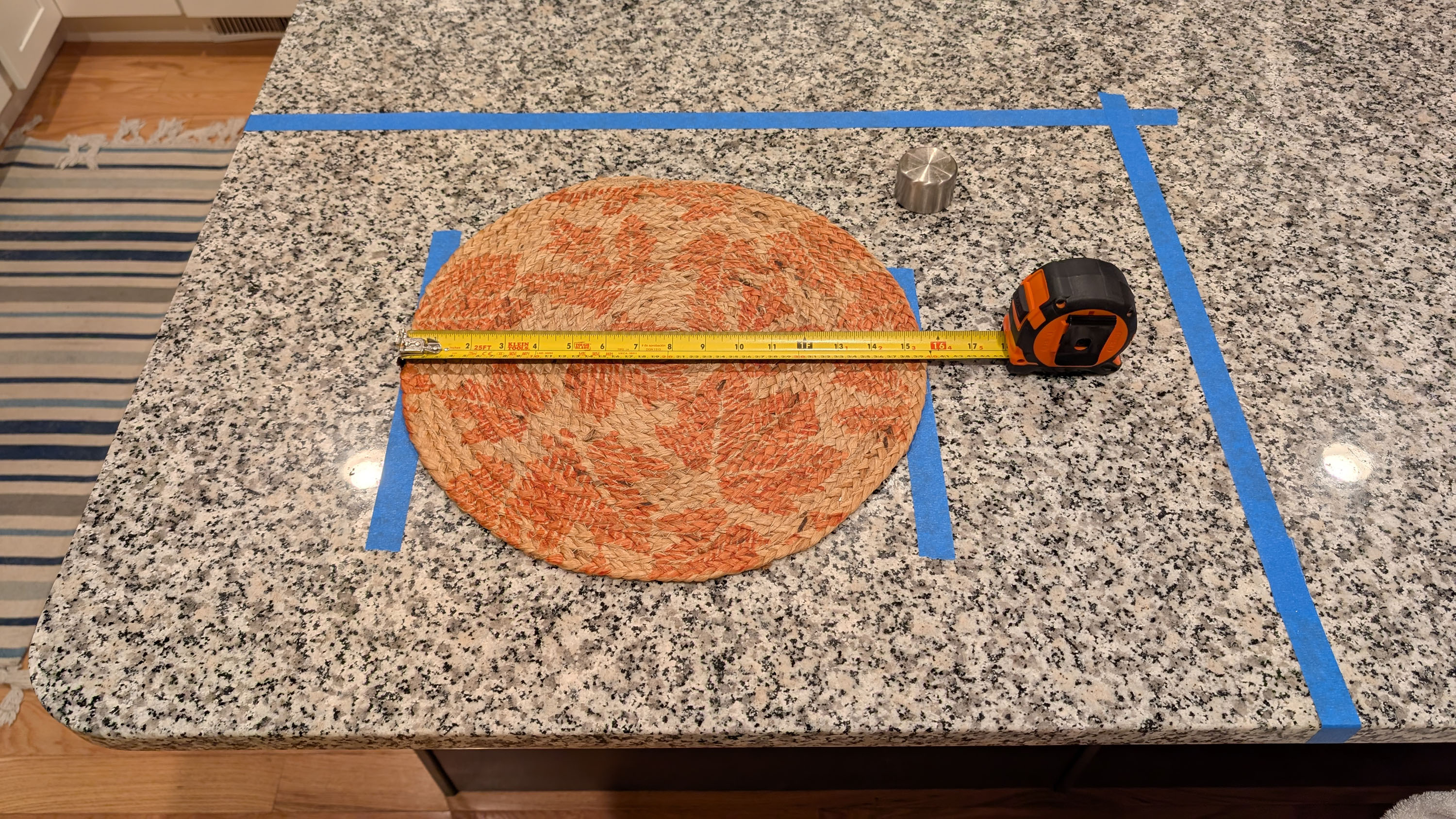
Next up, I told my son to take some painter’s tape and create an outline of his stone vanity top. He created a rectangle on his island countertop using the tape. The outline was 31 inches wide and 22 inches deep. This produced a 1-inch overhang on the front and left side of the vanity cabinet.
He was lucky to have a 16-inch-diameter placemat. That was used as a prop for the sink. I had him make sure the front edge of the placemat was the same distance from the front of his existing vanity top to the front of his existing vanity sink.
This showed he had plenty of room behind the placemat for both a stone backsplash and the faucet. Some faucets are too big, or the handle interferes with the wall behind the sink. This is why you often see the faucet offset to the right or left of centerline of the vessel sink.
My son decided to offset his faucet so there would be no conflict, and it would be much easier to operate the faucet handle.
You also need to be aware of the height of the faucet spout above the countertop. The spout must be able to pass over the vessel sink with at least an inch of clearance. My recommendation is to purchase the vessel sink and know exactly how high it is off the countertop. Don’t hope the measurement given on a website is correct.
He’s decided to use a clever pop-down sink drain. This adds to the sleek design since you don’t have a clumsy pull rod at the faucet that operates a hidden lever inside the cabinet. Pop-down drains, in my opinion, are superior to the pop-up drains. They are available in a multitude of finishes and are very easy to install and maintain.
My guess is you never thought so much planning goes into a simple bathroom sink! The issue is that the stone top, the vessel sink, and the faucet all add up to an eye-opening amount. You can’t hope it all works out. You must take the time to do what I just outlined above.
Subscribe to Tim’s FREE newsletter at AsktheBuilder.com. Tim offers phone coaching calls if you get stuck during a DIY job. Go here: go.askthebuilder.com/coaching
©2026 Tim Carter. Distributed by Tribune Content Agency, LLC.



























Comments