Jeff Ament talks new photo book, Pearl Jam's drummer situation
Published in Entertainment News
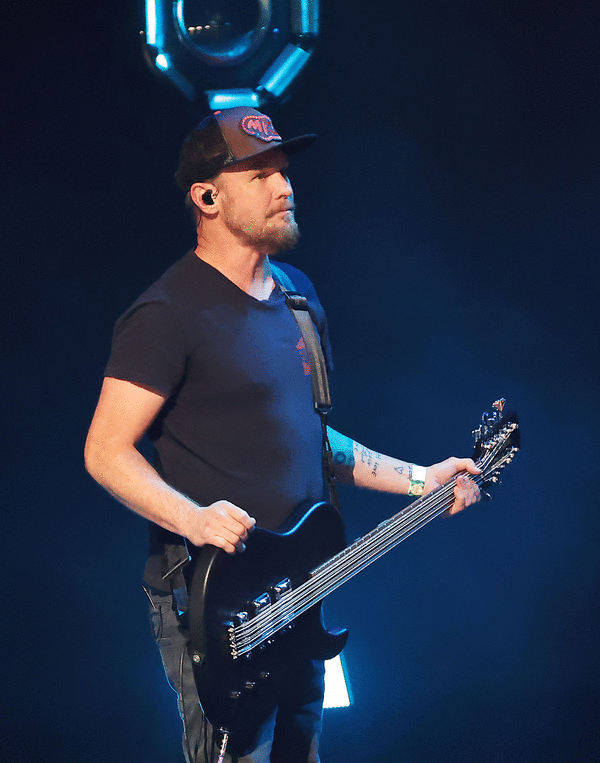
SEATTLE — Jeff Ament isn’t big on nostalgia. The Pearl Jam bassist was “adamantly against” doing the band’s 2011 documentary “Pearl Jam Twenty,” marking the group’s 20th anniversary, even if he was ultimately happy with the result.
“By nature, especially in music and the arts, people are nostalgic for the time when things were hitting big for us here, because there was a unique thing going on in Seattle,” Ament says. “I kept thinking that we still hadn’t made our best record and I didn’t want to be distracted by looking back.”
The Grammy-winning art director does, however, enjoy a good art project.
This fall, Ament published his new photo book, “Since Forever” — a “visual journal” composed of more than 250 black-and-white photographs Ament took during Pearl Jam’s early days. Sure, there are plenty of behind-the-scenes glimpses at signature points in the band’s fabled ’90s years, from the Temple of the Dog sessions to playing Moe’s Mo’ Roc’n Café (now Neumos) with Neil Young. It isn’t simply a highlight reel of the seminal Seattle band’s already well-documented rise.
“Since Forever” pulses with the moments in between the rock ‘n’ roll circus when the cameras aren’t usually rolling and the relationships forged along the ride are both tested and strengthened. The images are woven together with flickering memories and written commentary from Ament, reflecting on the road traveled from the burrito breaks at Mama’s Mexican Kitchen the week Eddie Vedder first came up to Seattle to the White House invitations.
Turns out, looking backward ain’t always so bad.
“There’s a real gift in going back to your life and just feeling so grateful for the whole trip and for all the friends,” Ament said. “The gratitude was the part that I wasn’t expecting that really came out and changed the bits of writing that I did in the book.”
To some extent, Ament was on the clock. Roughly five years ago, Ament went digging through his archives hunting for a specific photo. Searching through the boxes of negatives and contact sheets he’d kept in the basement for 30 years, Ament realized some were starting to degrade.
While he hadn’t looked at them in years, the trove of photographs from Pearl Jam’s transcendent ’90s period seemed worth preserving, and Ament’s brother, Barry — a partner in local graphic design firm Ames Bros — offered to digitize them. “I don’t think he realized how much work that was going to be,” Jeff says.
A year into the undertaking, Barry encouraged his brother to compile the photos for a book. He sent Jeff a batch of 100 or so photographs that became a starting point for the project. “Half of them I didn’t even remember taking,” Jeff says. “The cool thing for me, it was a way to remember things that we did that I totally forgot about.”
It was also intense. Whenever Jeff was in town for a week, the brothers spent 10-12 hours a day poring through old photos. It was like reliving “three years of your life in 10 hours.”
“I would leave those days with a pretty massive headache … because it was emotional,” Jeff says. “You’re reliving a lot of really amazing times, but you’re also reliving tough times, whether it was personally or tough times within the band. … That part of it let me know that the book was real.”
Besides the heavy lifting of digitizing everything, having Barry’s designer eye and outside perspective as a fan of Pearl Jam was invaluable as they crafted the book’s arc, Jeff says. It’s certainly not the first time the Ament boys have teamed up.
Barry effectively served as Pearl Jam’s in-house graphic designer throughout much of the ’90s, and the brothers won a Grammy together for their design and packaging work on a 2020 box set compilation for the late Chris Cornell. (Barry and his Ames Bros partner Coby Schultz were previously nominated for their work on Pearl Jam’s “Yield” packaging.)
After a talk last week at Town Hall, the Ament brothers held a Q&A and book signing at Easy Street Records on Monday moderated by acclaimed Seattle photographer Lance Mercer.
We caught up with Jeff to discuss “Since Forever,” gigging with his punk band, P.E.S.T. — which plays the Tractor Tavern with Dead Pioneers on Dec. 12 — and Pearl Jam’s plans to fill their drummer position. This conversation has been edited for length and clarity.
Q: As you had your camera out in the moment, did you have an idea of what you were taking the pictures for? Were you intentionally trying to document this stuff as you were living it?
A: No. I mean, I was taking pictures mostly for content. There were so many times we’d be on the road and we get a call, like, “Hey man, there’s a single coming out in two weeks and we got to have artwork.”
That happened to us maybe the second time we went to Europe. They said, “Hey, we’ve decided ‘Even Flow’ is going to be the next single. We need artwork in two weeks.” So, I remember Ed and I walked around Italy for a day and took photos and talked about what we wanted the artwork to look like.
And then the other part of it was finding out how much photographers were charging the record label, which essentially was us, to come out and take (promo) photos. A lot of times it’d be like $8,000 to $10,000 for a photo shoot, and I just thought that was insane. So, a lot of it was just your punk rock, DIY sensibilities are kicking in.
Q: As you were selecting photos, was there anything you wanted the book to convey about that period of the band? Any themes that you found yourself gravitating toward as you’re trying to tell the story?
A: Initially, you just gravitate towards the photos that have an underlying story for me. Then we started picking out photos that we thought just looked great. And then you start thinking about the book having sort of dynamics where it’s not just all photos of the band. Literally half the photos are like landscape photos, if I took a trip in between tours, like I did a lot in those days.
My brother being in the mix of that was super important. He’s a great graphic artist and has a great eye. And he also was a fan of the band, so it was important that he fight for certain photos, like, “Oh, that photo’s got to be in there. That’s the only photo from the Atlanta sessions.”
Q: You have a background in design and visual art. What do you enjoy about photography as a medium, versus music, painting, whatever else?
A: I took a couple of photography classes in college before I was in the band. Just learning a little bit about composition, shadows and trying to find the right angle or right composition for the photo. The more you take photos, the more you start to push the envelope, become more of an artist.
It helped me look at real photographers’ work in a different way and it sort of gave me a love for the way that great photographers can capture the moment — the split second that the energy peaks.
Q: You just got off the road with P.E.S.T. What’s it like for you to step away from Pearl Jam, where it’s obviously a much bigger machine and production, and do this club tour where you’re blasting out two-minute punk songs in sweaty rock clubs?
A: It was great. The tour was hard. It was six shows in six days. You’re driving 300 to 400 miles a day in between the shows. But I really love that there’s just no fuss. When Pearl Jam comes out, it’s such a big show. There has to be a lot of people that are doing their jobs to make the show great. And with this, there’s no crew. We’re doing all the driving, we’re loading the gear. Dave (Parsons), our singer (for P.E.S.T.), was selling the T-shirts. It makes you appreciate everybody who works in the big band. But that’s the cloth I’m cut from, so I sort of like doing the work.
Q: Last month, Pearl Jam played Eddie Vedder’s Ohana Festival, the first shows since Matt Cameron’s departure. What was it like having Abe Laboriel Jr. behind the kit for those shows?
A: Whenever you’re playing with anybody new — and it doesn’t matter if it’s in Pearl Jam, a side project or whatever — you’ve got to enter into that open-minded and with excitement. Like, “Oh, this is going to be different. We’re going to embrace how different it is.” That’s what those shows were like. We rehearsed quite a bit, and we worked pretty hard on it. There were two songs that we ended up playing that we didn’t rehearse, which is classic Pearl Jam.
Mostly, it’s just embracing the newness and the tension and all the stuff that you sometimes take for granted when you’ve been in a band with — like Matt, who we’ve been in the band with for 28 years or whatever. He was just rock solid, and we’ve been doing it for a long period of time, so you weren’t anxious about any of that stuff.
Then Abe’s so excited to be there with us and we were so excited to have him that I just had a blast. Some of it is like approaching some of the songs a little bit differently, with Abe’s feel. That part’s cool.
Q: Is he a full-time member of the band moving forward? Or was he just holding it down for the weekend?
A: We’re still having those conversations. He’s playing with Paul (McCartney) and so that’s part of the deal. We haven’t really talked about what we’re doing next other than we’re going to try to make a record at some point. We’ll probably have some conversations the first part of the year and try to figure out what we’re doing next year, because I know we want to play some shows. So, we’ll see what the gods give us.
Q: The “Montana Grind” documentary about your nonprofit Montana Pool Service, which builds skate parks in rural communities, came out this year. How did skateboarding and the subculture around it shape you growing up?
A: Skateboarding was massive for me. I grew up in a really small conservative town in north-central Montana. So, we were doing the mainstream stuff — playing baseball and basketball, there was a swimming pool in town and a bowling alley. When I was 12 or 13, we went to California and my cousin skateboarded and gave me a skateboard magazine. My cousin took me around, out to the beach and gave me a slice of California. I became obsessed with it through skateboard magazines and rock magazines like Creem and Rock Scene. I would send away for other magazines or small records if you saw a review for a record in a skateboard magazine. That’s how I bought the first Black Flag single.
It hit me. I think we’re up to like 45 skate parks. We get to meet kids in these towns and you see them struggling with isolation. They’re a little bit more connected because some of them have smartphones or computers, so they see what’s going on in the rest of the world more than I did at (that) age.
They’re trying to form themselves, too. So, you put a skatepark in a place where the only thing they’re doing is playing football and basketball, and it gives a kid that might want to do something different, be something different (an option). And skateboarding has always been a gateway activity to the arts. Most of the skaters I know are artists or musicians, photographers or woodworkers or whatever.
©2026 The Seattle Times. Visit seattletimes.com. Distributed by Tribune Content Agency, LLC.







Comments