Elizabeth Holmes' partner, Billy Evans, wanted flattering Harry and Meghan-style documentary for her
Published in Entertainment News
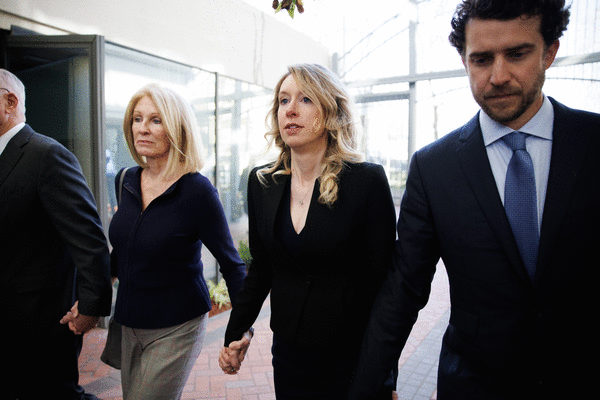
SAN JOSE, Calif. — It’s not spoiling the new film, “You Can See Everything,” to say that its subjects, Elizabeth Holmes and her partner, Billy Evans, eagerly invited Nathan Fielder and his film crew into their home to record them trying to spend some intimate, quality time together before she had to report to federal prison to serve an 11-year sentence.
The Theranos founder and Evans said they would offer “full transparency” in order to correct what they still view as the common false narrative about her — that she’s an alluring, sociopathic “monster” who lied to investors and the American public about the safety and efficacy of the blood-testing technology she developed at her Palo Alto startup.
It’s also probably not too much of a spoiler to say that the resulting three-hour film shows Evans, a hotel heir and wannabe hot-shot entrepreneur, trying to increasingly control access to him, Holmes and their family during filming.
But in another of its many critical moments, the film portrays a scene in which Evans is in a meeting with Fielder, co-director Lance Oppenheim and A24 studio producers and demands creative input in the film and a financial stake in it.
As Evans explains, he believes this movie could take inspiration from another buzzy project about a celebrity couple who generate global headlines and controversy — the 2022 Netflix “docuseries” about Prince Harry and Meghan Markle.
Evans points out that Harry and Meghan reportedly got quite a payday for starring in “Harry & Meghan,” which was billed as a news-feature-style documentary about their acrimonious departure from British royal life. The series was a massive streaming hit for Netflix.
“I heard they got $100 million,” Evans proclaims in the meeting.
The scene shows Fielder and Oppenheim trying to contain expressions of incredulity during these moments. Oppenheim is quick to dismiss Harry and Meghan’s Netflix series as worthy of consideration. “That’s not a real documentary,” he says.
Harry, Meghan and Netflix might beg to differ and say their series was rigorously researched and reported and told the truth about their difficult experience with the royal family. Or, maybe, they could say it told a version of the truth — “your truth,” as Oprah Winfrey famously said to Meghan during their 2021 interview.
In Oppenheim’s scene with Evans, the experienced and acclaimed filmmaker is not trying to engage in a philosophical discussion about post-truth world views — even if the film itself ends up contemplating these ideas as it transcends the usual documentary conventions.
With Evans, Oppenheim appears to refer to other debates within the documentary genre about whether celebrity-driven projects qualify as genuine journalistic exercises, especially if those celebrities have creative input, final approval or financially benefit from them.
Critics of recent, so-called documentary projects about Melania Trump, Taylor Swift, Beyoncé or Michael Jordan say these works function more as exercises in brand management, image control or even propaganda, especially if the subject, like the first lady, is a political figure.
As for Harry and Meghan’s Netflix series, it came under fire for what critics said was a very flattering, uncritical view of the couple, who spent six years in California before recently moving back to the United Kingdom.
The series didn’t do much to examine or challenge some of the misleading or incendiary things they had said over the years about their experiences with the royal family, including allegations of mistreatment and racist comments. The Sun and other U.K. outlets also found at least one instance of the series using footage of a pack of photographers at a Harry Potter film screening to stand in for an intrusive encounter with the U.K. media that Harry and Meghan said they regularly faced Britain.
During the meeting with Evans, Oppenheim and Fielder also voiced concerns that the integrity of their project would be compromised if he and Holmes were paid for appearing in it, as Harry and Meghan were for the Netflix project.
Fielder mentioned “the optics” would be bad if it became known that such a deal was made. Indeed, news organizations that want to be seen as credible have policies that bar them from paying profile subjects or sources for interviews.
In the end, “You Can See Everything” reveals that A24 producers had a different idea about compensating the couple, which didn’t make Fielder or Oppenheim happy. Following the film’s premiere, the co-directors said that communications with Evans eventually broke down after Holmes went to prison in May 2023.
Holmes being in prison made it difficult to maintain regular contact with her, while Evans “started trying to exert a level of control over the process that made it very hard to engage with him,” Fielder said at a screening of the film in Los Angeles earlier this month. He said the situation became “uncomfortable for us and also (film studio) A24 and everyone.”
But early in the process, Fielder and a film crew move into a guesthouse on the San Diego beachfront property where Holmes, Evans and their two young children stayed in the month before she reported to prison.
The year before, a federal jury in San Jose found the Stanford dropout and one-time Silicon Valley wunderkind guilty of three counts of wire fraud and one count of conspiracy for bilking investors in her startup company out of hundreds of millions of dollars.
The film shows intense, close-up scenes of Fielder pushing Holmes to explain why she doesn’t believe she committed any crimes or asking how he can trust anything she says. At one point, he asks her whether she’s ever lied to anyone.
“I’ve never tried to deceive anyone,” Holmes says. Fielder counters, asking Holmes to confirm that she’s “never lied” in her life, or even told a white lie.
Holmes replies: “I don’t think so.”
Fielder immediately responds: “Liz, what?”
“I’ve always tried to say what I believe,” Holmes says.
As for Evans declaring that Harry and Meghan made a $100 million for their Netflix series, that figure does not appear to be accurate and is probably inflated, according to reports over the years.
While neither Netflix nor Harry and Meghan have ever officially confirmed how much the couple was paid to sign a five-year production deal with the streamer in 2020, reports say the amount could have been as high as $100 million. But this figure could have been lower and it likely would have covered all their various projects, some of which didn’t get made or were far less successful than “Harry and Meghan,” including Meghan’s “With Love, Meghan” lifestyle show and Harry’s movie about elite polo players.
©2026 MediaNews Group, Inc. Visit at mercurynews.com. Distributed by Tribune Content Agency, LLC.








Comments