Column: A K-pop newbie went to TWICE, and here are a few thoughts
Published in Entertainment News
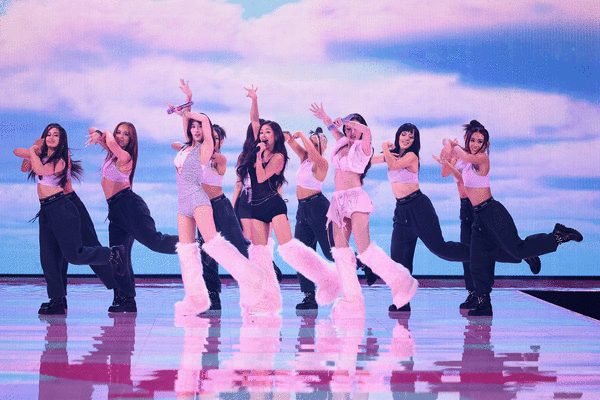
CHICAGO — If you’re like me, you’re K-pop curious. You know what K-pop is and you’ve heard some K-pop but you’re still uncertain if you like K-pop because you’re old and haven’t cared about the Top 40 since that time you taped Men at Work off the radio, and besides, you think The Replacements needs to be in the Rock & Roll Hall of Fame right frickin’ now. I got you, boo. I went to see the K-pop sensation TWICE on Monday night at the United Center and here are a few thoughts:
The woman seated in front of me, wearing a pink cowboy hat, turned to her friend (also wearing a pink cowboy hat) and groaned: “I feel so old at this concert. I remember (TWICE) when they first came out.” Meaning, way back in the stone age of 2015, when TWICE was crafted in the kiln of a South Korean TV competition show called “Sixteen.”
The South Korean music genre, and particularly TWICE — historically the bestselling female K-pop act — have perfected a sort of post-music concert music, a live show in which the performance is cheerful and danceable and several singers are charming. Also, there’s music, which sounds a lot like other music.
The audience provides what’s missing at a post-music concert. For instance, by a conservative eyeball estimate, I figured at least half of the sold-out arena carried CandyBongs, the official light stick of TWICE. They resemble handheld personal fans and sell for about $80. They blink on simultaneously and throb to the music. They change colors in sync and the colors are soothing and whenever energy lags, the image of thousands of personal lights dancing in tandem suggests a party. I asked the woman in the cowboy hat if she was being hypnotized by her CandyBong.
“Lil’ bit,” she replied.
More interesting to me than the official Bluetooth-ready CandyBongs were the many off-brand CandyBongs — the cheap giant light-up diamonds, the Disney-On-Ice wands, etc. — that left their own constellations of more distinctive colors across the United Center.
Roughly 90 million K-pop albums were sold last year. If creative inspirations, or just spiritual cousins, received royalties, Carly Rae Jepsen would be richer than Taylor Swift. TWICE, frankly, sounds a lot like the perpetually under-appreciated Jepsen. The artists of TWICE are unpretentious, pleasant, harmless — they sound like every Tuesday in Target — and are prone to unexpected bursts of infectious energy. Their first 20 minutes at the United Center on Monday were as delightfully rampaging as any pop show I can recall. Even a routine dance cut like “The Feels” became pure uncut 1977-era disco.
The highlight of TWICE at the United Center — and there were a few in the two-hour show, which had 29 songs and 8 million backup dancers — was the centerpiece, a showcase during which every member of TWICE sang a solo. That meant seven solo numbers. Typically, TWICE would be nine singers but Dahyun was on the DL with a troubled ankle and Chaeyoung is having back problems. What was fascinating was how nakedly it was about the ambitions of each member of TWICE, only one or two of whom clearly have solo careers coming.
Before the show, my favorite TWICE member — that is, in the language of K-pop, my bias — was Momo, who shows a slight bit of attitude. But Monday, she was muted. So my new bias — my bias wrecker, as K-pop kids say — is Jihyo, who is in perpetual motion, and whose voice is big and soulful, and who seems to be performing in the animated and imagined group that she wants to be in, not the group she is currently in.
The more K-pop fans I talked to, the more I was told — enthusiastically, without disappointment — that many K-pop singers sing along to obvious backing tracks. Unlike other pop singers, the K-pop variety just makes less effort to hide it. It’s the K-pop way. Also, I was told, when there are nine people in a group, they won’t all be winners. They won’t all dance all the time. Some may look bored. Some kind of stand there. A group like TWICE clearly goes for precision over style or spontaneity.
One of my biggest surprises happened during a transition, when the singers changed outfits. We get to watch the band for a few minutes. This is a surprise because, by the midway point of the show, I had assumed there was no band. In fact, they are hidden in the dark, in a nook of the gargantuan stage. For a fleeting moment, they get a showcase, and they sound intense, borderline prog rock, and definitely live.
Nine members seems like too many. On the other hand, Wu-Tang Clan had nine.
When TWICE wants to talk to the fans, they use a translator, who is offstage and enthusiastic. The thing is, when she talks, when each member of TWICE takes a turn introducing themselves and saying how happy they are, the rest of TWICE glazes over.
One of the more startling things about TWICE is the way its members habitually sing directly into the cameras, locking eyes with the lens, for the benefit of video screens, more often than not. To be fair, TWICE also walks the edge of their stage incessantly, taking in their fans, smiling, pointing, shrugging, miming emotions. They curl their fingers into hearts and toss them into the crowd. They wave. They mouth compliments. They do eye contact.
They call their fans ONCE.
———
(Christopher Borrelli is a features wrtier for the Chicago Tribune.)
———
©2026 Chicago Tribune. Visit at chicagotribune.com. Distributed by Tribune Content Agency, LLC.









Comments