Q&A: Steve Vai, a new San Diego County resident, reflects on music, Frank Zappa and more
Published in Entertainment News
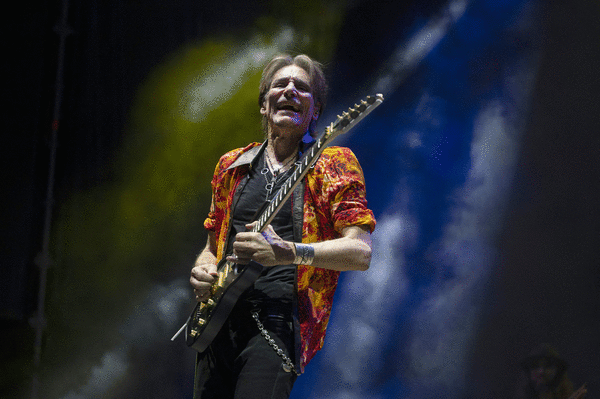
SAN DIEGO — Steve Vai was just 21 when he made his San Diego concert debut in 1981 at the Fox Theater as the “stunt guitarist” in the band of former Grossmont and Mission Bay high schools student Frank Zappa. At the time, Vai lived down the street from Zappa in the Laurel Canyon neighborhood of Los Angeles.
Now, after being an L.A. resident for more than 40 years, Vai and his wife, Pia, have officially become San Diegans. As of February, they are now residents of Rancho Santa Fe, the same tony North County community where Janet Jackson and Jewel both used to live. For more than a decade prior to moving to Rancho Santa Fe, the Vais spent up to six weeks a year vacationing at the Rancho Valencia Resort.
“We loved it so much that we started looking for property down there about seven years ago,” said Vai, who performs Wednesday at SDSU’s Cal Coast Open Air Theater with fellow guitar star Joe Satriani and their SATCHVAI Band.
“Right before our European concert tour with Joe last year, a house came on the market in Rancho Santa Fe and we got it. We just moved in about a month ago and it’s so quiet, peaceful, and the people are so nice. I’m 65 years old now and I don’t want to grow old in (Los Angeles). My wife and I raised our family there and it had an energy and vibe that was perfect at the time. But now it’s time for something safer, cleaner and friendlier.”
Vai spoke from Los Angeles, where he and Satriani were rehearsing with their band. The interview has been edited for length and clarity.
Q: Now that you are a San Diego resident, I’m curious if you have you had any opportunity to go out and hear music here, be it the San Diego Symphony, or a jazz show, or anything else?
A: No. I mean, we’ve been going down to San Diego for 13 years and that’s not what we end up doing. We go to dinners and movies, and clubs at times. But we haven’t really seen anything down there yet.
Q: You were 17 when you began working for Frank Zappa transcribing his music. Then, you became the “stunt guitarist” in his band. What are the biggest lessons you learned from Frank?
A: We could write a book! Frank was an explosion of freedom and he had this uncanny ability to recognize the potential of particularly inspired musicians. And then he would put you in a place where you had the opportunity to explore that potential. Because Frank was looking for people, musicians, that had some kind of extraordinary, maybe quirky, abilities. Then, he would use those abilities as a color in his palette. That’s why all of his records sound so different. But it was Frank that was able to recognize those abilities in you, even more than you did, and pull them out of you.
I had this very keen interest in high-information music and technical playing on the guitar. So I was pretty well-suited for all these wild melodies that Frank would write that he didn’t give any guitar players in his band before me, because I was more interested in spending time playing impossible stuff. So, he would feed me all these crazy lines that he would write on piano, which had no place on the guitar, but are so beautiful. And so, I was — I believe — the first one to do that with Frank.
Q: When people buy tickets for a SATCHVAI Band concert, what do you want to give them in return?
A: Joe and I play a particular kind of rock instrumental music, and it’s a celebration of the guitar in that genre. And you’ve got two guys that have lived in that genre their whole lives. So, when you are watching us play together, you get the expected: Nice songs, great energy, great guitar melodies, integrated playing, and us playing arrangements together. But the one thing you’re not going to get anywhere else is when Steve and Joe are hunkering down and exchanging riffs in a very intimate dimension. Because what comes out is usually inspired and it’s engaging, and you’ve got two guys that are at the top of their respective games. So, for people who love that kind of celebration, it’s really great.
Q: What’s the format for your tour with Joe and this band?
A: It’s quite diverse and the optics are engaging, because it’s always moving. So, in the past, Joe and I have toured with two bands — excuse me, his band and my band. And I would do a set, then he would do a set. But we just started thinking: “You know what? We should have some new music. That would be really nice, because we’re going to be out there on tour together.” And then that turned into: “Why don’t we make a record together? And also, now’s the right time to create one band.”
So it works great, because we come out on stage and when you’re playing composed music with somebody, the guitar parts are integrated. You know, you’re playing harmonies, melodies together, some crazy solo things. It’s really nice because you’ve got these two guitar players in sync. Whereas conventionally, you’d go to one of our shows and we’d get together at the end and just jam and trade solos, which is nice, and we do a lot of that. But with this band, we come out, we play together for about three songs, and then Joe leaves the stage and I do a couple of my songs. Then, he comes back out, and we do a track together, and then he plays a couple of his songs, and we go back and forth like that for a while. And it’s really nice because the fans get to hear these songs played in beautiful harmony.
Q: You last performed in San Diego in 2024 with BEAT, the King Crimson tribute band that teams you and (Tool drummer) Danny Carey with Crimson alums Adrian Belew and Tony Levin. Given what a very distinct and idiosyncratic guitar style (Crimson founder) Robert Fripp has — which you salute and then add your own personality to in concert — directly or indirectly, does that now affect what you do on this tour with Joe? Or are they two completely different things?
A: Well, anything you do is going to somehow change the landscape forever, even if it’s very subtle. If you’re a cook and, all of a sudden, you’re working alongside a Michelin chef and you’re just watching him, when you go to cook on your own, you’re going to be influenced. So, someone like myself absorbing all of those Robert Fripp, guitar parts, it would be impossible that it wouldn’t affect me.
Q: Can you give an example of how that might manifest?
A: Absolutely. On King Crimson’s three ’80s records — “Discipline,” “Beat” “Three of a Perfect Pair” — there’s a technique that Robert and Adrian employ that we call interlocking guitar parts. But what it is is the merging of two time signatures; it’s polymetric. Adrian will play a line in 7/8, and Robert will play the same line, minus one note, in 6/8.
So, you get this amazing kind of turnaround and these harmonies and things that just don’t repeat themselves until the whole line comes around. And this is the brilliant compositional technique that those guys used extensively throughout those three records. So, when Joe and I are standing on stage and we’re entering that very kind of intimate space of listening and responding, a lot of times we go into little rhythmic things, like Joe will play a little motif. And whereas in the past, I might have immediately recognized it and copied it, in harmony, and then you got this wonderful little harmony line going on. But now, instead of playing six notes, create this similar kind of a revolving pattern. So, there’s one example.
Q: We first spoke in 1985 and I’d like to read you a quote from that interview. You said: “There are a lot of different approaches I have to playing the guitar. One is to sing the melody as I play it. Another is to look at the neck of the guitar in a technical manner, so that you know what any given skill will look like. Then, there’s another approach, which is almost like praying or meditating without wanting to sound too occult. You try to clear your mind of all thoughts when you play and let your fingers and the guitar take over.”
I’m curious, 41 years later, how similar or different is your approach?
A: It’s exactly the same, because different situations require you to pull from different brain muscles. So, if I’m playing a written part that’s repeated every night, it’s more automatic. You’ve practiced it and it happens. Looking at a neck and imagining the scales and seeing the notes that work on the neck is more of an intellectual exercise.
But the more mediative approach is where all the good stuff really comes from in anybody, when they do it. And you can see when people are doing it, when their mind is open and they’re connected. They’re just connected to the flow of melodic dictation that’s emanating from their own uniquely creative impulses, and when that happens, what comes through a person is fresh and new and engaging — to the right audience. And that’s the most powerful approach.
Q: How does this play out with you and Joe?
A: When I’m playing with Joe, there are times where neck recognition is necessary, you know, where you’re being a little more intellectual. But in those intimate moments of sharing, you have to be present… so your full attention is in listening and responding. There’s no thinking; you’re not thinking. There’s no room for thoughts of the past, which can happen quite a lot.
These are obstacles. Examples of that might be, as you’re playing, you’re wondering what people are thinking about you, or you’re thinking about a bad note that you played previously. You’re in the past. You’re not present, or you’re thinking about what’s for dinner and you’re just not there. So the state of presence locks you in, because there’s no room for thinking, only instant recognition.
And it’s a slippery slope in that it’s a very delicate state of mind to be present. Because the mind is always interrupting with nonsensical thoughts that are completely meaningless, most of the time, and a lot of times negative. These are the obstacles. But there’s an impulse that resides in everybody that, when they enter their creative mind, you always feel that there’s more you can do and you’re always interested in developing more and more.
Q: When I first interviewed Joe in 1996, I did him some quick Q&As and think it would be fun to ask you some of the same ones. What was your first musical epiphany?
A: I was 4 or 5 years old, and I walked up to my aunt’s piano, which you were never supposed to touch, and I hit a note. I noticed that, to the right, the notes go higher and to the left they go lower. And I had a full-on epiphany. For some reason, I just understood the infrastructure of music.
Q: What was your most recent musical epiphany?
A: Recently, I heard some microtonal music that somebody sent me and it really inspired me. It gave me a sort of an inner vision of a composition using microtonal instruments. I could hear it in my head, and it sounds extraordinary, but it’s a heavy lift to manifest it.
Q: Complete the following sentence: In the right hands, a guitar can be …
A: Very healing.
Q: In the wrong hands, a guitar can be …
A: Chaotic.
Q: In your hands the guitar can be …
A: Chaotically healing!
©2026 The San Diego Union-Tribune. Visit sandiegouniontribune.com. Distributed by Tribune Content Agency, LLC.






Comments