Miami judge tosses Trump's $10 billion lawsuit over Epstein birthday letter
Published in News & Features
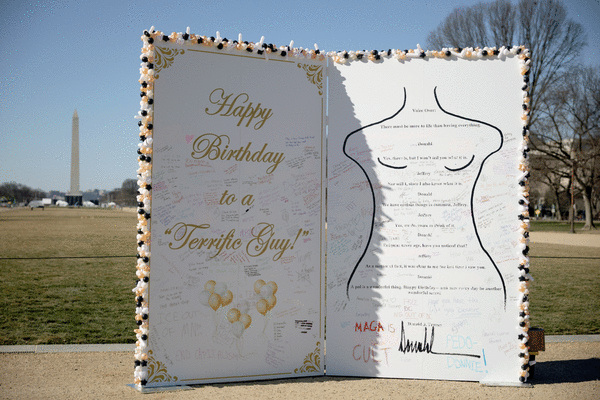
MIAMI — A federal judge in Miami threw out President Donald Trump’s $10 billion defamation lawsuit against The Wall Street Journal and Rupert Murdoch, saying the president was “grasping at straws” in challenging the newspaper’s reporting on a sexually suggestive birthday letter bearing his name sent to Jeffrey Epstein.
U.S. District Judge Darrin P. Gayles on Saturday dismissed the amended complaint with prejudice, ending Trump’s opportunity to revise his allegations in the case. The president can appeal.
The lawsuit centered on a July 2025 article describing a sexually suggestive birthday letter bearing his name in an album assembled for convicted sex offender Jeffrey Epstein.
Gayles did not decide whether Trump wrote or signed the letter, or whether the article was true or defamatory. He ruled that the allegations failed to meet the constitutional standard a public figure must satisfy for a defamation lawsuit to proceed.
“This Order addresses President Donald J. Trump’s second attempt to plead that Defendants ... acted with actual malice,” Gayles wrote. “As with his first attempt, he has failed.”
Trump’s legal team indicated it would continue fighting. A spokesperson told CBS News that the president would “continue to press forward in his lawsuit against The Wall Street Journal and all of the other defendants.” CBS also reported, citing a source familiar with the strategy, that an appeal was likely.
The defendants include Dow Jones, the Journal’s publisher; parent company News Corp.; Murdoch; News Corp. Chief Executive Robert Thomson; and reporters Khadeeja Safdar and Joseph Palazzolo.
Trump filed the lawsuit July 18, 2025, a day after the Journal published its story online. Gayles dismissed the original complaint in April but allowed him to amend it. Trump filed the revised complaint in May, again denying that he wrote, drew, signed or authorized the letter.
The Journal reported that the letter contained a typewritten imaginary conversation between Trump and Epstein, framed by the outline of a naked woman, with the signature “Donald” below the waist. It ended with a birthday wish that every day bring another “wonderful secret.”
According to the reporting, Ghislaine Maxwell collected contributions for an album marking Epstein’s 50th birthday in 2003, before his first arrest in 2006.
Trump alleged that the story falsely portrayed him as the letter’s author and linked him to Epstein’s crimes. His amended complaint accused the reporters of failing to authenticate the signature, explain the document’s origin or establish how the typewritten text could be attributed to him.
“This case is about that fake letter and the singular issue of whether President Trump was its author, not whether some piece of paper exists,” his lawyers wrote in opposing dismissal.
They argued that the dispute over authorship could not be resolved without allowing the case to proceed. The defendants, they said, were asking the judge to accept their version of contested facts rather than evaluate Trump’s allegations under the rules governing a motion to dismiss.
Gayles agreed that authorship could not be decided at that stage. But a disputed statement alone was not enough to sustain the lawsuit: Trump also needed to plausibly allege actual malice.
The standard, rooted in the Supreme Court’s landmark 1964 decision in New York Times Co. v. Sullivan, concerns whether a publisher knew a statement was false or seriously doubted its truth. It requires more than allegations of inadequate reporting or departures from journalistic standards.
Gayles emphasized that the protection applies before discovery, when litigation itself can impose substantial costs on publishers. Citing appellate precedent, he explained that forcing news organizations to defend insufficiently pleaded cases through expensive evidence gathering could chill speech almost as effectively as eliminating the actual-malice requirement.
Trump’s allegations, the judge found, were vague, conclusory and sometimes contradicted by the article itself.
A central argument was that the Journal published despite repeated denials from Trump, his lawyers and then-White House press secretary Karoline Leavitt. Trump also alleged that Murdoch told him, “I will handle it,” before publication, which he understood to mean the story would not run.
Gayles said those denials did not require the newspaper to abandon its reporting. Otherwise, any public figure could prevent publication of unfavorable information simply by declaring it false. The article also included Trump’s denials repeatedly, giving readers information with which to evaluate the account.
The judge rejected claims that the reporters had failed to investigate. He pointed to their requests for comment from Trump and his team, Justice Department officials, the FBI, Maxwell and others connected to the album.
The Justice Department did not respond, and the FBI declined to comment. Maxwell did not respond to an interview request; her attorney said she was focused on her Supreme Court case. The reporters also contacted Leslie Wexner, Alan Dershowitz and people involved in binding the birthday book.
“Grasping at straws, the Amended Complaint attempts to manufacture flaws with the investigation,” Gayles wrote.
He found no meaningful distinction, for purposes of alleging actual malice, between reviewing the letter and possessing a copy. The law did not require the reporters to obtain, retain or publish the document.
Trump’s reliance on Maxwell’s later statement that she did not remember him submitting a letter also failed. Her Justice Department interview took place after publication, Gayles noted, and her lack of recollection did not establish that the reporters knowingly published falsehoods or seriously doubted their account.
A separate dispute concerned documents released by a House committee in September 2025 after it subpoenaed Epstein’s estate. The production included a birthday album containing a page matching the Journal’s description, according to the ruling.
The defendants argued that the release established the accuracy of their reporting. They also maintained that the article described a letter bearing Trump’s name without claiming he personally drew or signed it.
Gayles declined to treat the album and letter as established evidence of truth because Trump disputed their authenticity. He likewise declined to determine whether the statements were defamatory.
The judge identified another deficiency in one of Trump’s two claims: a failure to adequately allege specific financial losses. General assertions of lost profits, out-of-pocket expenses and reputational harm did not satisfy the requirement to plead special damages, Gayles wrote. Harm to reputation, he explained, is not itself a special economic loss.
The defendants are now seeking to recover their attorneys’ fees and costs under laws intended to deter meritless litigation targeting protected speech.
Gayles agreed that Trump’s defamation claims lacked merit but deferred deciding whether the defendants were entitled to reimbursement. The parties had not sufficiently addressed whether Florida or New York law governed that request, a distinction that could affect how fees must be pursued.
He gave the defendants 30 days to file a motion addressing the applicable law and retained jurisdiction to decide fees and costs.
_____
©2026 Miami Herald. Visit miamiherald.com. Distributed by Tribune Content Agency, LLC.






Comments