More than 6,400 oil spills occurred in the Great Lakes over a decade, study shows. But the impact is largely unknown
Published in News & Features
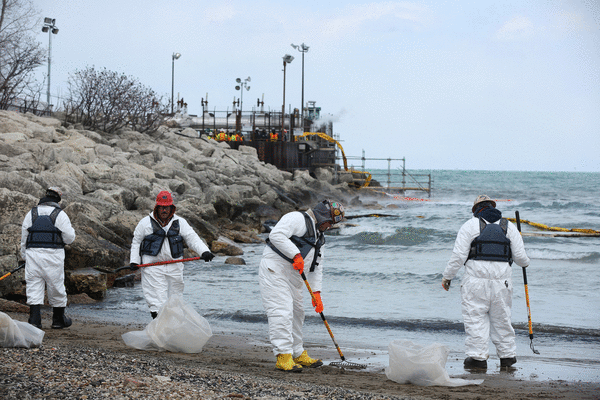
A pipeline that spilled at least 1.3 million gallons of hazardous natural gas liquids in Wisconsin two months ago garnered national attention and more calls for scrutiny. But thousands of small oil spills in the Great Lakes over the past decade have gone largely unnoticed, and little is known about their effects on the ecosystem, a new study shows.
The Lake Superior State University study, published in the Journal of Great Lakes Research, listed more than 6,400 oil spills across the lakes and their connecting waters between 2015 and 2024. Lead author and ecologist Cecilia Heuvel said the majority of these spills were small, or less than 1,000 gallons. Many of these small spills lacked information on the amount or type of oil released.
While large leaks in the ocean can garner significant media attention, researchers say small spills and those occurring in freshwater bodies are less likely to be identified, and less is known about their impact on the environment.
Lake Michigan saw the most spills of any Great Lake, at about 150 spills a year, according to the first study.
Researchers pulled publicly available data from the U.S. Coast Guard’s National Response Center and the government of Ontario, Hueval said.
“We know that these small spills aren’t going to have that same dramatic and immediate response, but that they could potentially have more of this underlying background, long-term effect on the ecosystems that exist in the Great Lakes, that we can’t fully quantify yet without further research,” she said.
A lack of information
A 2010 rupture of a pipeline known as Line 6B released more than 845,000 gallons of dark, viscous hydrocarbons into the Kalamazoo River, a tributary of Lake Michigan, according to 2014 research published in Ecology and Society. Most of the spill was contained roughly 87 miles from the lake.
Cleanup costs exceeded $767 million, and about 320 people, some of whom had evacuated their homes, reported symptoms consistent with crude oil exposure, according to the National Transportation and Safety Board. The pipeline was rebranded as Line 78 and still carries more than 500,000 barrels of crude oil a day, according to documents from Canada-based oil company Enbridge.
In August, a flatbed truck in Wisconsin hit a major pipeline known as Line 5, according to a news release from Enbridge. The pipeline, which crosses the Straits of Mackinac, released about 31,000 barrels of mostly propane and butane into the atmosphere over the next four days, Enbridge said.
The incidents highlight the risks Line 5, 6B and similar pipelines pose to natural waterways, said Liz Kirkwood, strategic partnership officer at Flow Water Advocates, a nonprofit aiming to protect the Great Lakes. Enbridge has proposed changes to Line 5, including the construction of a tunnel that would replace part of the pipeline.
But in late July, the Michigan Supreme Court reversed the state’s approval of the proposed tunnel, requesting additional environmental review.
“There are much smarter ways to transport carbon fossil fuels around the Great Lakes rather than through the heart of the Great Lakes,” Kirkwood said. “Line 5 is a ticking time bomb that must be shut down. The tunnel is not a viable option; the reroute is not a viable option; the entire pipeline is 73 years old.”
But little is known about the threat of smaller oil spills.
The lack of certain information in the study, led by researchers at Lake Superior State University, was especially fascinating, Kirkwood said.
Documents for just over a third of U.S. incidents contained oil spill volumes, according to the study, and Canadian records had no volume data before 2023. Shipping-related spills were the most common type in the U.S., while facility-related incidents came first for Canada.
Another information gap Hueval said researchers are trying to fill is the ecological effect of oil spills in freshwater systems. Connecting waterways such as the St. Clair and Detroit rivers had higher spill densities than open lakes, according to the study.
Large ocean spills are known to kill wildlife and heighten cancer rates in nearby communities, according to a study published in Environmental Science and Technology.
“There’s been so much research done in marine ecosystems on the ocean where a lot of these big spills have occurred, and there’s been very little work done in freshwater ecosystems,” Hueval said.
Expedited reviews
In a separate report on pipelines, members of different environmental groups spoke Wednesday during a virtual news conference. Research by the Environmental Integrity Project documented what it referred to as the largest pipeline construction boom in decades, enabled by the Trump administration’s undermining of safety rules and environmental reviews. This would expand the nation’s network of natural gas, oil, petrochemical and carbon dioxide pipelines, the report said. Most of these new pipelines would carry natural gas.
In January 2025, President Donald Trump declared a national energy emergency, citing an inadequate supply of power and critical minerals in the U.S., according to a White House news release.
Trump followed with two more executive orders in 2025. The first encouraged agency heads nationwide to explore emergency powers available to them in regard to the administration’s energy policies, and the second told the Department of Energy to use emergency authorities to halt certain energy producers from disconnecting from power grids.
But environmental advocates say the emergency declaration wasn’t warranted and has been used to fast-track projects harmful to the environment. Of 193 U.S. natural gas pipeline projects proposed or under construction in multiple states, including nine in Illinois, at least a quarter of them received or requested expedited reviews due to the emergency designation, according to the report from the Environmental Integrity Project.
Jen Duggan, executive director of the project, referred to the emergency act as a “sham,” saying reports from the U.S. Department of Energy indicate the U.S. electric grid has been reliable. The country also has been exporting an increasing amount of oil and gas over the past year, she said.
“There is no energy emergency, and there is no justification for putting people at risk of oil spills,” Duggan said.
A significant portion of the growth nationwide is for fueling the rapid construction of data centers, including in Illinois, according to the Environmental Integrity Project report.
The research also highlights additional changes under the administration it says have contributed to more lax regulations on pipelines. These include the weakening of anti-explosion rules that led to the fewest amount of enforcement cases on record in 2025, a gutting of the Endangered Species Act and a policy directive instructing regulators not to take action against pipeline companies asking for waivers to avoid safety rules in the Northeast, West Coast and Alaska, according to the report.
Comment periods for members of the public to respond to proposed pipelines also have been far shorter than normal, said James Hiatt, founder of For a Better Bayou, an environmental organization in Louisiana. Certain pipeline projects in the state received public comment periods of two weeks or less instead of the normal 30 days, according to the report.
“People cannot participate in projects that they don’t even know about, and when public comment periods are shorter than a fishing trip, this is not democracy, this is not for the people,” Hiatt said during the news conference.
_____
©2026 Chicago Tribune. Visit chicagotribune.com. Distributed by Tribune Content Agency, LLC.






Comments