Israeli vote deadlocked with Netanyahu level with opposition
Published in News & Features
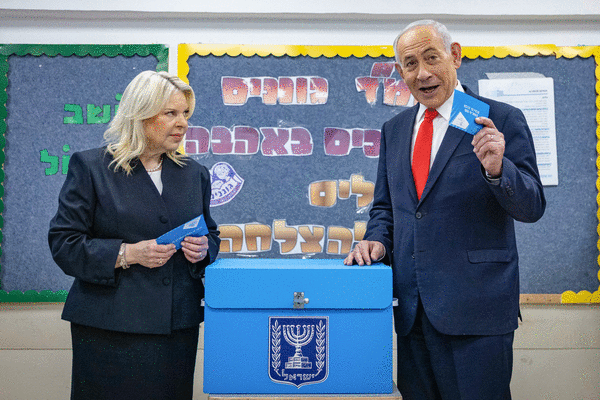
Israeli Prime Minister Benjamin Netanyahu and opposition leader Gadi Eisenkot are neck and neck in the first election since the 2023 Hamas attacks, setting up a tense period of negotiations over who will form the next government.
Netanyahu’s religious right-wing alliance and Eisenkot’s bloc are both on track to secure 51 of Israel’s 120 parliamentary seats, according to two exit polls published after voting closed late Tuesday. A third had Netanyahu slightly ahead, having earlier said Eisenkot was leading.
That would leave the contenders well short of a majority needed to become the country’s next leader, with both facing a difficult path to forming a ruling coalition without a second election. Votes are still being counted, however, and the final picture could yet change. Further complicating matters, Netanyahu’s Likud looks set to be the biggest single party, with Eisenkot’s Yashar in second place.
The two Israeli Arab parties, which have emerged as potential kingmakers, are forecast to win 18 seats, the exit polls showed, ahead of expectations. Both have said they’d support Eisenkot on some level, having rallied supporters to help oust Netanyahu and prevent a new term they believe would be existential.
Voter turnout was close to record highs throughout the day, reaching almost 78% as of 10 p.m, according to the central elections committee.
Should Eisenkot, 66, succeed in becoming prime minister, it would mark a stunning defeat for Netanyahu, 77, who has dominated Israel’s politics for much of the past three decades and led the country through three years of near constant war. While the final outcome of the election remains uncertain, it’s clear that a significant portion of the support that propelled Netanyahu to power in 2022 has been eroded.
Many Israelis blame him for failing to prevent, and subsequently take responsibility for, the 2023 Hamas assault on Israel that was the deadliest day in Israeli history. Netanyahu has since waged military campaigns in Gaza, Lebanon, Syria and against Iran, which he insists have made the country safer.
“The public has spoken — it has fired the Netanyahu government,” Yair Golan, leader of the leftist Democrats Party and part of Eisenkot’s bloc, said in a statement. “We represent an enormous constituency that has spent four years fighting in the streets,” he said. “We are ready to work with our partners, bridge differences and take responsibility.”
But with the makeup of a new government likely to take days or weeks to finalize, Netanyahu remains Israel’s prime minister. That would enable him to join U.S. President Donald Trump in a renewed bombing campaign of Iran after the US midterms next week, as both have repeatedly threatened.
Trump had endorsed Netanyahu, saying the incumbent had what it takes to “finish the job” in the eight-month war with the Islamic Republic.
Eisenkot pitched himself as a more modest alternative to Netanyahu, while still emphasizing a commitment to resolving Israel’s myriad security challenges. On Iran, he has said the country’s nuclear program must be curbed, militarily if necessary, but that regime change in Tehran is “not an achievable goal.”
No party in Israel’s history has won an outright election majority, requiring often long periods of coalition negotiations. President Isaac Herzog will nominate the presumptive prime minister based on the vote count and party recommendations.
Polling stations in parts of Tel Aviv were packed on Tuesday, with lines snaking through schools — where many of the booths have been set up — and spilling into streets. Some of the political parties set up stands blaring out music, and handed out balloons, sweets and stickers to voters and their children.
Beyond national security, voters cast ballots on a set of domestic issues — including whether to draft ultra-Orthodox young men into the army. The power of the Supreme Court and judicial system, which Netanyahu has sought to undermine, transparency and corruption are also on the agenda.
For Palestinians in Gaza and the occupied West Bank, where violence by Jewish settlers on Arabs has soared since the Hamas incursion, the election is unlikely to lead to any immediate changes. Like Netanyahu, Eisenkot has ruled out a two-state solution, saying it would threaten Israel’s security, though he’s condemned the government for supporting Israelis who have attacked Palestinians.
_____
(With assistance from Dan Williams, Carla Canivete, Marissa Newman and Alisa Odenheimer.)
_____
©2026 Bloomberg L.P. Visit bloomberg.com. Distributed by Tribune Content Agency, LLC.





Comments