Trump sees smiles in Venezuela, but new poll finds deep disappointment in him
Published in News & Features
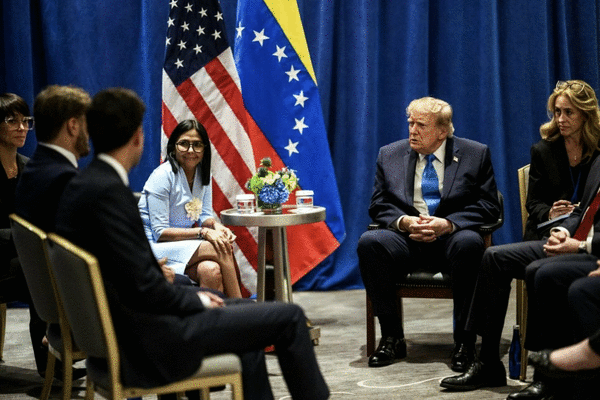
President Donald Trump was celebrating Venezuela’s recovery at the White House late last month, declaring that money was pouring into the country and its people were becoming wealthy again.
“We’re helping the people become rich again,” Trump told guests attending a Hispanic Heritage Month celebration on Sept. 30. “And the country’s coming back and the people have a smile on their face. They see what’s happening. The money is pouring in.”
But on that same day, a Venezuelan polling firm was completing a nationwide survey that paints a sharply different picture of the country’s mood.
According to Meganalisis, 83% of Venezuelans surveyed said they do not believe Trump wants what is best for their country, while only 7% believe he does. An overwhelming 95% said their household’s economic situation and quality of life has not improved under interim President Delcy Rodríguez, who remained in power following the removal of Nicolás Maduro by U.S. forces in January.
The findings suggest a significant disconnect between Trump’s portrayal of his administration’s accomplishments in Venezuela and the frustration reflected in the survey over persistent economic hardship, chronic electricity shortages and uncertainty about the country’s political future.
The results are particularly noteworthy because Trump himself shared a favorable Meganalisis survey on Truth Social in March, when 83% of Venezuelans surveyed said they felt grateful to him. Seven months later, the same polling firm is reporting widespread distrust of his intentions toward the country.
The two surveys asked different questions and cannot be compared as identical measures of Trump’s popularity. The February poll measured gratitude toward him, while the September survey asked whether respondents believe he wants what’s best for Venezuela.
The latest survey was conducted by telephone between Sept. 23 -30 among 1,357 Venezuelan adults across the country’s 23 states and Caracas. Meganalisis reported a margin of error of 2.66 percentage points.
From gratitude to distrust
Following Maduro’s removal, Trump appeared to enjoy considerable goodwill among Venezuelans who had spent years hoping for an end to Chavista rule.
Meganalisis reported that positive sentiment toward Trump stood at 92% in January. In February, 83% of respondents said they felt grateful to him, compared with 8% who said they did not.
Trump shared a graphic displaying those findings on his Truth Social account on March 6. The survey, conducted Feb. 18–25, included 1,021 respondents.
The polling firm’s subsequent reports describe a steady deterioration in sentiment as the months passed and expectations of a democratic transition remains unfulfilled.
Its historical figures show positive responses declining to 75% in March, 47% in April, 31% in May, 22% in July, 10% in August and 7% in September.
Those comparisons, however, require clarification because the published February and September surveys measured different attitudes. Without establishing whether the same question was asked throughout the period, the figures cannot reliably quantify a decline in Trump’s popularity.
Meganalisis characterized the September result as an approval rating, although its question did not directly ask respondents whether they approved or disapproved of Trump’s performance.
Economic hardship persists
The survey also raises questions about whether the economic benefits Trump has repeatedly described are reaching ordinary Venezuelans.
During his Sept. 30 remarks, Trump praised the military operation that removed Maduro, highlighted the growing involvement of major oil companies in Venezuela and claimed that oil revenues had already exceeded the operation’s cost many times over.
But the economic conditions reported by respondents suggest little improvement in their daily lives.
Asked whether their household’s economic situation and quality of life had improved under Rodríguez, 95% answered no, compared with 2% who said yes.
The question, however, explicitly described Rodríguez as being kept in power by Trump, wording that could influence responses. The result also should not be interpreted as a conventional measure of Rodríguez’s presidential approval.
Elsewhere in the survey, 82% of respondents described their household finances as bad or very bad. Another 65% characterized life in Venezuela as unbearable, while 19% described it as bad.
Electricity shortages emerged as another major source of dissatisfaction. According to Meganalisis, 88% rated electricity service as bad or very bad, while 87% reported experiencing power outages at least four days a week. Nearly eight in 10 respondents, 79%, said the outages typically lasted more than three hours.
Together, the findings suggest that the political changes following Maduro’s removal and Washington’s expanding economic relationship with Caracas have yet to produce improvements that many of those surveyed can recognize in their everyday lives.
©2026 Miami Herald. Visit at miamiherald.com. Distributed by Tribune Content Agency, LLC.



Comments