White House to hold its own hearing on claims against Fed's Cook
Published in News & Features
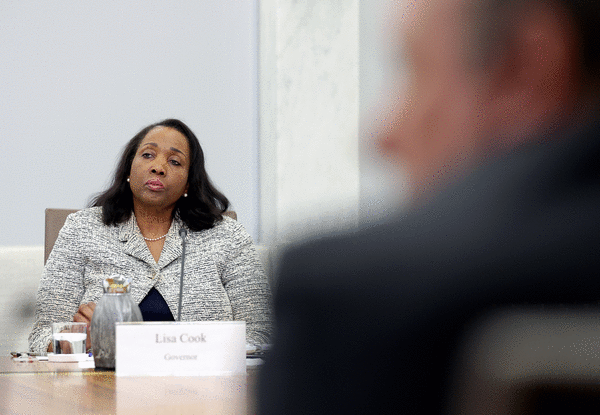
President Donald Trump is establishing a committee to investigate mortgage fraud allegations against Federal Reserve Governor Lisa Cook and is forcing her to appear at a White House hearing to defend herself, a dramatic escalation in his efforts to oust her from her role.
The White House shared a memorandum dated Wednesday from Trump to establish the committee.
“As President, it is my job to ensure the laws are faithfully executed, including by firing subordinates who cannot be trusted to tell the truth and follow the law,” Trump said in the memo. He said the committee would investigate whether there is “cause” for Cook’s removal following in a Supreme Court decision in June that allowed her to remain in her role while she fought an earlier attempt to fire her.
Trump’s memo says that Cook must appear at a hearing at the White House on Nov. 5, where the committee will be able to “consider the evidence and allegations” against her. Cook may submit a “written position statement” ahead of the hearing and may bring her lawyer to the proceeding, which will be closed to the public.
Cook’s lawyers said they had “grave doubts that this ‘hearing’ is a legitimate one that would conform to the law.”
“If it is anything close to objective, the conclusion will be that Governor Cook did not commit mortgage fraud, leaving no cause to remove her from the Federal Reserve Board,” the lawyers, Abbe Lowell and Norm Eisen, said in a statement.
“We have engaged with the White House to evaluate whether the process proposed has a possibility of being a genuine one and not simply a box checking exercise,” they said, adding that Cook welcomes the opportunity to clear her name.
A Fed spokesperson declined to comment.
Trump said the committee will include Kevin Hassett, the director of the National Economic Council, as well as the chair of the Equal Employment Opportunity Commission and the director of the Office of Government Ethics.
Trump’s action is the latest move in his bid to oust Cook from her position, a fight that has already forced the Supreme Court to weigh the broader questions surrounding the president’s powers to reshape the Fed.
No president before Trump has tried to fire a Fed governor, and his latest plan underscores the unprecedented nature of the situation. The Supreme Court held that Trump failed to provide Cook with enough notice and an opportunity to defend herself before attempting to remove her last year, but didn’t spell out what that must look like. The justices left it to the White House to create a process that would survive another round of legal wrangling.
Chief Justice John Roberts wrote in the majority’s opinion that the process didn’t have to include “an audience with the president or a full-blown judicial trial.” He did note that in the early 20th century, former President William Taft convened a “committee of inquiry” when he was considering whether there was cause to fire members of a federal board.
Jane Manners, a professor at Fordham School of Law and legal historian, said Trump appeared to be complying with the Supreme Court’s expectations as far as Cook’s right to process. Still, she said, the justices set a “high bar” for proving “cause” to fire a Fed governor and made a point of emphasizing the importance of shielding the Fed from political interference.
“That, I assume, will be the crux of the appeal that undoubtedly will move its way through the courts again,” Manners said.
Trump first announced in August 2025 that he had fired Cook, following a claim from Federal Housing Finance Agency Director Bill Pulte that she had lied on loan applications to get more favorable terms. Cook, who was appointed by former President Joe Biden to the central bank, in turn sued Trump arguing that the alleged conduct did not amount to “cause” for firing her under the Federal Reserve Act.
Cook has denied the allegations, casting them as a pretext to remove her from office and allow the president to reshape the Fed more to his liking. The president and his allies have taken actions against a number of political rivals and current or former government officials seen as opposing Trump on policy matters.
The Supreme Court ruled 5-4 that Cook could stay in her job while she fights Trump’s push to remove her, in a decision reinforcing the central bank’s independence from the White House.
The administration resumed its attempt to fire Cook in August, and she again denied the unproven mortgage fraud allegations.
The Justice Department and Cook’s lawyers are due to file a report on Nov. 6 — the day after her White House hearing is scheduled — with a federal judge in Washington about how they want to proceed with her original lawsuit contesting Trump’s bid to fire her.
Trump has long sought to pressure the central bank, including most notably its former chair, Jerome Powell, who the president faulted for not moving more aggressively to lower interest rates. Powell was succeeded earlier this year by a Trump pick, Kevin Warsh, as chair.
Senator Elizabeth Warren, the top Democrat on the Senate Banking Committee, criticized Trump’s latest move.
“President Trump is convening an illegitimate show trial in his dangerous quest to illegally take over our nation’s central bank,” she said. “Instead of playing judge in a kangaroo court of his own making, Trump should end the war in Iran and cancel his chaotic tariffs.”
____
—With assistance from Zoe Tillman.
©2026 Bloomberg L.P. Visit bloomberg.com. Distributed by Tribune Content Agency, LLC.




Comments