Haiti revises electoral law again, but doesn't formally postpone Dec. 13 vote
Published in News & Features
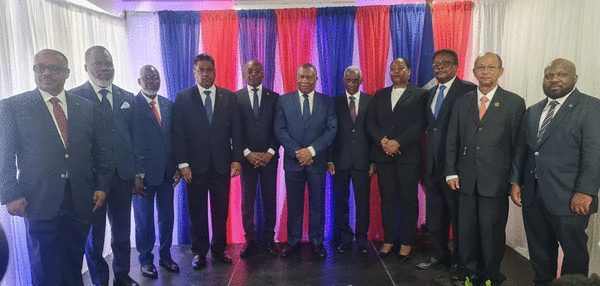
With voter registration lagging and political parties complaining that eligibility requirements for fielding candidates are too burdensome, Haiti’s transitional authorities have revised the country’s electoral rules for the third time in four months, but stopped short of formally postponing the Dec. 13 vote.
The revised electoral decree became public on Thursday, two days after it was published in Le Moniteur, the government’s official gazette. While it establishes the framework for organizing elections for president, legislative and local officials along with a constitutional referendum, uncertainty persists about whether Haiti can meet its Dec. 13 election deadline.
Ahead of the decree’s publication, the Provisional Electoral Council pushed the deadline for online candidate registration and submission of required documents to Oct. 31, postponed the official start of campaigning and said a new updated electoral calendar would soon be published.
The new changes in the electoral law ease some requirements for candidates seeking office, eliminate the need for some financial documents and a mandatory medical certificate, and introduce electronic voter registration.
For example, in June, individuals were required to provide a sworn statement signed before a notary certifying that they had never been convicted or detained, either in Haiti or abroad, for economic crimes, sexual violence, illegal trafficking of firearms, drug trafficking, kidnapping, unlawful confinement of individuals or any other misdemeanor or criminal offense.
Under the revisions, they just need to attest that they have never been convicted.
Although the revised decree continues to bar individuals sanctioned by the United Nations Security Council from running for president, Parliament and local elections, it does not automatically disqualify those who have been sanctioned solely by individual foreign governments, including the United States and Canada, or by the European Union.
A report published this week by a United Nations Panel of Experts on Haiti noted that the U.N. sanctions list includes just nine individuals and two entities, limiting the provision’s practical impact on Haiti’s long -delayed elections.
In its examination of Haiti’s deepening crisis, the panel detailed how influential figures in Haitian society continue to support armed gangs. It identified nearly a dozen people with alleged gang ties, including some who have registered to run in the upcoming elections, while warning that “the vast majority of those involved in supporting gangs and destabilizing the country have yet to be designated.”
The findings are currently being discussed by members of the U.N. Security Council as they prepare to vote next week on renewing the sanctions. While pressure is mounting to add potential new names to the U.N. sanctions list, the report raises questions about whether the revised framework governing the elections will do much to prevent individuals with ties to criminal networks from seeking office.
Electoral challenges
Since the electoral process was launched by the Provisional Electoral Council, political parties have struggled to qualify to field candidates by submitting lists of 30,000 supporters through an online platform, while voter registrations have also lagged.
As of Thursday, just 784,226 voters had registered to vote out of a potential electorate of more than six million, while 145 voting centers remain inaccessible, according to the electoral council’s website. Meanwhile, of the 105 political parties and groupings qualified to participate, only 33 had successfully submitted their membership lists. Millions of submitted entries had been rejected because they were duplicated or deemed fraudulent.
Among the new changes introduced in the revised decree are an extension of registration deadlines until the end of October, lower registration fees for candidates, particularly those running for legislative and local offices, and a reduction in the number of required documents from 26 to 22. The eliminated requirements include a certificate from the Bank of the Republic of Haiti, which had been intended as an additional safeguard against U.N.-sanctioned individuals.
Candidates still must present a sworn declaration that they’ve never been convicted of a serious or dishonorable offense, a criminal record certificate issued within the previous six months and a police certificate from Haiti’s Central Directorate of Judicial Police.
The decree also requires a notarized copy of a resignation letter for certain public officials including prosecutors, and proof that it was received. Among the 13 individuals who have registered to run for president so far is the controversial public prosecutor Jean Ernest Muscadin, whose candidacy has raised questions about whether he has complied with the rules.
_____
©2026 Miami Herald. Visit miamiherald.com. Distributed by Tribune Content Agency, LLC.





Comments