Sharp rise in deportation orders for Somalis in Minnesota
Published in News & Features
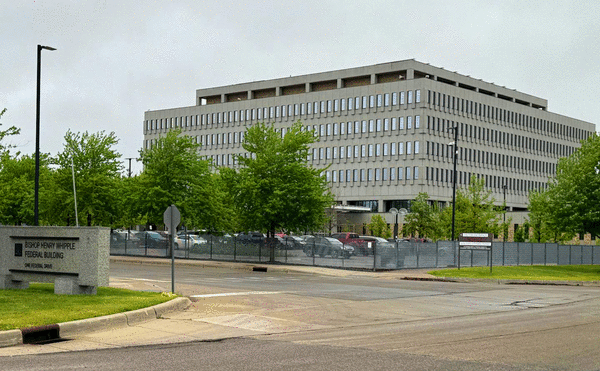
MINNEAPOLIS — More than 1,000 Somali asylum-seekers have been ordered deported since February, reflecting the Trump administration’s continued follow-through on last winter’s federal enforcement action in Minnesota.
More than half the deportation orders involve Somalis living in Minnesota, a nearly tenfold increase from 2025, according to a Minnesota Star Tribune analysis of federal data.
Most Somalis living in Minnesota are either citizens, had legal status or were pursuing asylum claims. Earlier this year, however, the Trump administration cut off a temporary legal protection for Somalis living in the U.S. and fast-tracked hundreds of cases to immigration judges who rarely grant asylum.
More than 500 Somali immigrants from Minnesota were issued removal orders this year. Some have already been deported. Others have been sent to detention centers as far away as Guantánamo Bay, Cuba including at least two from Minnesota.
Immigration attorney Marc Prokosch characterized sending people to the notorious military detention camp as a “political scare tactic.” Prokosch represented four men who were told they were being deported to Somalia but spent nearly a month at Guantánamo Bay before being flown to Africa.
“Think of the taxpayer dollars it takes to do this,” Prokosch said. “They are using every lever possible to terrorize and scare people.”
Few Somali asylum-seekers have felony convictions, but a spokesperson for the U.S. Department of Homeland Security said President Trump and Homeland Security Secretary Markwayne Mullin were protecting American citizens from criminals.
“If you come to our country illegally, you could end up in Guantánamo Bay or even another third country,” the Homeland Security spokesperson said.
Last December, Trump justified Operation Metro Surge to combat “Somali bandits” accused of defrauding social services programs.
Despite the bluster, federal records show only about 100 of the 3,800 immigrants detained during the surge were Somali immigrants, according to records collected by the Deportation Data Project.
Federal officials quickly changed tactics.
In mid-January Trump announced he would end Temporary Protected Status for Somalis.
In February, the Trump administration created the so-called “rocket docket,” which allowed judges to hold online hearings involving Somali nationals. The move forced immigration attorneys to scramble to prepare for cases that were initially scheduled for at least a year away. Nearly every removal decision in the first eight months of 2026 were for Somali immigrants put on that fast track.
Immigration attorneys say a court docket dedicated to immigrants of a specific nationality is unprecedented, but they have failed to stop it. The hearings are typically held outside public scrutiny and are restricted to attorneys, immigrants and their families.
An immigration court spokesperson said it prioritizes the “timely completion of all cases” and noted that federal law calls for asylum applications be decided in 180 days.
“Unnecessary delay hurts both aliens with meritorious claims and the American public who wish to see aliens with non-meritorious claims removed as quickly as possible,” the court spokesperson said in a statement.
A national backlog of 2.3 million pending asylum applications means the cases are rarely decided quickly.
In July, federal officials narrowed another avenue for Somali asylum seekers by transferring supervision of those seeking protection from a federal agency to immigration court.
Osman Ahmed, a community leader who previously worked for Sen. Tina Smith, said the spike in deportation orders is having a broader impact on Minnesota’s Somali community than the federal surge.
“This has been much more dangerous and harmful to families,” Ahmed said.
Somalis are also no longer guaranteed asylum if threatened by the terrorist group Al Shabaab or retribution for interclan marriages.
“Regardless of how much evidence individuals have, it doesn’t matter,” Ahmed said. “Judges are not questioning anything they are being told.”
Before they were deported this month, Prokosch represented four of the eight men detained at Guantánamo Bay.
Adam Abdullah, 31, was detained in St. Paul in December during Operation Metro Surge. Despite having few traffic tickets, he had a removal order. Immigration and Customs Enforcement has described him and the others sent to Cuba as a threat.
“This flight of illegal aliens to Guantánamo Bay included some of the worst of the worst with criminal histories including aggravated assaults, weapons offenses, robbery, multiple larcenies, police obstruction, possession of burglary tools, receiving stolen property, trespassing, unauthorized use of a vehicle, multiple drug charges and DUIs,” ICE said in a prepared statement.
Prokosch learned Sept. 24 the men were being flown from Guantánamo Bay to Kenya. ICE has not flown directly to Somalia in almost a decade, but the agency has sent detainees to neighboring nations including Kenya and Uganda.
In some instances, those detainees were later shipped to Somalia. Prokosch said he spoke with Abdullah after he arrived in Mogadishu.
In addition to being sent to Somalia, Prokosch and other immigration attorneys worry Somali asylum seekers could be sent to one of the growing number of African countries now accepting third country removals. More than 25,000 people have been deported to countries where they have no ties since Trump returned to office.
“Third country agreements are helping close one of the loopholes in our immigration system that has far too often been abused with false claims,” ICE said in a prepared statement.
The Trump administration is deporting Somali asylum seekers to their home country despite conflicting claims by the U.S. government over Somalia’s safety.
Officials with Homeland Security and the Justice Department have submitted a 270-page packet in dozens of immigration cases that maintain the country is safe despite warnings from the U.S. State Department.
The filing highlights sections of news stories portraying Somalia as secure but omits passages that describe ongoing violence.
“Mogadishu is actually safe,” the exhibit quotes a Somali woman visiting from Canada who was featured in an Associated Press story about a new bowling alley. What the court filing doesn’t highlight is the need for the bowling alley to hire private security. “Mogadishu remains vulnerable to militant attacks, however, with security measures like check points and heavily guarded zones part of daily life.”
The filing also makes no mention of the risk of “crime, kidnapping, terrorism” mentioned in the State Department’s current travel advisory. U.S. government employees are not allowed to leave the U.S. embassy at the Mogadishu International Airport complex without armed security.
One group continues to win asylum protections: women who’ve experienced or have been threatened with female genital mutilation.
Refugee and human rights advocates say female genital mutilation or cutting remains nearly universal in Somalia. Homeland Security officials still consider the practice a human rights violation and child abuse.
Of the 148 Somali applicants who won their immigration cases in 2026, over 70% were female.
©2026 The Minnesota Star Tribune. Visit at startribune.com. Distributed by Tribune Content Agency, LLC.






Comments