Newsom signs bills targeting hydrogen sulfide, worker safety in Tijuana River Valley
Published in News & Features
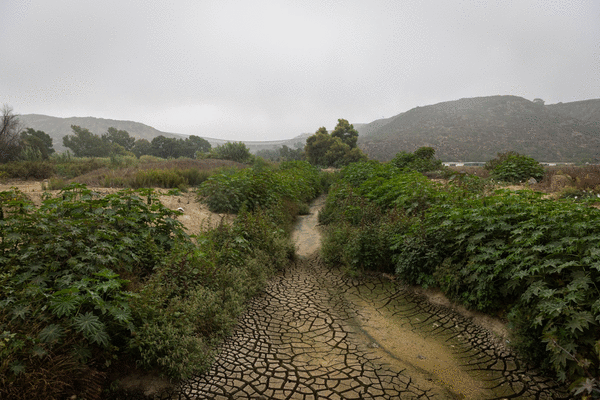
Gov. Gavin Newsom has signed two bills targeting the health effects of the Tijuana River sewage crisis. One orders the state’s first update in more than a half-century to its hydrogen sulfide air standard. The other requires workplace protections for lifeguards, park rangers and others working outdoors in the Tijuana River Valley.
Senate Bill 58, by state Sen. Steve Padilla, directs the California Air Resources Board to update the state’s air quality standard for hydrogen sulfide, which has not been updated since 1969, according to Padilla’s office.
Senate Bill 1046, by Sen. Catherine Blakespear, directs Cal/OSHA to develop workplace standards to minimize exposure to cross-border pollution. Newsom signed the bill Sunday, according to Blakespear’s office. Both laws take effect Jan. 1, 2027.
The signings come about a week after the federal Agency for Toxic Substances and Disease Registry found, for the first time, that hydrogen sulfide in outdoor air near the Tijuana River reached levels that could harm people’s health.
“San Diegans suffer from the effects of overexposure to this gas every day,” Padilla said in a statement. “This report just confirms what residents have known all along. We owe it to these communities to make this long overdue update. This law is just the start of critical protections the South Bay deserves.”
Hydrogen sulfide is a colorless gas that smells like rotten eggs. It is released in part during the bacterial decomposition of human and animal waste. Exposure can cause headaches, nausea, and eye and respiratory irritation. Chronic exposure can contribute to lasting respiratory and neurological effects, particularly among children, older adults and people with preexisting conditions.
The current state standard of 30 parts per billion, averaged over one hour, was designed to control odor nuisance rather than to protect public health, according to Padilla’s office. It was last reviewed in 1984.
SB 58 directs the air board to develop a response framework for hydrogen sulfide exposure events in the Tijuana River Valley and Salton Sea regions. The board must consult with local air districts, state health and emergency agencies, universities, tribal governments and community groups. The bill passed the Senate 40-0 and the Assembly 79-0.
Monitoring has shown conditions worsening. Hourly readings at the county’s Nestor station exceeded the 30 parts per billion threshold more than 10% of the time so far this year, up from less than 2% in 2024, according to county air monitoring data. The station recorded a high of 915 parts per billion on June 2, coinciding with the collapse of the Parallel Gravity Line.
Researchers led by UC San Diego atmospheric chemist Kimberly Prather have identified a culvert hot spot at Saturn Boulevard as the primary source of the gas. The site sits within 1.5 miles of 11 schools.
San Diego County Supervisor Paloma Aguirre called SB 58 “a monumental victory for public health and environmental justice across our region.”
“Families in South County and the Tijuana River Valley have borne the heavy burden of toxic hydrogen sulfide spikes without a unified, aggressive response strategy,” Aguirre said in a statement.
Under SB 1046, Cal/OSHA must adopt requirements for personal protective equipment, hazard communication, incident reporting and training. The standards will be developed with input from affected communities, lifeguards, park rangers, labor unions, air districts and academic experts, according to Blakespear’s office.
Workers in the valley have experienced headaches, fatigue, nausea and bloody noses, according to Blakespear’s office. The office also said the pollution has caused more than 1,300 consecutive days of beach closures along the South Bay coastline.
“The untreated wastewater pouring into the Tijuana River Valley has been an environmental nightmare for decades, and we need to protect any workers exposed to it,” Blakespear said in a statement.
The bill passed the Legislature without opposition. It is sponsored by SEIU, and Blakespear worked with SEIU Local 221, which represents more than 13,000 workers in San Diego County.
The state measures come as federal and binational efforts continue. The South Bay International Wastewater Treatment Plant has expanded from 25 million to 35 million gallons per day of capacity, with a target of 50 million gallons per day by December 2027.
Advocates said the new laws are a starting point.
“SB 58 is a step forward in establishing community-based standards and improving responses to toxic gases,” said Courtney Baltiyskyy of the Tijuana River Coalition. “We hope future commitments from the state will help make the Tijuana River Valley and surrounding beaches safe places to live, work, play, and learn.”
_____
©2026 The San Diego Union-Tribune. Visit sandiegouniontribune.com. Distributed by Tribune Content Agency, LLC.






Comments