Illinois calls for review of Flock cameras following national surge of misuse
Published in News & Features
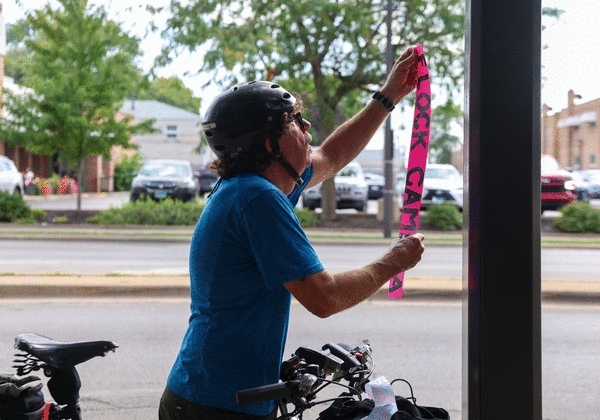
CHICAGO — Stalking of ex-romantic partners, unauthorized personal surveillance, tracking drivers’ behavior — these are just a few of the ways in which law enforcement officers, outside their official police duties, have been accused in recent months of misusing automated license plate reader (ALPR) technology.
Widely popularized by the private manufacturing company Flock Safety and used by thousands of police departments to aid in criminal investigations, these cameras work by photographing license plates and other motorist identifiers to build up a database of information. That data is then used by police to search for missing people, find stolen vehicles or reconstruct crime timelines.
But a recent uptick in both national and Chicago area police abusing Flock cameras has heightened residents’ concerns about their privacy, security and whether the technology’s public safety benefits ultimately outweigh its risks.
In Skokie, local residents turned out in high numbers at the village’s Sept. 8 Board meeting to voice their opposition to the technology and question how local law enforcement officers are using these cameras.
“[The fact] that I am even standing here honestly and discussing the idea of us living in a surveillance state, me, my children, I just can’t believe it,” said Skokie resident Julian Van Ostrand to the Board.
Van Ostrand then went on to paraphrase Benjamin Franklin’s famous quotation: “Those who would give up essential liberty to purchase a little temporary safety deserve neither liberty nor safety.”
“My God,” Van Ostrand said.
“Who are we giving our data to?” said resident Kimberly Polka. “Who knows when I’m going up and down the street? That is not okay…I don’t know what the benefit is, but the cost is too much.”
To address mounting concern, Skokie deputy police Chief John Oakley stood before trustees and a packed Board room Sept. 8 to discuss how ALPR technology is explicitly used in the village and where camera data is stored and shared.
According to Oakley, Skokie operates 27 stationary cameras, 20 of which are manufactured by Flock, mounted along high-traffic main roads in the village.
The camera system reads and logs passing vehicle license plate numbers, time of day, date and location for a period of 30 days before the system ultimately purges the data, Oakley said. Only authorized law enforcement personnel can access the system.
Officers receive an alert when a “hot list” license plate is read by the system — a flagged vehicle that may be a stolen car, a wanted driver or a vehicle involved in an Amber alert, he explained.
“I can go through hundreds and hundreds of examples of where we’ve used this ALPR system to benefit the residents of Skokie to make things safer,” Oakley added, listing off examples of how Skokie police located a missing person using the technology, found a stolen vehicle and tracked a violent armed offender.
Police Chief Jesse Barnes added during the discussion that Flock cameras aided in identifying the vehicles used in both of the village’s recorded homicides this year.
In response to cited trepidations about Flock, Oakley explained that the data from the cameras is only shared with in-state law enforcement agencies and is not accessible on a federal database.
Officers are unable to observe real-time movements, only points in time where a vehicle passed by a Flock camera. License plate data is only accessible if it’s tied to a qualifying investigation, he added, and Skokie’s cameras do not have facial recognition capabilities.
Skokie police are currently in the process of developing a transparency online portal that will allow residents to access up-to-date information on Flock camera footage that the department is legally able to provide, Oakley said, like how many vehicles are on the department’s hot list at a given time or a camera’s recorded number of plate reads per month.
“There are certain things that by law we can’t release, but we’re open to transparency.”
“We’ve heard a lot from residents who are extremely concerned about a lot of different things that weren’t so much addressed in this presentation,” Trustee Lissa Levy voiced to Barnes and Oakley at the Sept. 8 meeting.
“What are the measures in place to prevent hacking into [this] data, especially given what we’re all hearing about AI systems being able to hack into other companies, other entities unknown, unseen?” Levy questioned.
“Law enforcement data has specific security requirements,” Barnes responded. “The Illinois State police and the secretary of state, that’s who maintains our law enforcement data system…they have to approve of anybody who’s gonna have access.”
Barnes acknowledged the number of high-profile cases over the last year that have identified deficiencies in the system, but said he couldn’t speak to the specificity of those cases.
If the Skokie Police Department was found to be using Flock cameras improperly or disseminating Flock data improperly, Barnes said the Illinois State Police could restrict officers’ access to the department’s Law Enforcement Agencies Data System (LEADS), a statewide telecommunications system designed to allow law enforcement to share information across departments, like stolen vehicle files, criminal histories and existing warrants.
Suspension of that access, either for an individual officer or the whole police department, Barnes later noted, would mean losing one of the most powerful tools in an officer’s toolbox.
“This is a new technology, there is a learning curve to it…I’m not here to defend all of our vendors, but I will say that every one of them is recognizing that [data security] is something that needs to be a priority,” Barnes said.
Village Manager John Lockerby added that Skokie is one of more than 350 municipalities in Illinois that uses ALPR technology to help officers solve crimes.
While other neighboring communities have faced backlash over their use of ALPR cameras, Evanston is the only North Shore municipality to have banned them entirely after learning Flock Safety had shared information about city vehicles with federal immigration agencies last year.
Lockerby added that the village will soon be undertaking a “comprehensive review” of its ALPR technology to examine its effectiveness and to see if there are alternative approaches to ensuring public safety.
The study is expected to conclude in March, prior to the village’s budget process, Lockerby added.
Skokie’s contract with Flock Safety is set to expire in December 2028, according to village documents. Officials will assess that contract following results of the study.
“You’re toeing an important line between the safety of our residents…without giving away personal data,” said Trustee Alison Pure Slovin towards the conclusion of the village’s Flock discussion.
“We have to really look at who we’re representing, what the needs are of this community and how we help [police] keep [residents] safe.”
____
©2026 Chicago Tribune. Visit at chicagotribune.com. Distributed by Tribune Content Agency, LLC.






Comments