Florida's DEI ban may force Miami Beach to turn its back on city's Pride parade
Published in News & Features
MIAMI — Last spring, Miami Beach Mayor Steven Meiner waved from a city fire truck at the front of the annual gay Pride parade down Ocean Drive. Now, organizers aren’t sure whether the mayor can come back next year without violating Florida’s new anti-DEI law.
“That’s the absurdity of this law,” said Miami Beach Commissioner Alex Fernandez, who joined Meiner for the city-funded Pride parade on April 12. “I don’t even know whether attending Pride as a commissioner could put me at risk of being removed from office.”
On Jan. 1, the Florida law known as Senate Bill 1134 takes effect. It bans local governments from spending on programs promoting diversity, equity and inclusion, an umbrella term that typically involves special efforts to assist women and minority members in securing promotions, employment and contracts.
Other provisions of the law go further, restricting governments from allowing tax dollars to be spent promoting diversity or inclusion. On Wednesday night, Meiner and the City Commission unanimously voted to rush funding to Pride and the local LGBTQ Chamber of Commerce, and on other expenditures, before the anti-DEI rules take effect Jan. 1.
“These investments are part of what makes Miami Beach Miami Beach,” Miles Davis, advocacy director for SAVE, an LGBTQ-rights group, told commissioners.
Multiple speakers at the meeting said they hoped the state crackdown would be temporary, with a court challenge eventually striking down or weakening the funding restrictions. But for as long as the law remains in place, Pride backers expect to lose Miami Beach’s government as a high-profile partner of the event.
“The firetruck is usually at the front of the parade,” Bruce Horwich, chairman of Miami Beach Pride, told the Miami Herald. “We have an honor guard, which is police officers and firefighters carrying flags. That’s usually followed by a couple of police motorcycles.
“I don’t think they’ll be allowed. I don’t think the mayor can ride in a firetruck like he has the last few years,” Horwich said. “It’s kind of sad.”
Florida hasn’t released rules for how local governments should adhere to the new anti-DEI rules, leaving elected leaders and administrators to speculate on how to comply. Earlier this month, Miami-Dade began winding down volunteer advisory boards representing Black, Hispanic and LGBTQ residents, as well as the county’s Commission for Women. In North Miami, the city doesn’t plan to fund the annual celebration of Haitian Heritage Month.
The law allows Florida to force out of office any elected official or government employee who violates the law, raising the stakes for noncompliance and encouraging a play-it-safe approach on whether an event or program probably would be considered DEI.
“There is lots of fear about this law because of its vagueness,” said Joe Saunders, senior political director at Equality Florida. Saunders said he doesn’t see the new law being able to bar a mayor from attending a parade on behalf of the city, but he also predicted some local governments won’t want to test the limits of the rules. “We also know the draconian penalties in this law may lead local officials to self-censor,” he said.
The funding package sponsored by Fernandez that commissioners approved Wednesday has the hint of a possible workaround for Pride after 2027. It asks city lawyers to explore whether Miami Beach could enter into a funding deal in the coming weeks that would allow dollars to be paid out in 2027 and beyond, given the contract would be signed before the anti-DEI law takes effect.
While the Miami Beach Pride festivities rely on public dollars for about a third of its $1.2 million budget, government support also has symbolic value, backers said. Seeing the local mayor waving to the crowd or a squad car with a rainbow flag on the hood conveyed an official stamp of approval for people of all sexual orientations, said Henry Williams, who emcees the parade as his drag persona, Tiffany Fantasia.
“It shows that the leaders of our community support us,” Williams said. “That means a lot to many people.”
In June, city commissioners adopted a resolution celebrating Pride month, with a clause detailing the looming state ban on DEI-related funding. These “legal restraints,” the resolution read, do not diminish Miami Beach’s “responsibility to foster a safe, welcoming and inclusive community for all.”
Carol Coombes, a local nonprofit consultant and LGBTQ advocate, brought a jumbo version of the resolution to the City Commission meeting to thank the board for their funding. “It’s the last one they can give,” she told a reporter, referring to the Pride resolution. “The parade is going to look very different.”
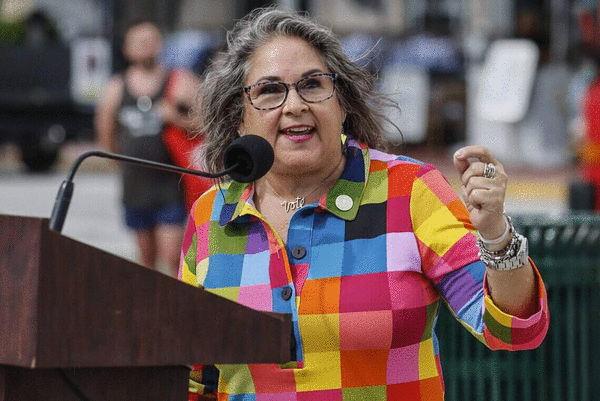
Meiner did not respond to Miami Herald inquiries on whether he’ll be able to repeat his Pride parade appearances in 2027. Commissioner Tanya Bhatt wore a rainbow-print dress to Wednesday’s meeting and said that while she’s not sure she can have an official role in the Pride parade again, she will definitely be there for the fun. “I may not be able to march as a commissioner,” she said. “But I sure as hell can march as a private citizen. And I will be. And if they want to remove me from office for that, so be it.”
©2026 Miami Herald. Visit at miamiherald.com. Distributed by Tribune Content Agency, LLC.





Comments