Trump DOJ asks Supreme Court to back third-country deportations
Published in News & Features
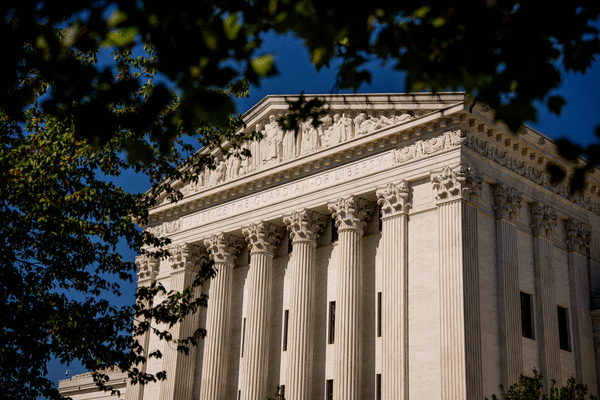
WASHINGTON — The Justice Department asked the U.S. Supreme Court to let the Trump administration resume its aggressive policy of deporting people to countries other than their own, seeking emergency action on a pillar of its immigration agenda.
The filing aims to lift a federal judge’s order barring deportation to a so-called third country unless migrants get notice and a meaningful chance to argue that they would be at risk of persecution or torture. A U.S. appeals court upheld the ruling and let it go into effect immediately.
U.S. Solicitor General D. John Sauer said the appeals court ruling has caused “chaos,” forcing cancellation of a flight to three countries carrying 70 migrants. The decision “created substantial logistical problems with ongoing removal operations — including the cancellation of flights — and led to added expense, potential diplomatic issues, and the inability to remove dangerous criminals,” he said.
The showdown comes amid reports that the administration has cut deals with dozens of countries to accept people who aren’t their own citizens. Many of the countries have notorious human rights records, according to a Sept. 18 New York Times story that described deported people being hooded and beaten at a remote hotel in Equatorial Guinea.
The Trump administration’s third-country deportations started as part of the crackdown on undocumented immigrants because of rules that prevent sending migrants to their home countries if they fear persecution or torture there.
Under the Department of Homeland Security policy, migrants aren’t guaranteed any notice before they are shipped to a third country. In a June 2025 memo, Immigration and Customs Enforcement said it will “generally wait at least 24 hours” before sending someone to a country that hasn’t disavowed persecution or torture.
The court signaled it will probably act quickly on the request, asking the migrants challenging the policy to respond by Monday.
The Supreme Court’s conservative supermajority has already backed the administration twice during earlier stages of the litigation. The court in June 2025 lifted a preliminary order that gave people 10 days notice and a chance to be heard before they could be shipped to a third country.
The justices quickly reinforced that decision with a second order that let eight migrants be sent to South Sudan, a country that was on the State Department’s “Do Not Travel” list amid an armed conflict. Both rulings, which applied while the litigation continued, drew scathing dissents from the court’s liberals.
U.S. District Judge Brian Murphy in Boston has since issued a final ruling, saying that the administration’s policy of swift deportations ran afoul of both federal immigration law and the Constitution’s due process clause.
The 1st U.S. Circuit Court of Appeals largely upheld the ruling on Sept. 18 on a 3-0 vote.
“An individual’s right to contest removal to a country based on a fear of persecution in that country means little if one does not receive prior notice of the intended removal destination and a meaningful opportunity to contest that destination,” Judge Seth Aframe wrote for the panel.
Sauer told the high court that the latest rulings exceeded the lower courts’ authority and rely on the same arguments a majority of the justices rejected last year.
The 24-hour notice that applies in most cases affords “reasonable opportunity to claim a fear of persecution,” said Sauer, the administration’s top Supreme Court lawyer. “The lower courts’ preference for more elaborate and lengthy procedures cannot overcome the lack of statutory support for imposing such procedures.”
Under the court’s usual procedures, the request will first go to Justice Ketanji Brown Jackson, a liberal who manages emergency matters stemming from 1st Circuit cases.
Sauer asked Jackson to issue an administrative stay to let third-country deportations resume immediately. He also made the unusual suggestion that she refer that request to the full court if she doesn’t grant an administrative stay herself.
The case is Department of Homeland Security v. D.V.D., 26a406.
_____
(With assistance from Brian Dowling.)
_____
©2026 Bloomberg L.P. Visit bloomberg.com. Distributed by Tribune Content Agency, LLC.






Comments