Beavers threaten to drown one Minnesota town's Swedish history
Published in News & Features
MINNEAPOLIS — Mature trees are dying. A bridge is swamped. Historic buildings are at risk.
The source of all the mayhem?
A colony of industrious beavers.
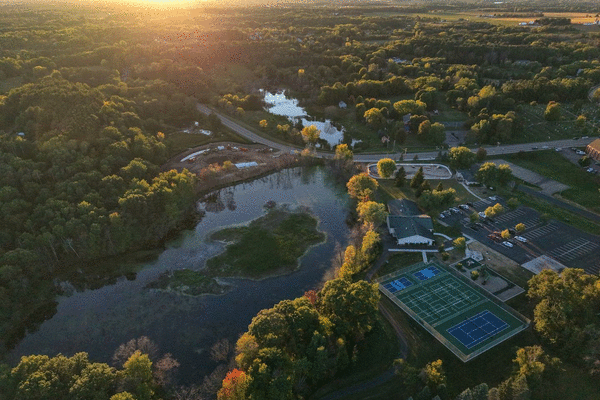
Their persistent dam-building is soaking the small town of Scandia northeast of the Twin Cities, causing floodwater to creep up behind City Hall and encroach on the Swedish immigrant heritage museum.
The workaholic rodents have engineered a battle between the city and a private property owner, led officials to consider litigation and stirred a debate over who is responsible for solving the soggy issue.
“It’s unnerving how close the water has gotten to the historic buildings, because if those are affected then we can’t replace them,” said Ann Rinkenberger, executive director of the Gammelgården Museum.
Rinkenberger looks out her window onto the museum grounds to see trees that have died and a prairie restoration project put on hold due to the flooding. She worries museum structures could be a total loss if water reaches their foundations, including an 1860s-era building full of historical artifacts in Scandia, the first Swedish settlement in Minnesota.
She’s been pleading for help for the past two years, to no avail: “We’re seeing more being damaged the longer this issue is not addressed.”
Beavers have dwelled in Minnesota even longer than Swedish settlers, and their preference for the wetlands south of City Hall dates back at least a couple of decades.
They’ve outdone themselves with their latest project, however, causing water to spread about 20 feet farther up the bank than normal. The dam is holding back water about 3 or 4 feet deep, City Administrator Kyle Morell said.
The city owns much of the wetlands. But the southern half, where the dam sits, is private property. The city holds a drainage and utility easement there, Morell said, but cannot access it to mitigate the dam except through the private property.
The property owners have refused the city entry, Morell said, over concerns that removing the dam would flood their land. He said they’re seeking a more permanent solution to manage the waterflow, rather than simply repeating the cycle of removing the dam and waiting for beavers to build again.
When reached by phone, one of the property owners confirmed Morell’s account was accurate, but declined an interview.
That’s left city officials gnawing on several tough options: Sue for access? Try to paddle down through the public wetlands?
Or perhaps most tempting, convince another agency to fix the problem?
The dam issue is plaguing everyone from private landowners to regional and state agencies. But other entities have pointed to the city as the one to curtail the beavers’ work.
Mike Isensee, administrator of the Carnelian-Marine-St. Croix Watershed District, said the issue lies squarely in Scandia city limits, so it’s not within the watershed district’s purview. He said the district typically steps in when drainage problems involve multiple jurisdictions.
“We’re lucky that we have such great water resources that beavers tend to thrive in. It’s part of managing drainage systems,” Isensee said. “And figuring out long-term solutions for larger local drainage systems is something that takes cities a while to address.”
But city officials argue the water and its impacts flow beyond Scandia. Morell said water behind City Hall travels through ditches, into wetland property managed by the Minnesota Department of Natural Resources, and then to the tributary of Sand Lake.
Meanwhile, the flooding is also affecting a county road, with the culvert on Olinda Trail Road under water for the first time.
“We’re committed to working with the involved agencies to identify a path forward that addresses the beaver activity and protects county infrastructure,” Washington County spokesperson Tina Elam said in an email, adding that officials are concerned about the road being saturated.
There’s also the question of how to actually mitigate the dam, if they can reach it.
City officials have mulled installing a beaver baffle, which uses a pipe to divert water and control how much passes through the dam. The City Council last month directed staff to continue meeting with other agencies to try to find a solution.
But Rinkenberger worries that the museum will only face more damage the longer officials wait on some sort of beaver intervention.
At the museum property, parts of a pedestrian bridge have been underwater for so long that Rinkenberger said the structure needs to be removed and replaced. She said the museum will need community support to replant trees and fix structures, including a ruined fence.
The museum also relocated gardens that were destroyed and paused a prairie restoration project meant to illustrate what the land looked like when immigrants arrived to Scandia.
She hasn’t yet tallied the cost of all of the damage that North America’s largest rodent has wrought. But she says it’s long past time that officials find a solution to such an old — and very Minnesotan — problem.
“It could have been prevented,” Rinkenberger said.
©2026 The Minnesota Star Tribune. Visit at startribune.com. Distributed by Tribune Content Agency, LLC.






Comments