Colorado faces another $1 billion-plus budget shortfall next year, forecasts say, but Taxpayer's Bill of Rights refunds could return
Published in News & Features
DENVER — It’s déjà vu for the Colorado Legislature, which once again faces the prospect of having to close a budget deficit exceeding $1 billion.
Lawmakers on the powerful Joint Budget Committee received the new projection Friday when economists for the nonpartisan Legislative Council Staff and the governor’s office presented their latest economic forecasts.
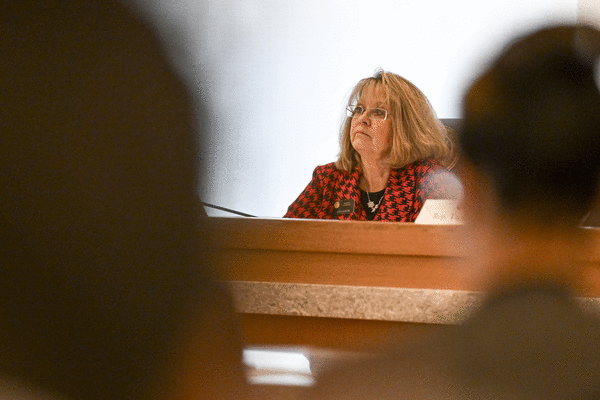
“I don’t think it was joyous,” Sen. Barb Kirkmeyer, a Brighton Republican, said of the news, which elicited sighs and distressed looks from several JBC members.
The forecasts project a continuation of a bleak budget trend for the state, which contended with shortfalls of $1 billion or more in 2025 and 2026 that forced a slew of cuts to government services and social programs.
Both the legislative and governor’s office economists say that if lawmakers want to return to a 15% reserve for the state’s general fund — which covers most day-to-day operations in the budget — they’ll be looking at a roughly $1.5 billion shortfall for the 2027-28 fiscal year’s budget, which begins next July.
The reserve serves as the legislature’s rainy day fund, to be tapped in extreme circumstances such as a major economic downturn to keep government operations afloat.
The legislature this year lowered the reserve threshold to 13% to help ease its budget woes for the current fiscal year. Rep. Kyle Brown, a Democrat, asked Friday what the general fund’s projected shortfall would be if those reserves were kept at that lower level.
Greg Sobetski, the LCS’s chief economist, said that would likely reduce the deficit to $1.2 billion.
Medicaid costs are a primary driver of the projected shortfall. Lawmakers learned Thursday that in the last fiscal year, which ended June 30, the Colorado Department of Health Care Policy and Financing, which oversees Medicaid, overspent its general fund budget by $158 million. It’s already projected to overspend by $443 million by the end of the current fiscal year in mid-2027, unless lawmakers make additional cuts.
Rep. Rick Taggart, a Republican, told The Denver Post that next year’s projected $1.5 billion shortfall was larger than he expected. He believes it will force the JBC to make even deeper cuts to Medicaid than what was approved this year. Those included ending automatic enrollment in adult services for children with severe intellectual or developmental disabilities and adding limits to billable caregiver hours — spending cuts that he and other JBC members described as painful.
“We just don’t have a choice,” Taggart said. “We have to balance this budget,” which is a requirement for lawmakers under the state constitution.
In November, Gov. Jared Polis, who leaves office after this year, will present his budget proposal for the next fiscal year based on the new forecasts. The legislature convenes in January for its regular session and must pass a budget by the spring.
Adding to the legislature’s challenges for the next budget are federal cuts to the nation’s social safety net system that go into effect next year as part of congressional Republicans’ and President Donald Trump’s One Big Beautiful Bill Act, passed in 2025. That includes cuts to the Supplemental Nutrition Assistance Program, the largest food assistance program, that will be based on each state’s SNAP payment error rate.
The governor’s office estimates the changes could cost Colorado between $110 million and $150 million next budget year. The state could also lose out on more than $105 million in revenue from hospitals as a result of federal cuts to hospital provider fees, which states use to bring in larger federal matching funds for Medicaid.
The $1.5 billion shortfall projection largely does not include those impacts, partly because they may be offset by other state revenue or savings, said Mark Ferrandino, the executive director for the governor’s Office of State Planning and Budgeting.
State voters in 2025 voted to lower the amount high earners can deduct from their incomes to raise money for the state’s universal free school meals program, while allowing the program to use excess dollars to cover SNAP costs. The governor’s office says the program currently has nearly $104 million to help defray additional SNAP costs next year.
Medicaid work requirements that start in January could lead to 100,000 people in Colorado losing their benefits, which Ferrandino said could save the state $50 million to $100 million and partly cover the loss in provider fees, though he called the loss of Medicaid coverage “not good news.” Provider fee cuts will also ratchet up over time, resulting in deeper revenue losses after 2027.
Rep. Emily Sirota, a Democrat who chairs the JBC, told The Post that the combined pressures of runaway state Medicaid costs and federal cuts could make for one of the most difficult legislative sessions yet.
“It becomes harder and harder with each passing year,” Sirota said of the budgeting process.
Despite the tight budget environment, state revenue is projected to increase in 2027, leading to a return of Taxpayer’s Bill of Rights, or TABOR, refunds in 2028.
Economists for both the LCS and the governor’s office expect the state to go roughly $470 million over the TABOR cap, which limits government revenue using a formula that factors in the rate of population growth plus inflation.
Around half of that surplus would be used to cover property tax cuts for seniors under the state’s homestead exemption, meaning taxpayers would see smaller individual TABOR refunds in 2028.
The two forecasts differ on whether tax credits meant to help lower-income individuals and families will return in the coming years after the credits were turned off this year and next because of reduced state revenue. The LCS says the Earned Income and Family Affordability tax credits may be partially restored beginning in 2028, while the governor’s office says they may not be available until 2029, though that will officially be determined by the office’s December forecast.
_____
©2026 MediaNews Group, Inc. Visit at denverpost.com. Distributed by Tribune Content Agency, LLC.






Comments